
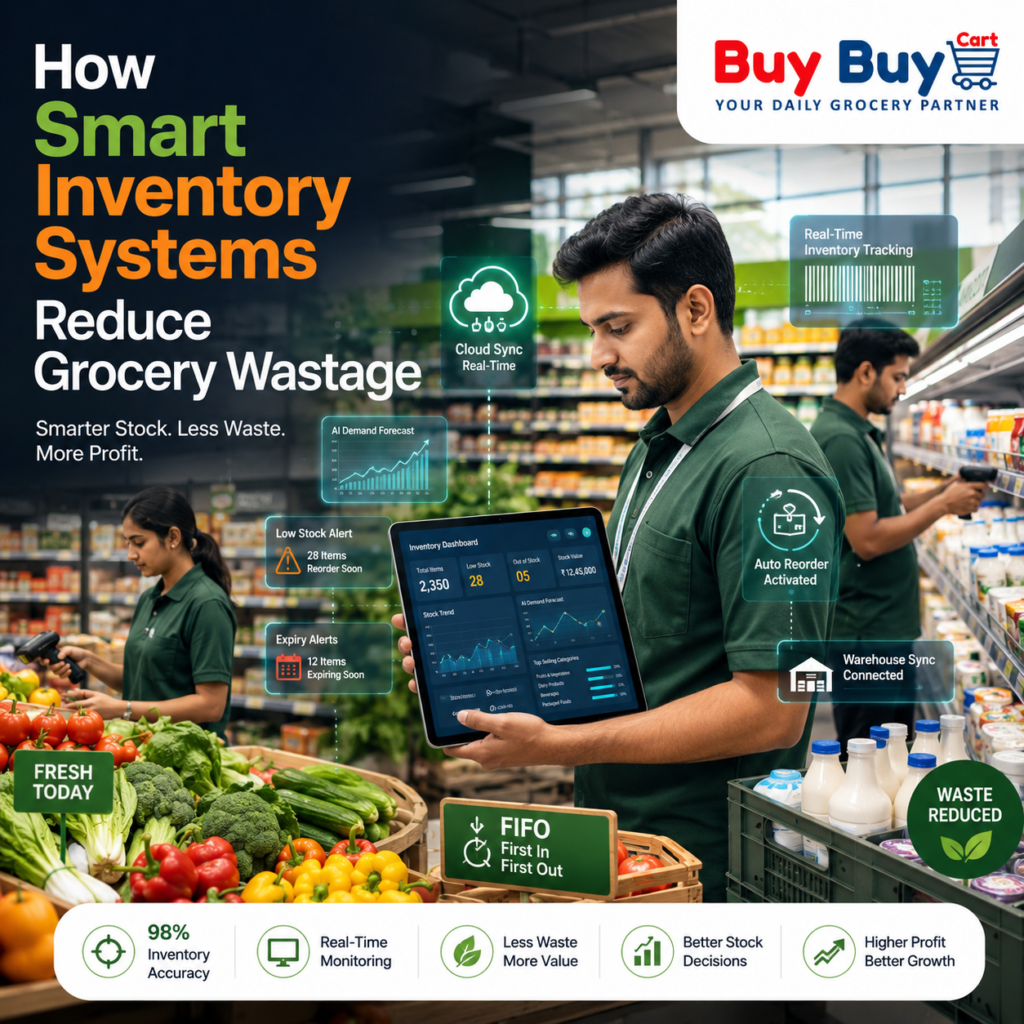
Contemporary grocery industry has a lot of difficulties to encounter every day; however, the greatest of them is reducing waste. It applies to delivery of products which are generated quickly. A Bad delivery system leads to lots of expired goods. The impact of intelligent stock systems is efficient.
The help from smart inventory is the right combination of technology and effective choice-making based on data that allows retailers to work with stock effectively and minimize waste at grocery stores. It is possible to apply this system both in supermarkets and in small grocery stores.
Why Grocery Waste is a Big Problem
Most grocery retailers want their shelves to be completely stocked but not overloaded with unnecessary stock. But getting the balance can be very tricky and challenging. Overstocking increases the risk of products perishing before being sold; on the other hand, understocking means customers are unhappy, and sales are lost.
Changing market demands make it hard to plan. Some products will sell very well during holidays, but will struggle to sell during other periods. So without proper forecasting, grocery retailers can purchase too much or too little stock.
Also, human mistakes add to the issue. Manual counting of the stocks, inaccurate record-keeping, and slow inventory updates create gaps between actual and recorded stock levels. Bad tracking of the inventory makes the situation even worse because it is very hard to define slow sellers and control their risks. The growing competition in grocery retailing makes the need to get rid of all those inefficiencies more significant than ever.
What is a smart grocery inventory system?
The smart grocery inventory system is a technology-based alternative that automates the management of inventory while allowing the users to see what’s happening with their stock at every moment. Instead of using spreadsheets or journals, the retailers utilize smart software that allows them to track their inventory accurately and make better decisions.
Modern smart inventory systems have the following characteristics:
- Real-time stock tracking
- Working with barcodes and QR codes
- Access to cloud storage
- The ability to predict demand with the help of AI
- Automated low-stock notifications
- Managing expiry dates.
These solutions contribute to better management of grocery inventories by making it sure that the right products are available to the consumers at the right time. The managers can control the inventory from any place, cut down on the manual work, and react to the demands of the consumers without delay.
How Intelligent Stock Management Solutions Help Curb Food Waste
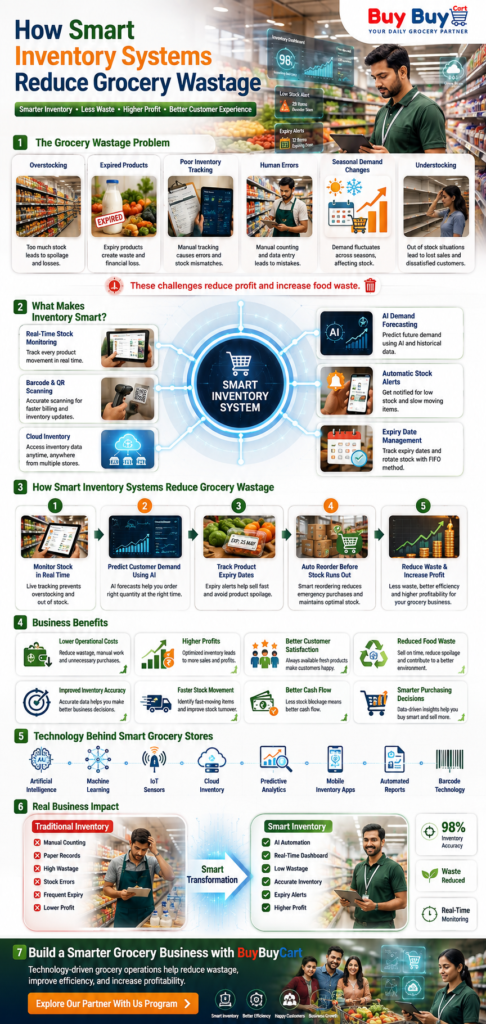
Real-Time Grocery Stock Monitoring
Real-time inventory monitoring provides a tool for retailers to keep track of stock movement at all times. Every time an item is sold, returned, or restocked, the inventory gets modified automatically. This allows store managers to get rid of uncertainties and determine the real stock availability.
For instance, if a grocer understands that a type of candy is moving at a higher rate than anticipated, they may order the new lot from the warehouse. Conversely, some items that aren’t selling well could be advertised with the help of discounts before being wasted.
The Use of AI in Demand Forecasting
Supermarkets have found themselves relying heavily on artificial intelligence as a useful asset that allows for better inventory management. AI supply management takes historical sales, behaviors of consumers, seasonal patterns, and other relevant aspects into account to make informed decisions regarding future demand.
With this sophisticated system of ordering, suppliers no longer rely on guesswork when placing orders, allowing them to control stock in the way the sales forecast suggests.
Automated Expiration Date Monitor
Expiration date monitor is yet another useful feature offered by some suppliers. This technology is especially useful for grocery stores that sell fresh produce and perishables, as well as bakery goods.
Using this supply system stores will be able not only to monitor expiration dates but also use methods such as FIFO inventory rotation or planning promotional campaigns.
Smarter Reordering
With the help of technology, companies now have the ability to automate most of their inventory processes. Instead of waiting for items to get out of stock and relying on humans to re-order products, automated inventory systems notify retailers to purchase the stocks when their quantity drops to a certain level set by managers.
This strategy eliminates the need for emergency purchases, minimizes excessive inventory, and helps maintain the right balance between supply and demand. Companies can also avoid unnecessary investments in items that are not likely to be sold soon.
Also Read: Best Customer Retention Strategies for Supermarkets: A Complete Guide
Reducing Human Errors
The traditional ways of managing inventories have many flaws due to their reliance on human efforts. Mistakes related to stock-level updates, misrecording stock data, having duplicate records, and making errors when counting goods can seriously affect a business’s performance results.
Using advanced inventory management software, a retailer can automate all the labor-intensive processes involving a bar-code scanner, computerized inventory records, and automated reporting. By decreasing human actions in the inventory management process, companies can increase accuracy in managing stocks while also letting their employees focus on running the store and serving customers.
Benefits of Grocery Store Ownership
Advanced inventory management systems do not just ensure that stocks are monitored. They enhance grocery business operations and provide information support to owners, who make business choices based on reliable data.
Businesses that implement grocery inventory management software generally have lower operational costs since a smaller percentage of their goods perish or are less sold. Better inventory accuracy minimizes unnecessary purchasing, while quicker stock turnover leads to enhanced cash flow and profitability.
Customers also benefit from regularly available products and fresher inventory. A quality shopping experience translates into a greater likelihood of customers returning for shopping. Moreover, automated inventory reports give valuable recommendations on sales, thus enabling retailers to identify successful products and make necessary changes in their purchasing approach accordingly.
Impact of Technology on Grocery Inventory Management
Technology continues to have a profound effect on the grocery retail sector in India and all over the world. Two technologies that have revolutionized demand prediction are Artificial Intelligence and Machine Learning. The Internet of Things has allowed for the use of temperature sensors for monitoring the temperature of storage units and keeping spoilable products fresh and safe at all times.
Systems for cloud inventory management give managers an opportunity to track supermarket inventory across a number of stores from a single computer interface. Software applications enable retailers to carry out inventory counts straight from their smartphones and tablets.
Predictive analytics add to the levels of business decision-making by tracking shopping behavior and preferences of customers. Automated reporting processes save time while having a number of benefits in terms of monitoring retail productivity and effectiveness in inventory management.
How BuyBuyCart Helps Modern Grocery Businesses
BuyBuyCart understands that the key elements of modern grocery business are running operations efficiently, using technology in operations, and providing excellent customer service. Using smart inventory management practices helps to minimize grocery wastage, improve the availability of stock, and ensure products delivered to customers are fresh and of high quality.
In the long run, the introduction of practices of modern inventory management can lead to the growth of the business while reducing losses. If you are looking for an existing retail brand to help you start your modern grocery business, check out the Partner with Us page on BuyBuyCart. Our focus on innovation, operational competence, and customer satisfaction will allow you to grow your grocery business.
Conclusion
Reducing the amount of wasted food has necessarily evolved from merely counting stock items to utilizing advanced IT and making data-informed decisions. Advanced systems for inventory management allow businesses to keep real-time track of stock, anticipate consumer demand, manage expiration dates, automate reorders, and eliminate costly human errors. Such innovations not only boost the level of profitability but also enhance the shopping experience for customers.
As the grocery industry becomes more competitive, employing smart inventory control tools is one of the most sensible investments businesses can make. Whether managing a single store or planning to expand to multiple locations, smart inventory management aids a grocery business in achieving its operational goals and gaining sustainability.
Frequently Asked Questions (FAQs)
- In what way do smart inventory systems minimize grocery waste?
Smart inventory systems minimize grocery waste through their real-time stock tracking, monitoring of expiry dates, demand forecasting, and automated reordering. Because of that, such systems make it possible for companies to prevent overstocking, detect items with lower movement early on, and keep inventory suitable for sale. All of that leads to minimization of spoilage and improvement in customer satisfaction.
- Which is the most suitable inventory management system for a grocery store?
The right inventory management solution varies depending on the type and size of a grocery business. In general, a successful solution should possess features such as real-time inventory tracking, barcode scanning, access to cloud resources, forecasting with AI, expiry management, and reporting.
- Why is inventory management important in grocery retail?
Management of inventory is necessary in order to guarantee that the goods will be available for purchase at the right moment. Moreover, correct management of inventory will help businesses gain a significant profit because they can get rid of any excess goods and expired stock.
- How does AI improve grocery inventory management?
Artificial intelligence is used in grocery retail due to its ability to analyze data on previous sales, seasonality, purchasing patterns, and external factors in order to predict how much inventory will be required in the future.