
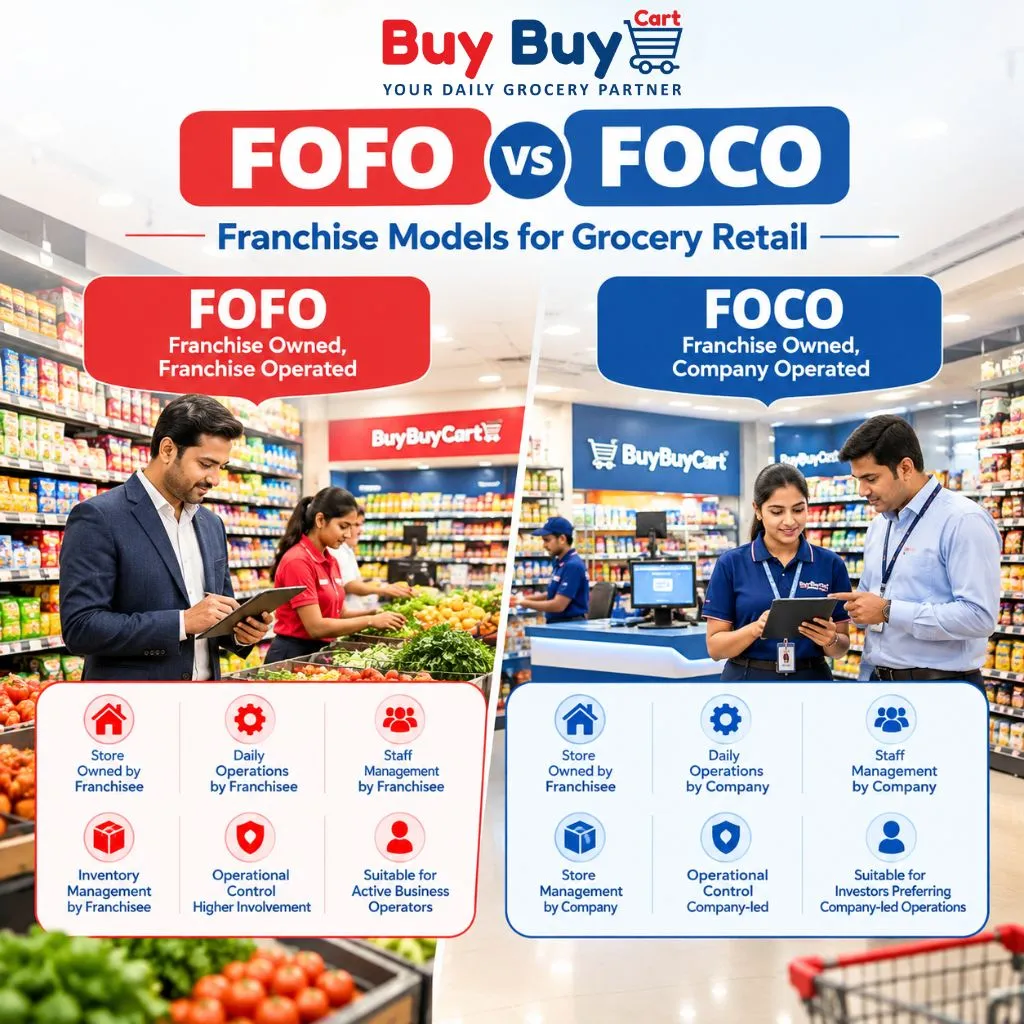
When entering the grocery retailing business, it is essential to select the most appropriate franchise structure. An FOFO vs FOCO Franchise Model comparison will help business owners determine who owns the outlet, who runs the business on a daily basis, and how much involvement is expected from a franchisee. Both methods can be adapted by grocery stores and supermarkets, but they differ in how operations are monitored and managed, and who is responsible for hiring staff and conducting day-to-day activities.
For the first-time franchise investor, knowing their differences may affect the way they approach their business. A retailer who wishes to take part in daily operations will have different requirements from the one who is interested in a company-operated store. Thus, having a clear understanding of the structure before signing a franchise contract will enable entrepreneurs to ask smarter questions and choose a model that fits their approach to business, time, experience, and objectives.
What Is the FOFO Franchise Model?
The acronym FOFO stands for Franchise Owned, Franchise Operated. In the implementation of this model, the franchisee owns the outlet and is responsible for running it according to the franchise brand’s instructions and standards.
The franchise owner usually takes part in the everyday management of the outlet. It may include hiring and directing the staff, controlling the inventory, handling customer service, ensuring the quality of the store, and controlling revenues and expenses. What the franchise owner needs to do may differ because of the terms of their franchise agreement.
Since the franchise owner is closely engaged in the process, the FOFO franchise model gives them better control over the outlet’s operations. The model may work well for those entrepreneurs who have previous experience in retail business or are ready to actively be engaged in food retail.
Some typical operational duties may include:
- Employee supervision and scheduling
- Inventory management and restocking
- Store running and consumer service
- Local business management and implementation
Still, with greater operational involvement, this means that a franchisee has to spend time on the business.
What is the FOCO Franchise Model?
FOCO stands for Franchise Owned Company Operated, where the franchisee owns the store but the company runs the business with the agreed management model.
This arrangement will reduce the involvement of the franchisee in everyday operational processes. Depending on the franchise agreement, the company may be in charge of staffing, store operation, inventory management, and customer service.
While the franchisee is still the owner, they may find it easier to concentrate on ownership and management oversight as opposed to running every detail of operations.
Thus, a FOCO model may be appealing to stakeholders wishing to invest in grocery retail while not having to deal with daily management of all aspects of running the store. However, here it is important to stress that the exact responsibilities, duties, fees, reporting requirements, and control methods will vary from one brand to another; thus all those aspects have to be checked in the franchise agreement.
FOFO vs FOCO Franchise Model: Key Differences
The main distinction between FOFO vs FOCO Franchise Model lies in the entity responsible for running the store on a day-to-day basis. In the case where the FOFO model is implemented, the franchisee acts as the owner and operator of the store. This means the franchisee manages the store’s daily operations (employees, stock, and customer service). Thus, it increases the franchisee’s operational participation and control while increasing their time and management responsibilities.
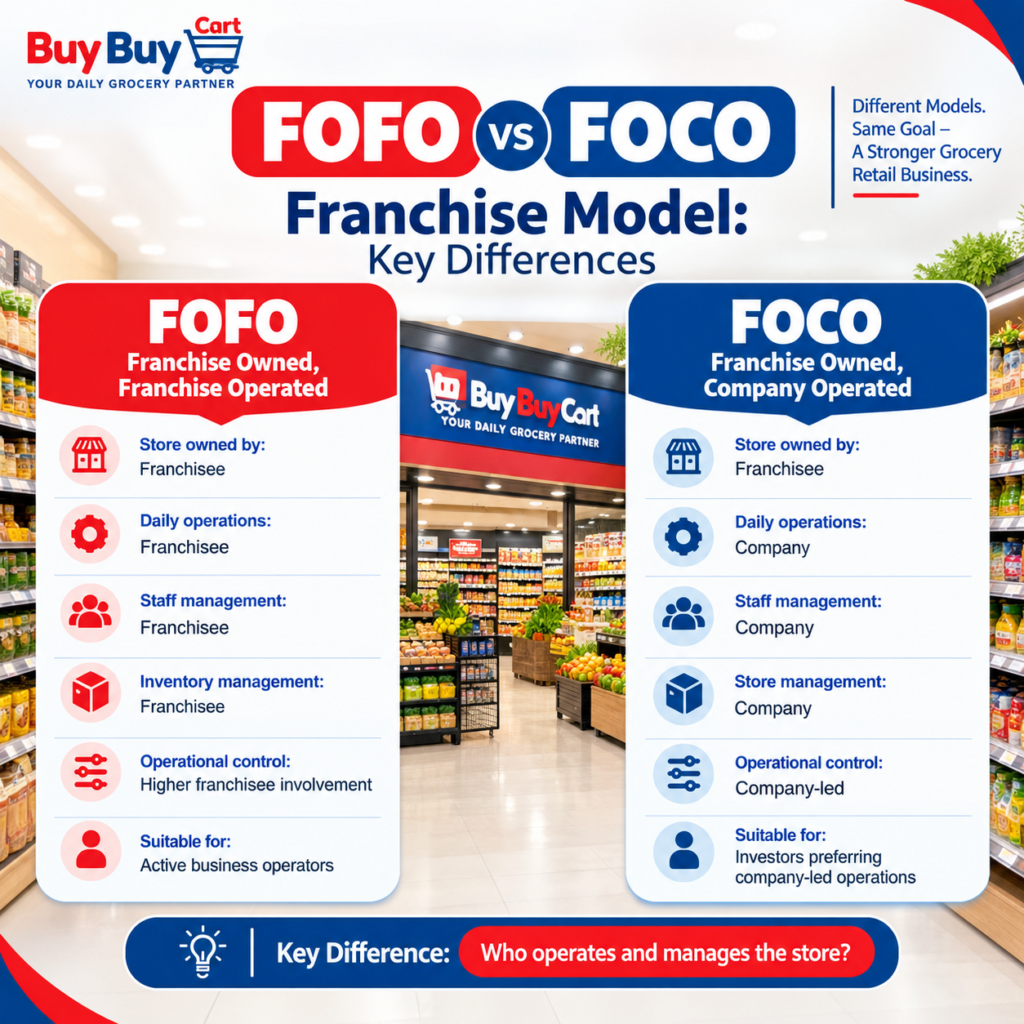
On the contrary, the FOCO model implies that the company carries out day-to-day operations of the store while the franchisee holds store ownership. Quite different levels of the company’s involvement may be observed here, while most of the operations are transferred to the company
So the key difference is ownership and operational responsibility. Both models may be applied in grocery retail; however, their applicability will depend on the entrepreneur’s experience in retail, time availability, control requirements, management skills and choice for support through the company. Always double-check the exact responsibilities in the franchise agreement.
FOFO vs FOCO: Which Alternative is Better for Your Grocery Business?
Every grocery entrepreneur needs to choose a franchise structure that suits them best. What choice to make depends on how actively you plan to run the business and how much responsibility you can stand.
You may consider FOFO if you have experience in retail, want to be actively involved in operations, and can spend time on staff, inventory, customers, and performance management.
On the other hand, FOCO may be the better option for you if you prefer the company-operated model and want to minimize your participation in daily store operations. It is also a good alternative for those investors who cannot devote much time to their supermarkets.
Prior to making any decisions, it is important to keep in mind:
- Your experience in retail and business management
- The time you can devote to daily operations
- Your preferred level of control
- Your ability to manage and organize staff
- Investment and risk aspects
- Your demands from the franchisor
Read the franchise contract carefully in order to fully grasp contractual obligations, costs, business authority, reporting, and other conditions.
Also Read: How to Modernize Your Kirana Store Without Losing Your Local Identity
Why the Franchise Model Matters in Modern Grocery Retail
Contemporary retail grocery entails much more than stock and sales. Retail operations rely heavily on organized inventory processes, billing systems, customer experience, branding, marketing, and the provision of efficient operating processes.
A franchise model should be able to elaborate on the mentioned areas. The franchise assistance may involve some brand-specific areas such as technology, store operations, inventory systems, branding, marketing, personnel training, and many other aspects of grocery business functioning.
The need for proper planning for an independent retailer means a lot of work. The franchise has the advantage of having an established business system, but the level of support depends on the franchisor.
Exploring a Grocery Franchise Opportunity with BuyBuyCart
The grocery franchise industry brings a lot of business opportunities for entrepreneurs looking for a modern grocery store franchise, as BuyBuyCart provides franchise business opportunities to those who want to start a grocery retail business. The franchise promotes entrepreneurship and business growth in the Indian grocery market.
While going through franchising options, one should review and analyze the franchise opportunity with BuyBuyCart in advance.
Prospective franchisees also need to make sure that they are well informed about the business specifics, brands, and trademarks involved in the franchise investment.
Conclusion
Comparing FOFO to FOCO boils down to distinguishing between ownership and operations. Under the FOFO model, the franchisee is the owner and operator of the store, but under the FOCO model, the owner is the one who owns the business, and the company does the rest of the work.
In this case, the right approach for grocery entrepreneurs is based on personal factors rather than on the absolute winner. All considerations such as knowledge, availability, willingness to share control, and ability to manage should be taken into account in order to make the most reasonable decision. The franchises should make sure they read and fully comprehend the franchise agreement and the obligations of the parties.
Frequently Asked Questions (FAQs)
- How do FOFO and FOCO franchise business models differ from one another?
The franchisee is responsible for managing the store in the FOFO model, while the FOCO franchise model combines ownership and management of the store by the franchisee.
- Which model is more suitable for opening a grocery store?
Neither option has any particular advantages over the other; the choice simply depends on the entrepreneur’s prior experience, time availability, willingness to control the operations, managerial competence, and the amount of assistance desired from the company.
- Who operates the business in the FOCO type of franchise?
In a FOCO model, the store operates through the company, while the individual franchisee is the owner. Specific responsibilities of the parties involved depend entirely on the franchise agreement.