
The grocery retail industry in India is changing as consumers show a preference for organized supermarkets, ease of shopping, digital payments, and access to different products. Despite the fact that conventional kirana shops continue to serve many homes, new prospects are arising in the form of contemporary retail formats. Starting a grocery store franchise can be an enticing business option for people willing to enter the organized retail business with a known brand and help manage the operations.
Opening a supermarket, however, is not just about stocking goods and arranging shelves. Businesspeople need to be aware of what investment they will need to make, how much it will cost to set up the shop, how they will stock the shop correctly, how high the operational costs will be, and what return they will get.
Whether you are a startup entrepreneur or an existing storekeeper planning to upgrade or an investor in search of retail business prospects, knowing the performance and feasibility parameters of grocery stores is important to help you make informed decisions. This guide outlines food retailing in India and how to run the business in a sustainable way.
How Much Investment Is Required to Start a Grocery Store Franchise in India?
The required investment for launching a grocery franchise varies based on several factors such as location, store size, interior design, inventory amount, franchise concept, and investment scale.
The store’s interiors, merchandising racks, cash counters, POS terminals, inventory, branding, security deposit, and improvement cost are considered the most significant items that have to be covered. The investments of a premium supermarket in an expensive business zone will be most likely different than that of a grocery store in a residential district.
The franchise agreement also affects overall investment. Some franchises require franchise fees and royalties. Others work within a different commercial structure. It is therefore important to obtain a detailed description of the investment from the company.
Key Costs Involved in Setting Up a Grocery Store Franchise
By understanding grocery store setup costs, business owners can allocate funds effectively. Among the primary expenses to be found are:
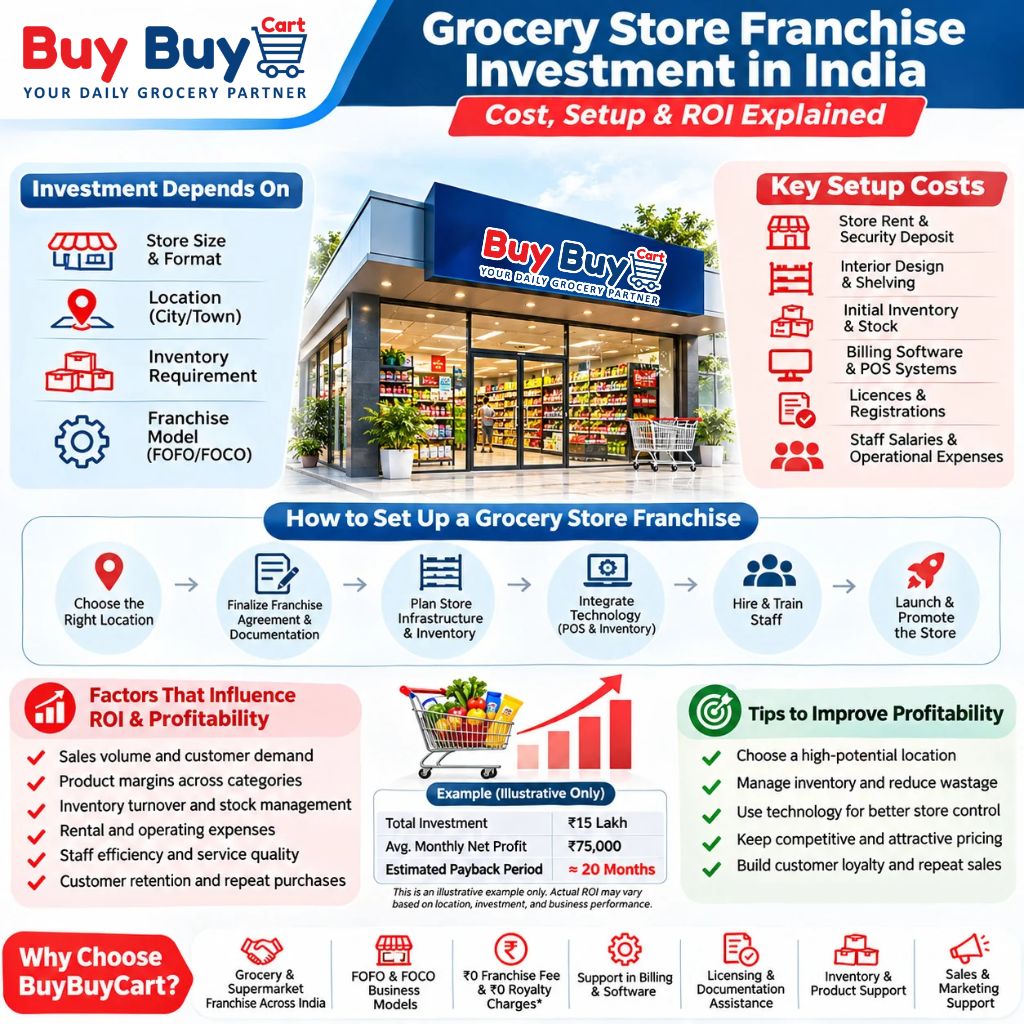
- Rent and security deposit: This depends on the location and commercial viability etc.
- Store arrangement and fittings: This includes special displays, counters, lighting, floors, signs, and approach to design made for customer convenience.
- First inventory: This includes all basic grocery items, fast-moving goods, manufactured food, hygiene products, and goods for home.
- Payment software and POS systems: This helps control sales and transactions.
- Licenses and registrations: This may involve different registrations or licenses required by government authorities.
- Staff and costs of operation: This includes salaries, electricity supplies, telecom services, maintenance, packing materials, and many others.
A sound financial plan must cover all required costs related to the opening of a grocery store and keep enough money for day-to-day expenses.
Also Read: How Long Does It Take to Open a Grocery Franchise Store?
How to Set Up a Grocery Store Franchise in India
Setting up a grocery franchise can be an orderly process. The careful selection of the right steps can simplify the process and prevent operational difficulties that arise.
- Choosing Suitable Store Location
A location with great residential mix and high customer foot traffic should be selected. One should have access to supermarkets, kirana shops, understand the customers’ tastes and preferences, and analyze competition.
- Finalizing Franchise Agreement and Documentation
Fluency in one’s own franchise model and contract terms with franchisees is required. Moreover, the completion of all necessary registrations and permissions connected with establishing a business is obligatory.
- Planning Store Infrastructure and Inventory
The store design has to take into account the arrangement of shelves, counters, storage, and distribution facilities. The inventory management has to be based upon the study of customer preferences, fast-moving goods, seasonality, and the amount of products recommended for stocking.
- Apply Tech & Employ Team
Implement billing software, point-of-sale systems, and inventory management systems. Employ and prepare the team for billing, storing, and serving customers.
- Launch & Publicize the Shop
Think up opening promotions, localized advertisements, approaches for fostering customer engagement, and ways of becoming visible on the Internet.
Understanding Grocery Store Franchise ROI and Profitability
Grocery Store ROI tells how much a business investment is effective due to the gained profit. It may rely on sales volume, margin on the goods sold, inventory turnover, rent expenses, employees’ salaries, and overall efficiency of business.
Grocery business usually has margins based at the product level which varies across product categories. Therefore, it’s not always the case that high sales mean high profitability of the business. Costs control and good inventory turnover are also important.
A simple formula to calculate the recovery of the investment can be:
Payback Period = Total Initial Investment ÷ Average Monthly Net Operating Profit
For instance, if a fictitious retail outlet needs an initial investment of ₹15 lakh and makes ₹75,000 monthly net operating profit, then the approximate payback duration could be expected to be 20 months. Such a calculation is only for reference and in no way a norm or a warranty.
Real profits are determined by the factors such as business performance, location of the establishment, franchising agreements must be considered as well as operating costs.
How to Reduce Investment Risks and Improve Grocery Store Profitability
Businesspeople can enhance financial performance and minimize risks by applying practical retail management strategies. The initial step would be to identify a location that will correspond with the target clientele instead of a costly one for the sake of visibility.
Regular tracking of both popular and unpopular items is imperative. Avoid making large purchases of slow-moving items since they will occupy working capital and increase chances for spoilage and damage.
Use technology to keep track of sales, stocks, and the need for reorders. Reasonable pricing policy as well as relationships with suppliers and consumer loyalty constitute other elements leading to good profitability.
Why Consider BuyBuyCart for Your Grocery Store Franchise?
BuyBuyCart provides grocery and supermarket opportunities to entrepreneurs looking to enter the organized grocery retail sector in India. There are two business models offered by BuyBuyCart:
FOFO (Franchise Owned, Franchise Operated): The franchisee owns and runs the store.
FOCO (Franchise Owned, Company Operated): The franchisee owns the store while the company performs store operations based on mutual agreements.
BuyBuyCart has waived its franchise fees and royalties, thereby charging its franchise partners ₹0 in fees. There are a number of services offered by BuyBuyCart, including billing software, licensing and paperwork support, supply and product assistance, and promotion and marketing.
These services will allow franchise owners to operate their stores more effectively while benefiting from an already established infrastructure. Partners interested in cooperating with BuyBuyCart should refer to the information about the available services, the franchise agreement, investment requirements, and operational obligations.
Interested entrepreneurs and retailers may find more information about the franchise agreements and partnership processes on the official Join Us page.
Conclusion
Establishing a grocery store franchise in India requires meticulous financial planning, locating the ideal location, managing inventory well, and ensuring regular control over operations. Knowing the setting up costs and expected ROI helps people in planning for a viable retail business.
BuyBuyCart is offering franchises in FOFO and FOCO models with a tech edge, inventory, and business support. Visit the “Partner With Us” page to know the opportunities available with the company.
Frequently Asked Questions About Grocery Store Franchise in India
- What amount of money is needed to open a grocery store franchise in India?
The amount of money needed for starting a grocery store franchise will depend on the size and location of the store, the store layout, initial stock, equipment, working capital, and terms of the franchise. It is wise to ask the franchise company for a detailed estimate.
- Is a grocery store franchise business worth investing in?
Yes, it can be profitable depending on the demand for the product, the product margins, the good management of stock, and the reasonable operating costs of the franchise.
- What is the minimum area required to open a grocery store franchise?
The required area depends on the format of the store, the types of products, storage requirements, and the location. Please clarify this point with the franchise.