
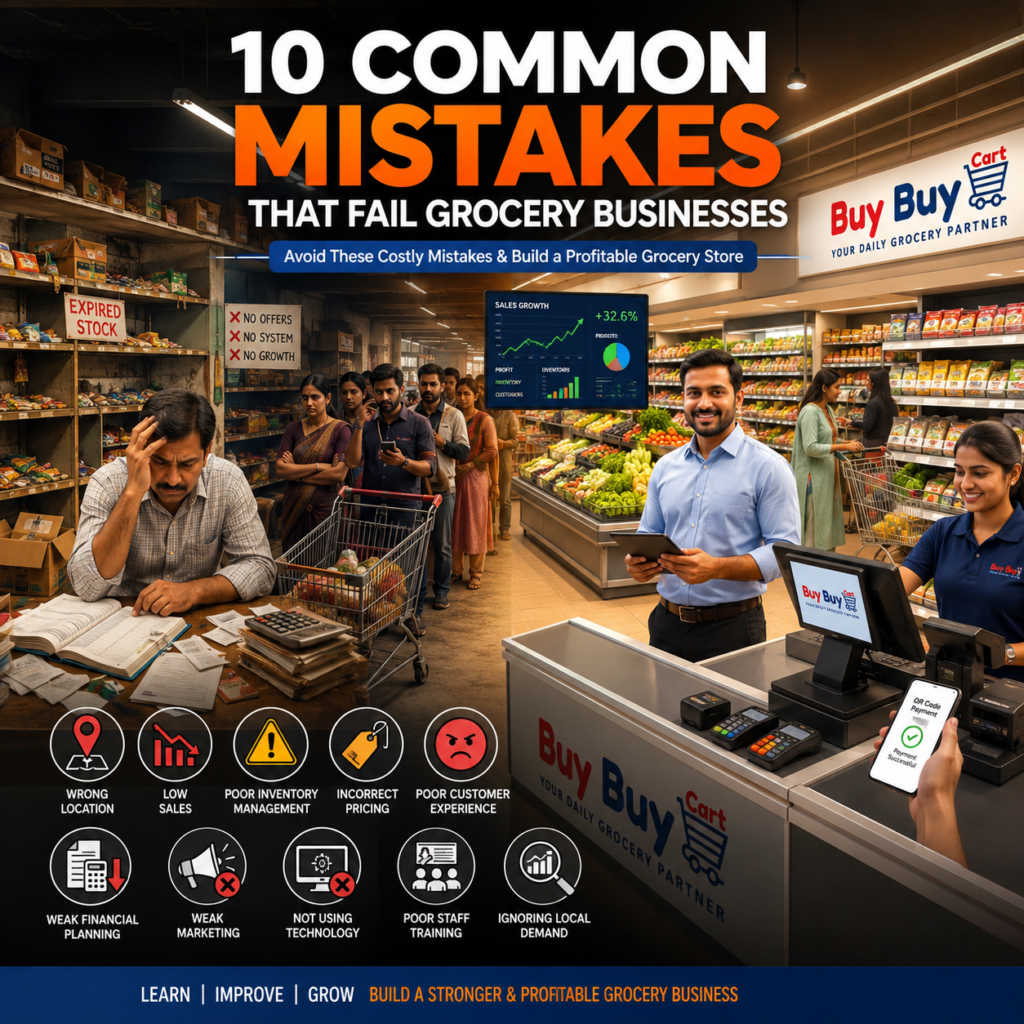
Initiating a grocery business in India might seem easy, as groceries are vital. Nevertheless, numerous revenues through grocery shops, supermarkets, and kirana outlets fail soon. This usually happens due to poor business planning and market strategies. Understanding the reasons behind failure can help you operate successfully, irrespective of whether you own a small grocery store or want to set up a supermarket.
India sees rapid development in the grocery sector attributed to the changing shopping habits of consumers, new infrastructure, and demand for improved goods. However, success here is considerably influenced by a strategic approach – just stocking simple grocery goods is not enough. It is necessary to focus on every single decision made while doing business, because unnecessary costs can easily limit profit margins.
Bad Location Choices
Choosing the right location is considered one of the most important factors for grocery store success. Even the best grocery shops can face problems if their premises are too difficult to reach for customers.
Many entrepreneurs are obsessed with low rent prices and ignore customer accessibility issues. A location with challenging access, limited parking, or low population density will likely cause low numbers of customers.
When a store is located poorly, this affects daily sales and prolongs the period until return on investment is obtained.
Prior to starting the grocery business, one should analyze local demographics, competitors, traffic flow, and purchasing power. For example, a grocery shop location in a rapidly developing residential area would have better performance than one occupying commercial premises.
Poor Inventory Management
Inventory management is one of the main components of grocery store management and success. Thanks to bad inventory management, stores face the problem of having expired products, empty shelves, and losses.
Store owners either buy too much stock or fail to replenish items promptly. In both cases, this affects profitability negatively.
An advanced POS system with a stock control feature allows tracking of stock levels in real time.
To illustrate, if packaged milk moves off the shelves early on each day, having enough stock will support sales and avoid unhappy customers.
Also Read: How BuyBuyCart Helps Kirana Stores Compete with Retail Chains
Neglecting the Customer Experience Factor
In the modern economy, customers want more than products themselves. They appreciate cleanliness, well-organized shelves, quick checkout processes, helpful sales assistants, and a pleasant atmosphere in the store.
Many grocery entrepreneurs underestimate the value of customer experience. Long queues, confusing layout, and poor service make shoppers go to competitors.
Any improvement will considerably affect your business:
- Keep aisles clean;
- Implement quick checkout;
- Keep shelves organized;
- Train your employees to help customers politely;
- Solve complaints fast.
Happy customers will come back and tell others about your grocery store.
Common Mistakes That Fail Grocery Businesses
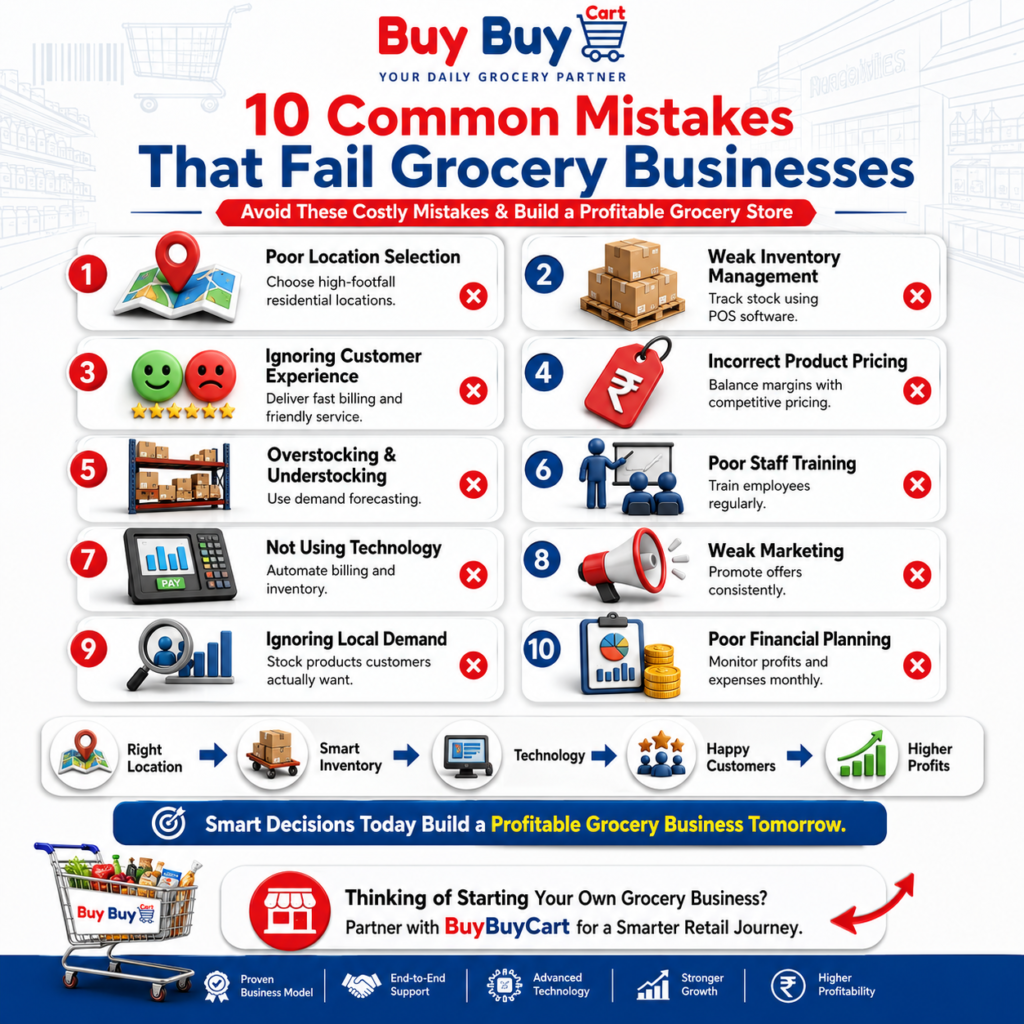
Pricing Issues
Pricing is vital when it comes to running a retail business. Some owners set prices too high; others sell below the profit margin to compete with giant supermarkets.
Both practices will bring problems in the long run. High pricing drives customers away, while low pricing leads to losses.
Monitor your competitors’ prices, understand the customers’ expectations, and check product profitability on a regular basis.
Overstocking and Understocking
Achieving the ideal stock balance is a major problem faced by supermarket managers.
Having an excessive amount of stock can lock up precious money, create high storage costs, and even result in product spoilage. On the other hand, understocking creates empty shelves and unhappy clients.
Make sure to use past sales performance to accurately estimate demand. Seasonal planning will allow you to achieve optimum levels of stock during holidays and promotional periods.
Having good inventory management will offer you better cash flow as well as ensure that customers always have access to the necessary products.
Untrained Staff
The quality of employees affects customer satisfaction. Regrettably, a lot of grocery businesses make huge investments in technical facilities but forget about the necessity of training their staff.
Poorly trained personnel make mistakes during the checkout process, incorrectly deal with goods, and may not provide effective customer support.
The training program should consist of:
- First of all, employees should acquire knowledge of various products
- The second aspect is customer service
- Thirdly, the training process should teach employees how to operate a cash register
- Fourthly, training should include hygiene matters
- Finally, the staff should learn how to file complaints correctly
Running the grocery business without technology has become a very tough task as many grocery stores still have to rely on written records and methods that are not compatible with the current pace of retail business.
Not Using Technology
Modern technologies are making supermarket management simpler than ever by assisting with stock management, billing, reporting, and sales analysis.
This corresponds to the following technologies:
- POS software
- Barcode Readers
- Digital Inventory Management
- QR Code Payments
- Loyalty Programs
Using technology has two big advantages: fewer human mistakes and more analytical information to make better business decisions.
Often, grocery store owners think that as long as they offer essentials to customers, they do not have to worry about marketing. Unfortunately, it doesn’t work like that.
Even the most successful retail store needs to be advertised constantly.
Some easy advertising strategies include local advertising, holiday offers, WhatsApp promotions, Google Business Profile updates, and social media advertising.
For instance, announcing weekly discounts on grocery essentials might increase the number of customers.
Neglecting Local Consumer Preferences
Each locality has its own shopping tastes. Some people require expensive goods while others are in the hunt for cheap goods.
An expensive mistake committed by third-party retailers is stocking items without researching the required nearby demand.
Communicate with consumers on a regular basis, observe consumer trends, and adjust the product line accordingly. The introduction of popular local brands alongside popular national FMCG brands will lead to an increase in sales and better customer satisfaction.
Listening to clients is one of the easiest methods of improving a grocery business in India.
Bad Financial Planning
High sales do not guarantee good profits. Some supermarket businesses fail because of bad financial management.
If business owners fail to track the budget, it may lead to overspending on stocks as well as payment delays for suppliers.
Key indicators include:
- Gross profit margin
- Inventory turnover
- Monthly costs of operations
- Cash flow
- Average spending of consumers
Monthly reviews of financial reports will help identify potential problems within the company in advance.
Tips for Creating a Successful Grocery Business
Creating a successful grocery store requires a commitment to doing things consistently instead of taking shortcuts. To put it in a few words: treat customers well and constantly strive for operational efficiency.
Great retailers always watch their stock levels, offer attractive prices, educate their staff, and use technology to make their operations in grocery stores easier. They also study customers’ buying habits and respond to this data.
Finally, it is crucial to always remember that satisfied customers mean a successful grocery business.
Want to Start Your Own Grocery Business?
Opening a grocery business independently is certainly a rewarding endeavor, but it can also be difficult since you will have to deal with tasks such as supplier management, maintaining inventory, setting up the store, branding, operational processes, and more. That’s why many entrepreneurs opt for a grocery franchising model since it offers structured support and helps eliminate a lot of the risks entailed in starting from scratch.
BuyBuyCart is one of the emerging supermarket franchise brands in India, providing entrepreneurs with a complete business ecosystem along with operational assistance, technology support, branding, and retail expertise to ensure that new business owners can focus on serving customers instead of building every aspect on their own.
Conclusion
To summarize, launching an effective grocery store is all about taking the right steps on a daily basis. Avoiding common mistakes, like choosing the wrong location, poor inventory management, pricing errors, lack of staff training, and financial planning problems, will definitely help to achieve better results in the future.
Retail has been developing fast while customers’ needs have also been changing a lot. Companies that use technology, improve customer experience, know the local supply, and keep their business optimized remain the most successful.
Thus, whatever grocery store you are going to open or improve, get actively involved in the process.
Frequently Asked Questions (FAQs)
- What are the reasons behind grocery business failure?
The main causes of grocery business failure are insufficient inventory control, inappropriate pricing methods, poor financial planning, bad customer service, and wrong location selection. Moreover, neglecting the use of technology and consumers’ expectations leads to decreased profitability of grocery stores over time.
- How do I create an efficient grocery business?
The ways to achieve a successful grocery business include technology use, product availability analysis, positive customer experience, and developing an efficient pricing approach.
- What is the big problem of the grocery industry?
The challenge of the grocery industry is to maintain the efficient management of stock levels and make sure that there is enough product available for consumers.
- Should you start a grocery business in India?
Definitely. There are good growth prospects in the Indian grocery trade since groceries are necessities that every household needs on a daily basis. The success of the venture depends upon the selection of a good location, the efficiency of operations, and the provision of good customer service.
- How does technology affect a grocery business?
Technology streamlines billing and inventory management, customer loyalty, reporting, and payment processes. Modern POS systems also minimize errors, maximize operational efficiency, and yield information necessary for better decisions.