

Starting a Supermarket Business in India can be a lucrative prospect for entrepreneurs because grocery shopping is a normal household need of people. People are increasingly preferring convenience through a wider selection of products, organised shelving in stores, simple payments and an enjoyable shopping experience instead of going to a number of smaller stores. Traditional kirana stores are also adapting to the changing requirements of customers.
However, starting a supermarket is more than just leasing a retail space and filling shelves. Factors such as location and customer demand, investment in the supermarket business, selection of goods, inventory turnover, supplier relationships, employees and running of everyday business will determine how profitable your supermarket will be. A successful grocery business will balance customer satisfaction with control over spending and inventory.
Whether you are starting a new store, expanding your existing grocery business or considering a supermarket franchise, knowing the fundamentals will help you make the right decisions in business. Let’s take a look at the process.
Understanding the Supermarket Business in India
An average supermarket generally stocks a wider variety of goods in a planned self-serve setup. Customers can find groceries, ready-to-eat food products, drinks, personal care items, household needs, and other common products at one place under one roof.
There is much more to it than just acquiring a wide variety of goods. A successful supermarket knows what customers buy in that locality. A supermarket in a residential area may have different priorities than a similar store in a business area inhabited by offices, flats, and high-traffic areas.
Create a Practical Supermarket Business Plan
Before you invest any money, develop a viable supermarket business project. Determine your store format and size, target customers, product categories, and working hours. You should also estimate your average monthly costs and establish the amount of working capital you will need beyond the initial startup.
Your business plan should not be based solely on projected sales. Take into account the rent, salaries, utility bills, maintenance, supplies, and potential losses. Knowing your costs might help you find out how much money your business cannot exceed.
Identify Your Target Customers
The customer profile should determine your key business decisions. Investigate the areas around your supermarket to find out the types of inhabitants, their income, and how frequently they shop and spend on groceries.
For example, if a location has many families, there will be demand for packaged grocery products, which is not true for an area containing mainly young professionals.
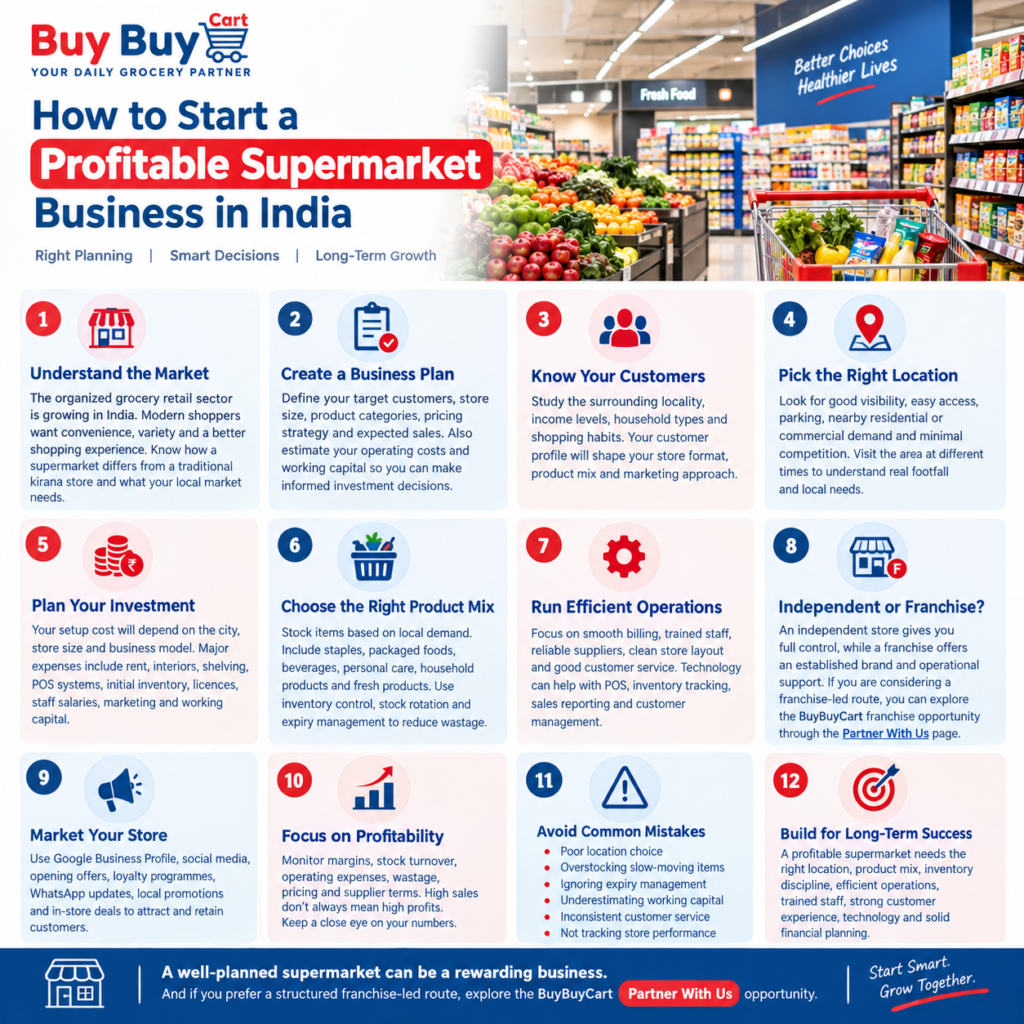
Choose the Right Location
Location of a supermarket is the main factor that impacts its daily influx of customers. Although the store may be well-designed, customers may not come if they cannot access it properly.
Look for areas that have many houses or businesses and where people can spot the supermarket easily. Accessibility of that spot is also important, meaning that it should be easy for cars and pedestrians to reach it. Observing the area throughout the day is essential in understanding the potential customer base.
Also Read: How Supermarket Layout Design Impacts Sales
Estimate Your Supermarket Investment and Setup Costs
There is no universal average price for supermarket setup costs in relation to business location since this expense largely varies based on the size of the shop, layout of the property, and how the shop is designed.
Some of the items you should include in your initial estimates are:
- Rent or other property-related costs
- Shop’s decor items, display systems, and shelving
- Payment systems and types of registers
- Basic inventory of the supermarket
- Registrations and licenses
- Staff recruitment costs and people’s salaries
- Marketing and advertising costs
- Working capital to support operations
It is essential to highlight the concept of working capital. Even after your supermarket has started, it is essential to have sufficient money for working purposes, including replenishment of fast-moving products, payment for services and staff, utility costs, and unexpected expenses.
Determine Your Product Mix and Your Inventory
The selection of products should be based upon demand in your locality, rather than attempting to offer everything. Staples such as rice, flour, lentils and cooking oils can make up a significant portion of the grocery selection, while processed foods, drinks, personal care products, home care products and the rest of the FMCG category can improve basket size.
As the business grows, inventory management becomes more critical. It is important to monitor how fast selling items are and which ones are left on the shelf for a longer time. Regular rotation of stocks, expiry checking and replenishment can keep the wastage at its minimum and avoid blocking finances into slow moving inventory.
Build Efficient Store Operations
Efficient operations in a supermarket depend on regularity in operations. Restocking of products must be done on time, a fast billing system must be in place, the product shelf must be easy to access, and the store should be clean and systematic. The management of suppliers is equally essential.
The success in supply chain management depends on efficient supplier management, since the possible option is to have reliable relations with the sellers and to compare different purchase terms for obtaining maximum efficiency in product availability and better price management.
It is also important that staff are equipped with knowledge about several elements of the operations, such as customer service, product placement, billing process, and proper stock management.
Marketing Your Supermarket for Local Customers
Marketing needs to be executed prior to the opening and continuously after the opening. Local marketing is of great significance since supermarkets rely heavily on clients from their local area.
Marketing strategy can comprise Google Business Profile marketing, local search marketing, social media advertising, opening promotions, WhatsApp messaging, loyalty programmes, and neighbourhood marketing campaigns. In-store marketing efforts and limited-time promotions will encourage clients to buy additional items from non-food categories.
Customer retention is equally crucial as acquiring new customers. A well-thought-out loyalty programme, customer-oriented service and timely product availability will make clients come back for more.
Concentrate on Profitability Rather Than Sales
Achieving high sales figures does not instinctively result in superior profitability. A food retailer should, instead, keep an eye on gross profit margins, product turnover, operating costs, waste and procurement both simultaneously.
The outcome of selling a high number of low-margin products is exceptional revenue that turns out to generate low profits after covering costs of sales. Furthermore, poor inventory management could result in excessive investments as well as the risk of stock damage or expiry. Regularly monitoring performance by product categories, supplier pricing, and cost of goods sold at store level can pinpoint the areas that require an enhancement.
Common Mistakes to Avoid
Various business problems start with actions taken before opening the supermarket. Entrepreneurs must be aware of the following points:
- Picking the wrong location without looking at the needs of the market
- Overloading on products that do not sell
- Not planning the amount of working capital
- Not following expiry dates and wasting goods
- Having poor service at the point of sale
- Not monitoring sales and expenses
Conclusion
Successful supermarkets necessitate meticulous preparation. From the selection of a location to inventory management, each step must be catered for. A profitable supermarket combines the correct product mix, effective stock management, good business practices, trained workers, local marketing and constant tracking of financial results.
There are no universal instructions for owning a good supermarket; one needs to take into account the local market, start-up capital, clientele and objectives.