
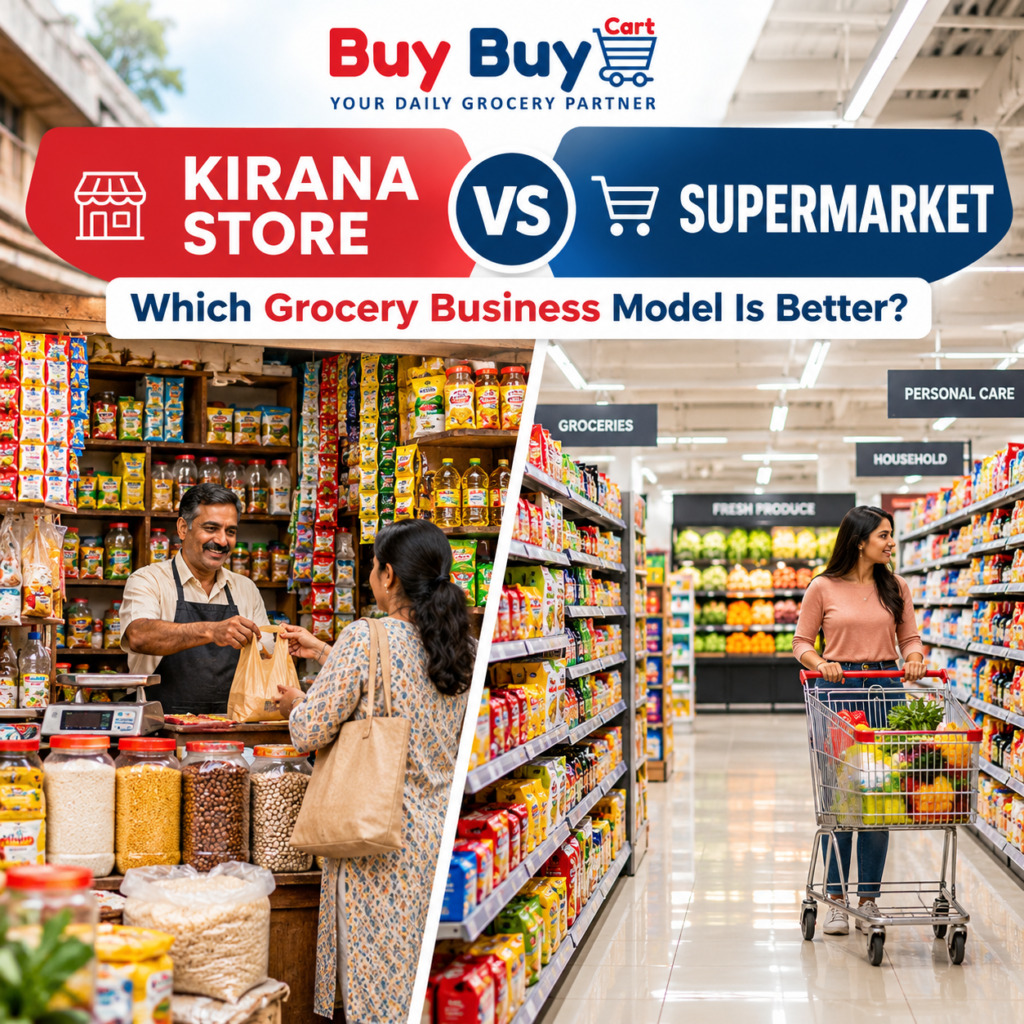
Beginning a grocery store business in India can be a viable option for business owners who wish to step into the world of retail. Grocery stores can include small neighborhood grocery stores or large supermarkets and serve customers who need to buy fresh groceries for daily use at home, along with essential products for personal care and household supplies. However, selecting a grocery business model plays an important role in investing money safely.
The traditional grocery store model works on a small scale with a focus on local clients only and offers day-to-day items only. In contrast, supermarkets are more developed grocery establishments that are larger and offer more products and organized shelves in addition to a greater overall shopping experience regarding grocery buying.
Many aspects play a role when determining which option will suit potential entrepreneurs and current business owners the best, including the amount of money one has, the future location of the store, the competition present in the area, the habits of the consumers as well as the goals that the person intends to achieve eventually. By knowing all of these factors it is possible to make the correct choice of the business model, control the expenses, and run a successful grocery store.
What Is the Kirana Store Business Model?
Kirana stores are small-scale shops in the neighborhood selling daily products like rice, wheat, oils, snacks, beverages, and other household products. The familiarity, convenience of shopping, and their knowledge of the customers contribute to the beneficial relationship between a kirana store and its customers.
Flexibility is one of the advantages of a kirana shop. They begin with a small shop and gain experience over time with fast-moving products. They can also add to their product mix as per the customer needs over time.
However, the limited storage capacity of the shop creates limitations on the variety of products. Manual inventory management can also result in stockouts, overstocking, as well as mistakes in billing. In small stores, the owner manages the purchase, service, billing, and overall operations of the store, which makes it difficult to expand the business without implementing more effective systems.
Supermarket Business Model Explained
A supermarket is a regulated retail system, offering consumers many products in different categories. Shoppers can take a look at the merchandise which is displayed on the shelves, choose, compare, and buy various kinds of groceries, personal care products, food, and household items at one spot.
Opening a grocery store in India has definite criteria that necessitate more careful planning than starting a small kirana shop. Shop owners need to concentrate on the design of the premises, proper product display and billing, recruitment, relations with suppliers, inventory control, and customer service.
Supermarkets are busy places for shoppers who want to buy more. Due to the existing opportunities in a supermarket, consumers can buy more things in bigger stores, thanks to ample stock and regular promotions.
Still, it is important to remember that manufacturers and suppliers, staffing, and rental charges require more funds from the grocery stores.
Kirana Store vs Supermarket: Key Differences
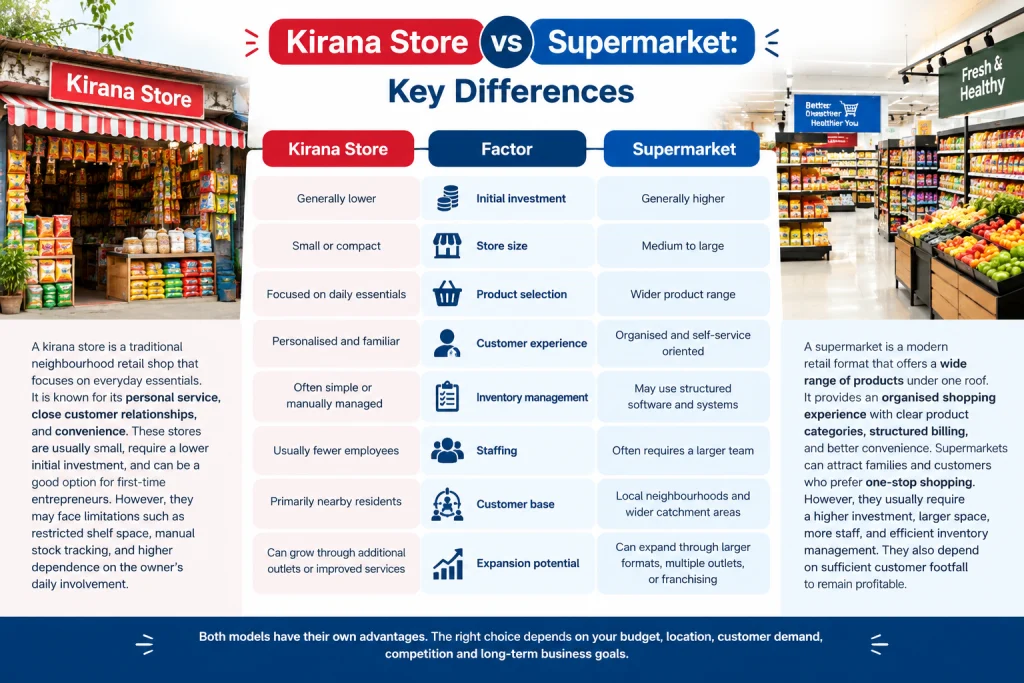
There are distinctions between a kirana store and a supermarket in terms of the investment needed to set it up, its size, and its product variety. A kirana store generally requires a smaller investment than a supermarket does and occupies a small area. This makes the kirana store suitable for small entrepreneurs who want to cater to a specific area.
Kirana stores usually carry daily essentials and provide individualized attention, familiar relationships with customers, and ready access to frequent purchases. However, they can face serious challenges in operations because of lack of shelves, stock management, and the owner’s daily involvement in operational matters.
A typical supermarket can involve a bigger investment and a bigger retail space. Supermarkets provide customers with a large variety of goods, a properly arranged organized shelving system, an effective billing process, and a highly convenient shopping experience for customers who can make use of nearly all types of goods in one place. Supermarkets are attractive to families and customers who are looking for alternatives. However, the expenditures associated with supermarkets are also higher.
Both systems have unique chances for growing. A kirana shop can grow by diversifying its product offerings, enhancing shopper experience, utilizing electronic payments, or even setting up an additional location. A supermarket can expand its business through either larger shops, more branches, or successful franchises. Ultimately, what model is better depends on the businessman’s financial capabilities, area of operation, need in the market, competition, and how efficiently he is able to run his store.
Also Read: Small Grocery Store vs Supermarket: What Is the Future of Retail in India?
Investment and Profitability: Which Model Makes More Sense?
The cost involved in starting a grocery store business would normally include rent or the cost of the premises, shelving, interior fittings, billing machine or POS machine, opening inventory, licenses, electricity, and working capital. There might be additional expenses related to store design, installation of refrigerators, staff training, and inventory systems in case of supermarkets.
While in case of a smaller type of shop, called a kirana, the fixed costs are usually lower, but the sales capacity may be limited by floor space and product availability. Supermarkets may have a higher sales figure because of serving more customers and having more items on shelves, but on the other hand, they also need to cover higher operational costs.
Setting up a business plan is important as it helps determine factors such as the estimated monthly sales, gross margins, staff salaries, rental costs, utilities, purchase of stock, and others. It is also important to calculate the break-even sales in order to determine the necessary revenues for your store so that it covers all of its costs. Also, do not forget that having revenues does not always guarantee profitability, and the store’s profitability can only be ensured after considering all operating expenses involved in running this grocery business.
What Grocery Business Model Should You Select?
Go with the kirana store option if you have limited funds to invest in a grocery business, plan to operate in a specific area, and prefer to work in a smaller scale. It can be a beneficial option for new entrepreneurs since they can apply knowledge of the local buying trends and try to gradually attract customers.
Pick the supermarket option if you are ready to invest more money in this business, find a proper retail facility, and have experience in managing large amounts of inventory and employees. This type of business may fit entrepreneurs who want to implement organized shopping and plan to open multiple chains.
Think of improving the existing kirana store if you already have regular customers and want to make a better business, without opening a bigger store straight away. New shelves, digital bills, stock management, new categories of products, and digital marketing can make the shopping process easier and improve the quality of work.
In the end, the best option depends on the local demand and competition, available funds, and your capability to run the everyday business.
How Technology and Franchising Can Help Grocery Retailers
The use of technology can benefit kirana and supermarket stores in becoming more efficient in their operations. Billing software makes transactions easier, inventory tools help prevent stock mismatches, and mobile apps facilitate payment at checkouts. Having access to customer records and engaging in local digital marketing can also assist retailers in building repeat sales and attracting local customers.
The franchising option is also available to grocery retailers. Rather than doing all the work involved in setting up a retail business on their own, entrepreneurs can look into starting a business under an already existing name. Depending on the terms of the contract, a franchise can provide help in the areas of billing software, product development, marketing, paperwork, and more.
BuyBuyCart provides franchise opportunities in the grocery and supermarket domain for businessmen looking into organized shopping. BuyBuyCart’s franchise proposal covers FOFO (Franchise Owned, Franchise Operated) and FOCO (Franchise Owned, Company Operated) models. The aspects of ownership, operational responsibilities, investment requirements, and support should be verified with the company prior to choosing it.
Businessmen are willing to get more information about the grocery franchise in BuyBuyCart to check whether this franchise option fits into their business agenda.
Conclusion: Which Grocery Business Model to Choose?
Whether to go for a kirana outlet or a supermarket is a decision based on various factors including budgets, geographical location, customer expectations, and future goals. For serious entrepreneurs who believe in maintaining good relations with their surroundings, a kirana outlet could be an excellent option. A supermarket could work well for those with ample resources and who are capable of running organised retail operations.
Running a successful grocery store does not begin and end with picking the right format of your store. There are many other aspects of running the grocery business that include proper financial planning, inventory management, reliable suppliers, customer service, and regular tracking of expenditures.
Evaluate the market conditions before investing, calculate your break-even sales, and then decide which store format will suit you best. If you are thinking about going with a branded retail format, then check out grocery franchise opportunities at BuyBuyCart.