
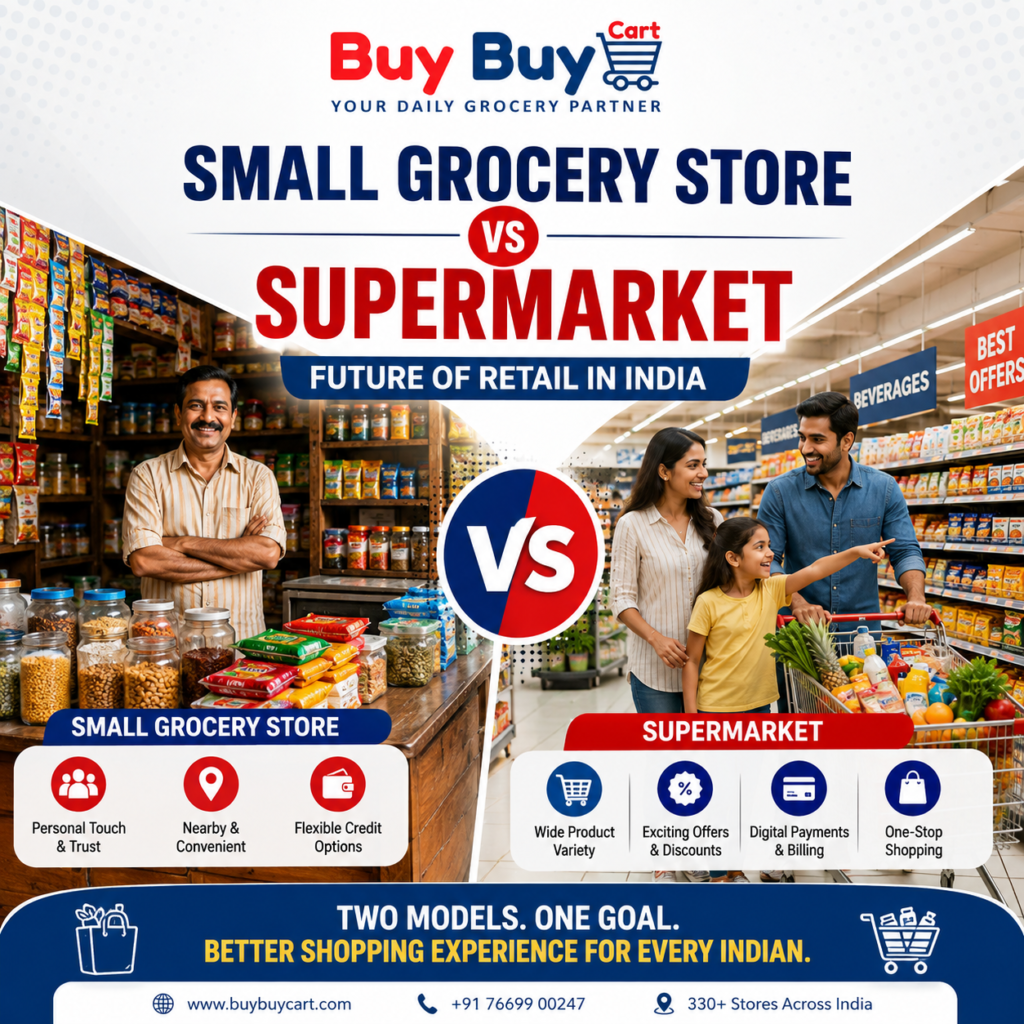
India’s grocery retail sector is rapidly evolving, and supermarket are becoming an increasingly popular option for urban and semi-urban consumers. In the past, local kirana stores used to dominate this space, providing customers with a level of personal service, friendly faces, and the convenience of access to everyday items.
However, with supermarkets coming into play, the shopping experience has taken on an entirely different character. This means more organized shopping, more options and choice, as well as the introduction of cashless payments and discounts.
Nonetheless, one should keep in mind that one format will not replace the other as such. For instance, a person looking for milk or some other essentials can easily go to a local kirana store while another consumer making weekly shopping will visit a supermarket.
The future of both types of retail is largely dependent on their characteristics, advantages, weaknesses, and consumer expectations from both formats.
Know Your Neighborhood Grocery Store in India
Kirana stores, or small grocery stores, form a significant part of the retail industry in India. The proximity of these stores is the biggest advantage. Customers can just walk into one of the stores in their vicinity, buy a few items, and get back home!
The familiarity of neighbors is also a major point of strength. Shop owners in the area know who their customers are and what they generally buy. In certain places, loyal customers may also avail of informal credit from the shop owner. Customers can rely on their shop owner for a level of customer service that is difficult for larger retail formats to match.
But customer preferences are constantly evolving. People are increasingly looking for a wide variety of products, clear pricing, facilities for digital payment options, special offers, and convenience.
What Sets a Supermarket Apart?
A contemporary supermarket is all about convenience and variety. Rather than visiting multiple stores to fulfill different needs, customers may find all their grocery and household needs, as well as personal care items, in one well-organized place.
Additionally, a supermarket offers a unique shopping environment as items are displayed according to type, price would usually be visible, and customers can see products on their own. Digital billing and payment systems, along with loyalty programs, add to the overall experience.
Possible advantages of a supermarket include the following:
- A wide range of products
- Ease of shopping for items
- Various brands
- Discounts and offers
- Payment options and billing systems
- Shopping for groceries in one place
- Inventory control improvement
This is why supermarkets are particularly appealing to families thinking of buying more goods at the same time.
Differences between a Grocery Store and Supermarket
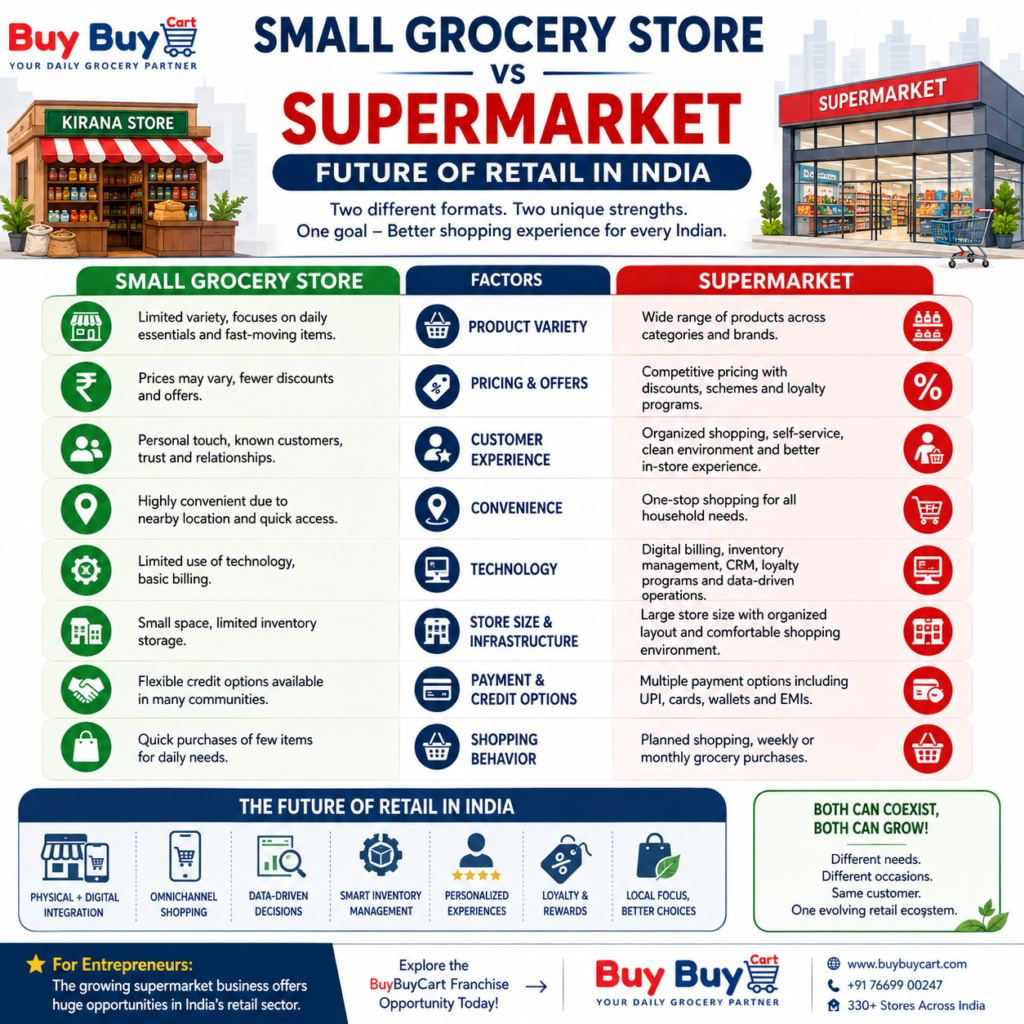
While a grocery store and supermarket may look similar, there is a greater difference than size between the two formats. It is the shopping experience and the way that the two formats serve customers.
A kirana shop caters to convenience, personal interaction, and speed of purchase. On the other hand, a supermarket aims at product variety and a more organized way to shop, as customers do most of their shopping in one place.
Pricing could also differ according to products and promotions. While supermarkets are known for structured sales, offers, and loyalty programs, local stores can sometimes compete through their personal approach.
Technology also plays a huge role in their differentiation. Supermarkets usually possess digital inventory management, barcode billing, and data on customers. However, small grocery retailers are also rapidly implementing UPI payments, billing software, and order systems.
In the end, the choice is made depending on the shopping reason. If the customer needs a couple of items, he may want speed and convenience, while a family carrying out a monthly shopping routine may want variety and experience.
Also Read: How Digital Payments Changed Grocery Shopping Behavior
Reasons Behind Supermarket Expansion in India
There are a number of socio-economic and technological changes that led to the development of supermarkets in India. Urbanization has caused a shift in consumer behavior, leading to the preference for doing all shopping in a single location.
People have become more aware of the products around them. Advertisements, online shopping, and social media have improved the knowledge of consumers about new brands, making them demand more variety in products. The growth of digital payment has made transactions easier.
Another point worth mentioning is the growing importance of customer experience. Clean stores, organized shelves, visible pricing, and promotional offers make grocery shopping easier for customers.
As modern retail moves beyond the metropolitan cities to smaller towns and cities, supermarkets have an opportunity to meet the needs of customers who don’t want to be fully reliant on online grocery shopping.
Will Supermarkets Take Over Small Grocery Stores?
There is a low probability of supermarkets overtaking small grocery stores completely. The retail industry in India is too diverse for a single kind of business to provide a solution for all customers and locations.
Kirana stores also have the added advantage of being sufficiently accessible in the community and possibly providing better relationships with customers. While supermarkets offer more diverse products and experiences in shopping. Therefore, both formats can work next to each other and customers will choose which one fits them according to their needs.
Next time around the comparison will be made not between small stores and supermarkets and what is going to prevail; it will be how these two formats adapt to one another. A regular retailer that adopts digitization and learns how to manage stock effectively can survive in such environment.
Future of Retail in India
Prospects in grocery retail may likely see a combination of bricks-and-mortar shops as well as digital technology. Online grocery shopping, loyalty programs, data-led inventory management, the use of electronic payments, and faster payments are growing in importance in the context of grocery shopping.
Shoppers might switch between online and offline shopping situations. They might see a product online and then buy it from a store in the vicinity or walk into a physical supermarket after comparing prices online.
Localisation also will continue to play a role. The grocery retailers who know what products, brands, and prices consumers in a certain area prefer will be able to create a more pleasant shopping experience. So, the future of grocery retail in India seems to be omnichannel, technology-enabled, and consumer-oriented, not only offline.
Possibilities in the Expanding Grocery Store Sector
The evolving retail space is presenting possibilities for the ones interested in the grocery store sector at the same time. With the modern consumers who are getting more and more familiar with grocery shopping, the retail model which incorporates various goods, technology, convenience, as well as knowledge of the local market will definitely be in demand.
Thus, if a new player wants to enter a grocery store business, he/she should understand that it is not enough just to open a store. The factors like the location, inventory allocation, customer service, technology, product choice, and everyday functioning must be taken into account.
Coming to the aid is the BuyBuyCart Franchise proposal, which will help those who want to enter the grocery store business.
Conclusion
When looking at the comparison between a small grocery store and a supermarket, we really cannot conclude which of the two will be wiped off the market for good. Both concepts have their merits, which are still relevant amongst Indian buyers.
While the Kirana shop attracts buyers due to its proximity and personal touch, supermarkets’ advantage is technology-based convenience.
The retail landscape in India is going to be a mixture of traditional and modern retail strategies. The supermarket is still expected to have an important place as consumers will increasingly demand convenient shopping options and an appealing shopping experience.
For entrepreneurs, this holds a good potential of getting involved into the rapid development of organized grocery retail via options such as BuyBuyCart.
Frequently Asked Questions Regarding Supermarkets and Grocery Stores
- What are the distinctions between a grocery store and a supermarket?
The grocery store is generally smaller and concentrates on everyday necessities, while the supermarket is both larger and offers more items, more organized aisles, more product categories, and other shopping benefits.
- Supermarkets or small grocers: which is better?
Neither of the formats can be said to be better than the other. Supermarkets can be more useful for big purchases or wide assortment, while small grocers appeal to consumers who want to buy something quickly and personalized.
- What is the reason behind the increase in popularity of supermarkets in India?
Supermarkets are growing in popularity due to diversity in product selection, systematic shopping, the availability of digital payment options, discounts and deals, as well as comfortable shopping experience.
- Do supermarkets have the possibility of replacing Kirana stores in India?
It is most likely that they will not be able to replace kirana stores completely. This is because kirana stores have good relations with their customers and have better availability, while supermarkets are for customers who want variety and well-planned shopping. Therefore both can work together.
- Is it worth opening a supermarket in India?
The organized grocery market is gaining popularity, but this is possible only if one takes into account important considerations including the location of the shop, customer needs, stock management, pricing, effectiveness of work, and customer experience.