
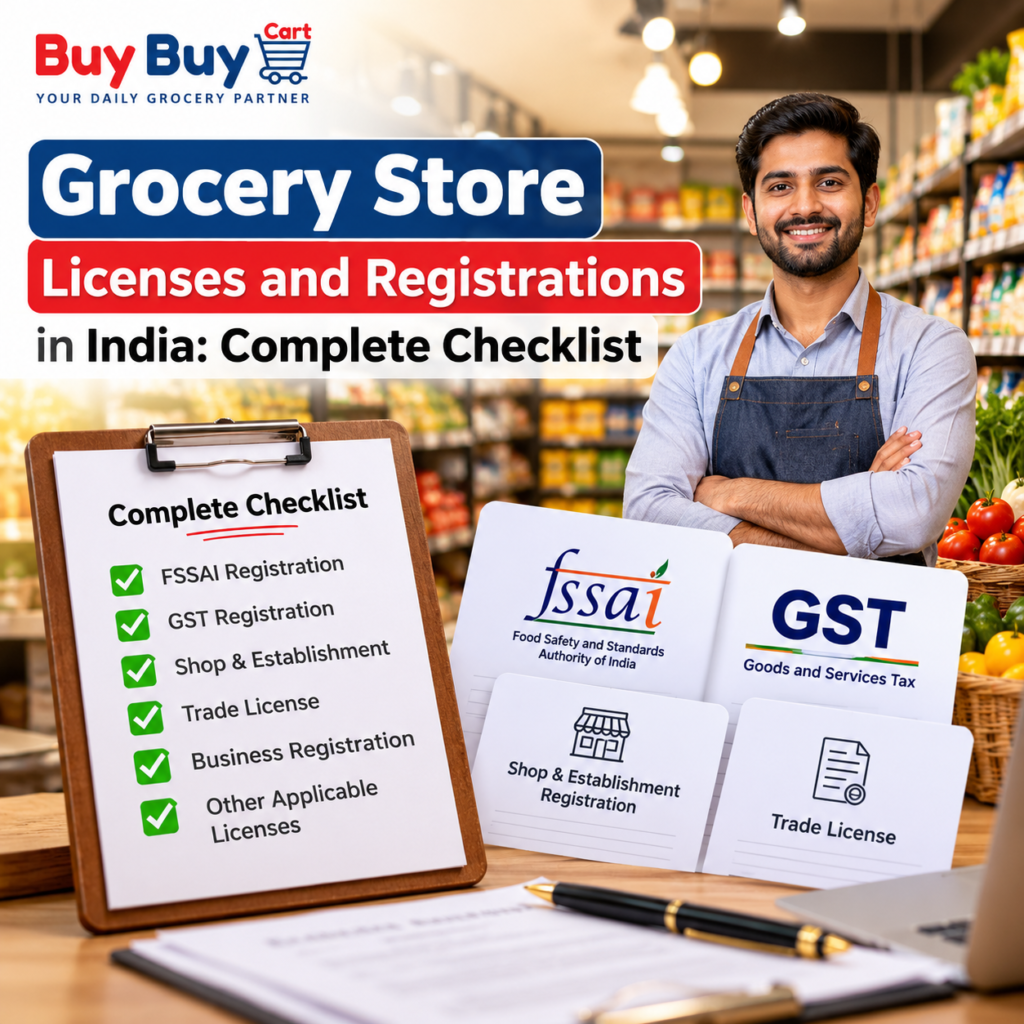
Opening a grocery store in India can be a lucrative venture whether you want to start a neighbourhood kirana store, a grocery retail store, or a modern supermarket. But prior to starting the business, it’s critical to understand the licences/ registrations associated with it. This understanding also enables business owners to sell food products legally, ensure food safety and hygiene, and comply with tax requirements.
The requirements for opening a grocery store actually depend on factors such as your annual turnover, your business format, the location of your store, your staff, and the products sold in your store. These requirements may include an FSSAI licence or registration and GST registration, compliance with the Shops and Establishments Act, and obtaining a trade licence from the municipality, among others.
This guide describes crucial grocery store licenses in India along with the documents you might need as well as the process to apply. Even if you are an entrepreneur in the making or a kirana owner who is looking to grow your business, the information here will clarify your queries regarding the requirements you need to meet before you invest in your grocery store.
Why Does a Grocery Store Need Licenses and Registrations?
Licenses and registrations help you establish the legal identity of your company and demonstrate that you are abiding by the various rules and regulations applicable to your business. Food safety issues are especially important to grocery stores, as consumers expect products to be safely stored, handled and sold.
If you don’t register your business properly, you could face a number of legal consequences – fines, notices, restrictions on what you can do in your business, and more. Good documentation helps in maintaining good relations with suppliers and also helps in complying with taxation issues. However, it’s important to be aware that not every store will require the same kind of registration, so research the requirements for your business.
Essential Licenses and Registrations for a Grocery Store in India
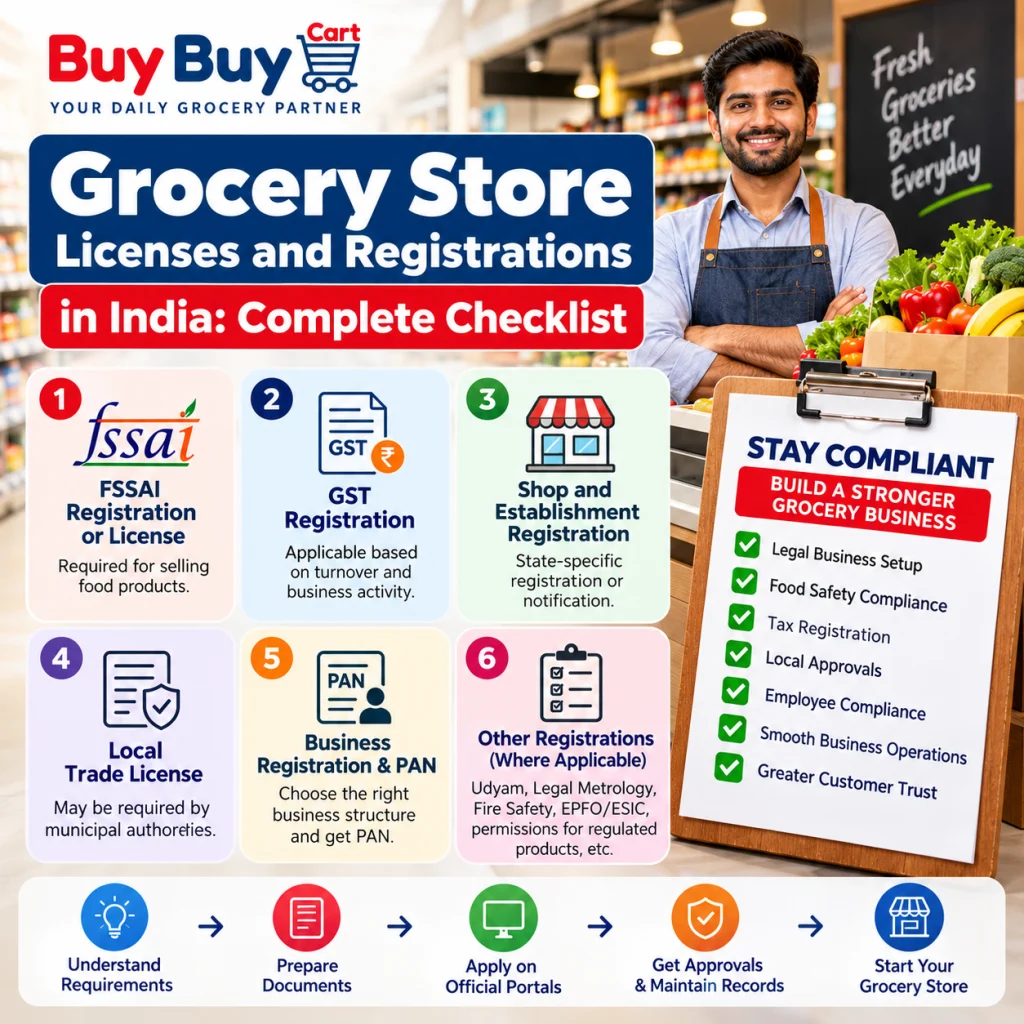
FSSAI Registration or License
To run a grocery store dealing in food items, registrations or licenses need to be obtained from the Food Safety and Standards Authority of India (FSSAI). Applications can be placed on the FoSCoS official portal.
As per the rules applicable from April 1, 2026, the categories for food businesses based on turnover are given as an annual turnover of up to ₹1.5 crores, for which registration is required; a state license if annual turnover is between ₹1.5 crores and ₹50 crores; and a central license if the turnover exceeds ₹50 crores.
These limits are subject to the category of the business and eligibility criteria. The existing businesses have to follow the migration process, as applicable. Choose the correct category, i.e., retailer in this case, on FoSCoS while applying. Official FSSAI advice.
GST Registration
The requirements for GST registration differ for grocery businesses based on aggregate turnover, the nature of supplies made, and applicable exceptions. In many states, the threshold is ₹40 lakh, and in certain states, it is ₹ 20 lakh for businesses that solely engage in the supply of goods.
Do not assume that crossing the threshold of turnover is the only factor. The registration requirement might also depend on interstate transactions, the nature of business activities, and notifications.
Registration of Shops and Establishments
The Shops and Establishments Act varies from state to state. Depending on the state, a grocery store may require registration and an intimation or other compliance with the labour department concerned.
The legislation includes regulations pertaining to working hours, rest days, employee record maintenance, payment of wages and the general working conditions. You must check with the labour department website in your state to find out the specific details that apply to your establishment.
Also Read: Complete Grocery Store Business Plan: How to Start a Grocery Store Business in India
Local Trade License
Some municipal corporations and local agencies require a retail license to run any kind of retail shop. The requirements can be different depending on the town being located, type of building and activities carried on.
Contact your local authorities before starting your enterprise. Verify the zoning, use of buildings and signage, etc. before opening a retail store. Where applicable, the trade license and FSSAI registration processes are different.
Business Registration and PAN
Selection of business structure is crucial to grocery store registration. The options include functioning as a sole proprietor, partnership, Limited Liability Partnership, or a private limited company.
Business structure plays an important role in influencing documentation of the business. While the sole proprietorship can use the PAN of the proprietor, the LLP or company will have its own PAN. You need to procure the relevant PAN and also carry out other registrations beforehand.
Other Relevant Registrations
Depending on the activities, size, and location of your store, further compliance could include:
- Udyam registration: This is a voluntary MSME registration that applies to eligible companies and can be accessed free of charge at the official Udyam website.
- Legal Metrology: This refers to the checking of weighing apparatus and compliance with guidelines regarding packaged goods.
- Premises approvals: This includes getting fire safety clearance, building-use permit, and other local approvals depending on the premises.
- Employment compliance: This includes EPFO, ESIC, professional taxes, and others if applicable.
- Regulated products: Extra approvals may be required if the government legislation allows certain products such as tobacco and alcohol.
Not every supermarket or kirana shop needs all these registrations.
Documents Needed to Start a Grocery Store
The type of documentation required for launching the grocery shop will depend on the type of application you are submitting but you may usually expect to provide:
- Identity and address proof (like your Aadhaar).
- PAN card for the owner or business organization.
- Business constitutional documents, like a partnership agreement or incorporation certificate.
- Proof of ownership or lease agreement for your shop.
- Utility bill or any relevant address proof of the premises.
- Bank account details and supporting documents, if necessary.
- Photographs, declaration, and any other documentation as needed.
How to Apply for Grocery Store Licenses in India
In India, the process of getting licenses for grocery stores starts with the identification of a suitable business setup and accessory premises. After doing that, the next step is to check compulsory requirements set by the municipal authority and labour department in the area. This should be followed by obtaining necessary registration with FSSAI or FoSCoS and managing the GST registration on the GST portal.
Once the forms are filled in and sent with all the documents and payments, the government officials will start processing the application. After getting approvals from the authorities, it is important to keep copies of documents that may be required for other purposes.
Common Mistakes to Avoid
It should not be assumed that a license fulfills every legal obligation. Municipal permits and state employment regulations, for instance, cannot be disregarded. Additionally, selecting the wrong business category when applying for a license may cause problems with compliance.
So many people think that it is necessary to register for GST or Udyam regardless of the grocery store type. Verify your eligibility in the particular case as opposed to relying on general information. On top of that, a proper approach should be used for maintaining business information and checking changes in the law.
Planning to Start a Grocery Store Business?
Opening a grocery business goes beyond the task of simply choosing premises or purchasing products. Successful entrepreneurs manage to find the right business model as well as conduct adequate planning before launching the grocery store.
Those who are interested in a grocery store or supermarket franchise should get acquainted with the franchise possibilities that BuyBuyCart offers.
Conclusion
It is essential to comprehend the licenses and registrations necessary when establishing a Grocery Store in India. The FSSAI registration, eligibility for GST and local approvals, as well as employment regulations must be verified based on your everyday operations and physical location.
Before applying, make sure that you have checked the latest rules with the appropriate governmental authorities or a credible expert.
Commonly Asked Questions
- Which license is required to set up a grocery shop in India?
Usually, grocery businesses that sell food will be required to obtain FSSAI licensing or registration. The other permits needed, such as the shop permits or those from the Shops and Establishments Act, depend on local and state laws.
- Is GST registration compulsory for all grocery shops?
Not necessarily. GST registration is dependent mainly on the turnover, the type of supplies being made, the state, and applicable exemptions. Many businesses are required to register even if they do not cross the normal turnover limits.
- Can food retailing be set up in a rented building?
Yes, depending on the local requirements. To set up a grocery shop in a rented building, you generally need to provide either a valid lease agreement or proof of ownership of the rented property.