

India’s grocery retail industry has great opportunities for individuals wanting to get involved in the retail sector. Newer shopping habits, greater demand for supermarkets, and the ease of ordering grocery shopping online have led to an interest in grocery store franchise. There is an increase in people thinking of starting a franchise, regardless of whether they are first-time entrepreneurs or experienced kirana shop owners.
But starting a grocery store can be much more than simply setting up a shop. One has to manage suppliers, keep stock, run daily operations, know customer preferences, and compete with well-established retailers when going at it alone. There are many responsibilities that one can fulfil with the help of a franchise model, including a well-known brand, operational assistance, and technology services.
How should you go about identifying the ideal franchise opportunity? Before investing, you must analyze brand reputation and requirements, business models, supply chain network, and future growth opportunities. The following points need consideration when choosing a grocery store franchise in India.
Why Choosing the Right Grocery Store Franchise Matters
Franchise partnership can impact how your business functions, influence customer service, and change the pace of business growth. The wrong brand choice can bring supply problems, lack of help, and unexpected expenses.
A good franchise partner has to offer a viable set of business practices, clear financial terms, good product availability, and technology that helps with the routine operation of the store.
7 Important Factors to Consider Before Choosing a Grocery Store Franchise
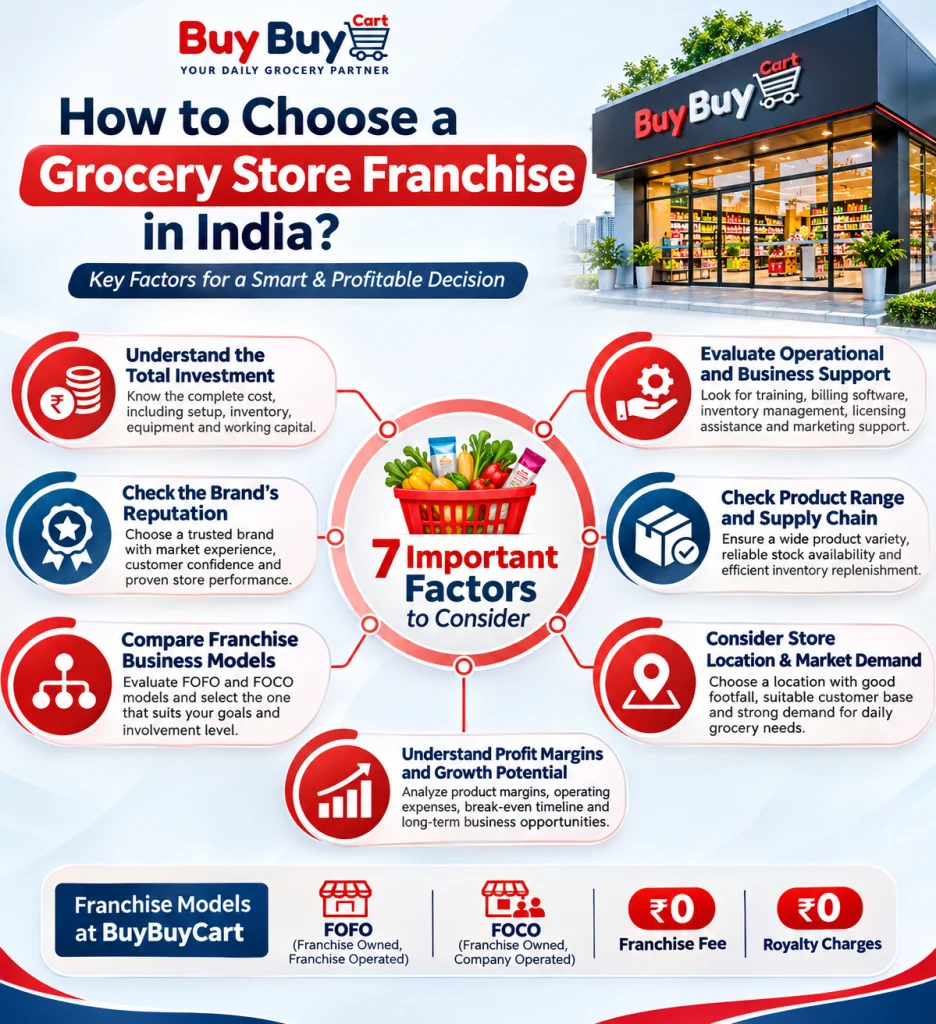
Understand Total Investment and Franchise Costs
Before deciding on a Grocery Store Franchise, ensure that you have a fair idea of the total money needed to set up and run the store. The initial budget includes property rental, security deposit, interiors, furniture, billing equipment, inventory, branding, and working capital.
Also, find out if the company charges a franchise fee, a royalty fee, or other related charges. Even if the business offers a zero-franchise-fee agreement, this doesn’t mean that you don’t have to invest anything, as expenses related to inventory, setup, and general operations will have to be borne by you as well.
Obtain a detailed cost breakdown so that you know what your responsibilities will be in terms of money before signing the franchise contract.
Also Read: Monthly Expenses of Running a Grocery Store in India: Complete Cost Breakdown
Analyze the Brand’s Reputation and Market Presence
The credibility of the brand is significant in wooing customers since a well-known supermarket brand can gain customer trust more easily than a new independent supermarket.
Study the market presence, the existing franchises of the brand, customer feedback, and the history of the business carefully. Try to visit some functioning retail outlets and talk to currently operating franchisees about the business properties, support and customer needs.
Compare Available Franchise Business Models
The different franchises provide varying levels of ownership and operational management. FOFO (Franchise Owned, Franchise Operated) and FOCO (Franchise Owned, Company Operated) are two commonly found models.
FOFO (Franchise Owned, Franchise Operated) refers to the franchise operator owning the store and responsible for day-to-day management of the store.
FOCO (Franchise Owned, Company Operated) means the franchise operator owns the assets while the company takes on agreed operations.
Entrepreneurs interested in implementing control over store management may prefer the FOFO option; whereas if investors want more control on the operational aspect they may prefer choosing FOCO as the preferred model.
Make sure you establish and clarify what will be required for staffing, expenses, and decision-making authority within the agreement.
Assess Operations and Business Assistance
Successful franchising does not mean just creating a brand for the franchisor’s store. It also means providing operational support which would help franchise owners solve the issues of daily operations and ensure that franchises provide the same level of service.
Among the operational support services that a franchise should provide, there are the following:
- Billing and inventory control software.
- Training of employees and consultations on operations.
- Support with licensing and documentation.
- Help with product management and sales.
- Help with the execution of marketing campaigns.
The utilization of technology-based systems can enhance the accuracy of bills, aid in the inventory check, and ensure proper management of stores.
Analyze Product Availability and Supply Chain Operations
Product availability significantly affects customer satisfaction and repeat buying. For a supermarket, it is essential to stock up on some basic food items, food items that come packed, drinks, personal hygiene items, household goods, and many other goods sold frequently.
Before making an investment, ensure you understand how the franchise organization manages the purchasing process, warehouse operation, supplier relations, and industry replenishment. Inquire how frequently the inventory arrives at stores and how the organization deals with shortages and spoiled goods.
An effective supply chain will enable retailers to ensure the availability of goods and manage stock effectively.
Select Store Sites Based on Market Potential
A well-known franchise may not get the proper recognition if improperly located. The choice of a venue should cater to clients’ needs, accessibility and the state of competition.
Pay attention to demographic data, the number of residential homes, the surrounding area, parking availability, and visibility. Also, analyze certain stores and supermarkets, their price levels, kind of merchandise, and clientele.
The area of the outlet must meet the franchise concept and correspond to the prospective demand.
How Profit Margins and Long-Term Growth Potential Works
Understanding how the grocery store franchise generates profit requires knowledge of how the business operates in order to project its long-term potential.
You may examine how much each product contributes to the total profit margin, the monthly sales volume for each product, along with expenses such as rent, salaries, utility bills, costs for storage and repair, and other overhead expenses. Don’t forget to discuss financial plans and business assumptions with the franchisor before reaching any decisions.
It’s a good idea to analyze your expected break-even point using conservative sales figures as opposed to optimistic projections.
Questions to Ask Before Investing in a Grocery Store Franchise
Before entering into a contract, there are some vital questions you should ask the franchisor:
- What’s the total investment required, including inventory and setting up the store?
- What franchise formats are available, and what are the responsibilities of each one?
- What support will I receive in terms of technology, operations and marketing?
- How will you deal with product sourcing, inventory and stock replenishment?
- What are the terms of the agreement along with renewal and exit options?
Receiving precise responses to these questions will allow you to make an informed decision in regard to your investment.
Conclusion
It is essential to carefully consider aspects like investment size, brand strength, franchise type, business support, product range, and future growth potential while choosing a Grocery Store Franchise in India. A successful retail operation involves various factors rather than just brand presence; it must be located in the right place, stocked appropriately, and enjoy good customer service along with sound financial planning.
Before choosing any franchise model, properly assess the alternatives and related franchise agreement along with the company’s benefits.
If you wish to start a grocery store or expand your existing business, check out the grocery and supermarket franchises on BuyBuyCart’s website to determine what models they have as well as the assistance they provide in retailing.
Frequently Asked Questions (FAQs)
- What factors should I consider when selecting a grocery store franchise in India?
It is crucial to analyze the total investment, brand image, franchise contract, available business models, product distribution network, and required operational assistance. Similarly, consider the proposed site of the store, local competitors, and achievable profits prior to deciding on a franchise.
- What investment is required to open a grocery store franchise?
The amount of investment depends on the particular franchise company, size of the store, location, design, inventory, and business needs. The costs include, among other things, rent, equipment, imports, personnel remuneration, and working capital. Always ask the franchisor for a detailed breakdown of investments.
- What distinguishes FOFO from FOCO franchise concepts?
In the FOFO concept, the franchise owner operates the outlet, doing all the necessary activities within its operations. On the other hand, under the FOCO concept, the franchise owner owns the outlet and delegates all agreed operational responsibilities to the franchisor. This agreement varies depending on the contractual relations established between the parties.
- Is opening a grocery store franchise a good investment option in India?
Opening a grocery franchise can present an appealing retail opportunity because groceries and other necessary goods are consistently in high demand. However, various factors such as location, proper inventory management and ongoing costs, consumer preferences, and the level of franchise support can influence profit potential.