
In India, grocery and other essential items are commonly placed items in the lives of common people. With local kirana shops or swanky supermarkets, food staples such as rice, lentils, cooking oil, etc. are in constant demand. This continuous need for grocery items makes grocery shops an enticing option for entrepreneurs.
Though it may look easy, starting a grocery business is not just about finding a place and filling it with goods. You have to take care of things like knowing how much money to invest and what customers in the area want, managing your stock, and keeping operational costs low.
One of the advantages of opening and operating a grocery retail store is that this type of business does not necessarily need to start with a large supermarket chain. It is even possible to be successful with a neighborhood grocery shop or small grocery store, with proper inventory control and management, as well as good knowledge of costs.
Whether you are a newcomer in the world of business or already a medium-sized kirana shop owner aiming to grow your business, this article will help you understand the ways of starting a grocery store, calculating expenditures for starting a grocery store, looking for various franchise types, and find a good partner.
Why Consider a Grocery Store Franchise in India?
Grocery retail meets the never-ending demand of consumers. Customers regularly visit grocery stores in their area for daily shopping. Hence, grocery stores have an opportunity to establish stable relationships as long as they provide a wide range of goods with reasonable prices and high-quality service.
When starting a business from scratch, a company gets great control over the brand (its own name), range of suppliers, and the business process. However, on the other hand, they need system and confidence of clients about the brand.
Franchising can be considered as a version offering plenty of benefits to people who want to start their own business. Firstly, they can get already established brand name, already functioning finance reporting software, training of staff, advertising help, and the way of purchases already defined. Such experience can be useful for those workers who know how to run their grocery store but want to integrate technology in the work of the company because they will be able to track inventory and grow their client base.
How Much Investment Is Required to Start a Grocery Franchise?
The total price of a grocery store franchise comes down to the franchisee’s mode of operation, the location of the shop, and the products offered at the supermarket. A local grocery store will have a different budget than a multinational supermarket.
Before you start spending any funds, create a detailed budget that should include the following:
- Payment and deposit: depends on the place and lease agreement terms.
- The design of the store and equipment: shelves, tills, signage, storerooms, refrigeration;
- The initial purchase of products: foodstuffs, canned goods, beverages, household supplies;
- Equipment: payment instruments, IT gear, scanners, and inventory software;
- The staff and utilities: payroll, power, facility maintenance, and other usual expenses.
- License costs and working capital: registration fees, compliance costs, and operating funds.
Ask the franchisor for a detailed list of costs and check whether there are any refundable deposits or recurring charges when purchasing goods. Make sure you don’t pay everything in advance.
Also Read: Top Grocery Store Franchise in India: Costs, Profits & Step‑by‑Step Process
5 Ways to Start a Grocery Store Franchise With Low Investment
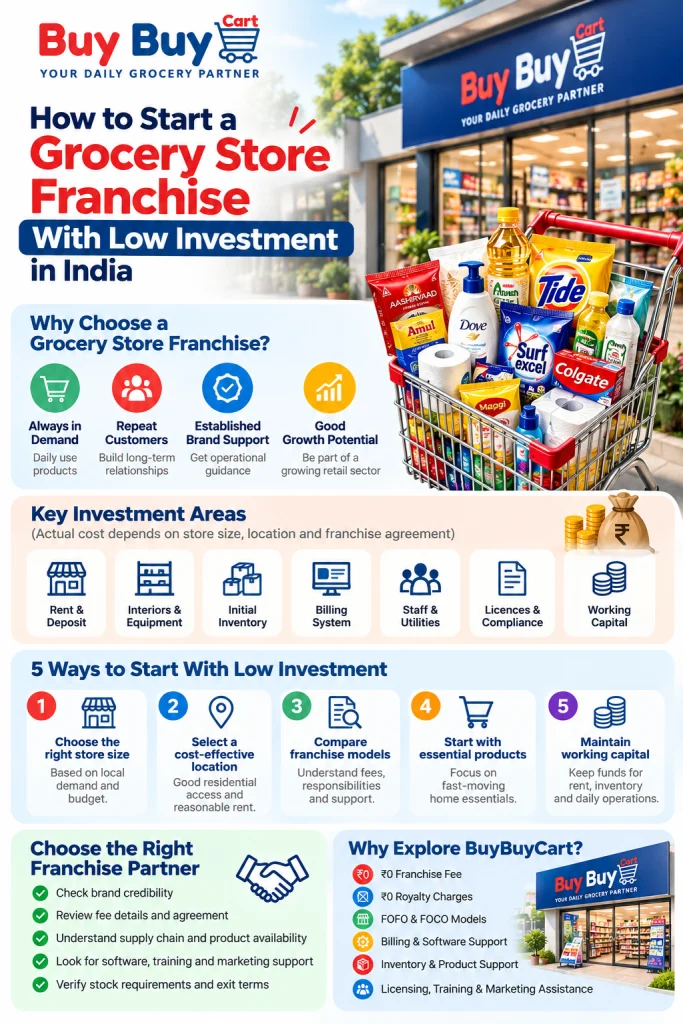
Thinking about low-cost grocery store franchising doesn’t mean choosing the cheapest option. These practical steps can help you cover your basic investments.
Check the size of the store: Opt for an area based on local demand, expected turnover, and available funds. Do not pay for empty square meters.
Look for the right location: Choose a place that is easily accessible from residential areas, visible, and has enough foot traffic. Check rents, competition levels, and parking facilities before signing the lease.
Choose the right franchise: Learn the difference between FOFO (Franchise Owned Franchise Operated) and FOCO (Franchise Owned Company Operated) models. Compare costs, obligations, and staffing arrangements of each model.
Pick a fast-moving product range: Start with regular grocery products that people buy all the time. Monitor sales and replenish stock based on real needs.
How to Choose the Right Grocery Franchise Partner
It is crucial to select a good franchise partner. Be sure to check the applicant’s experience, their business model, purchasing policies, and whether they provide franchisees with the necessary support. If possible, engage with the current partners to find out their opinion. Furthermore, check whether the franchise offers accounting and inventory software, employee training services, advertising assistance, inventories, and licensing issues.
Do not forget to ask for the documentation that contains such information as start-up costs, materials expenses, profit forecasts, repayment plan, and obligations in case of future cooperation. Take time to read the agreement attentively, paying particular attention to extension terms, area limitations, termination, and exit conditions.
Why Explore a BuyBuyCart Grocery Store Franchise?
BuyBuyCart provides people who wish to enter into a grocery and supermarket retail franchise business in India the opportunity to do so. The company offers prospective franchise partners two kinds of business models to choose from – Franchise Owned Franchise Operated (FOFO) and Franchise Owned Company Operated (FOCO).
The company promises no franchise fee and 0% royalty for its partners. In return, it will help you with things like the billing system, technology, licenses, inventory, employee training, and marketing. This support will make things easier for the business owners, giving them access to retail systems without having to develop them by themselves.
However, it is important to remember that zero charge means not being charged for the franchise, but does not mean that there are no expenditures necessary for renting premises, buying goods and furniture, paying salaries, utilities, etc. It is advisable to check currently applicable costs and responsibilities with the company.
Those who want to take advantage of the opportunity may visit Partner With Us and find out about BuyBuyCart’s franchise concepts and how to become one of its business partners.
Conclusion
To start a low-cost grocery franchise in India, it is critical first to prepare a proper budget, find an appropriate location, and control inventory. Those who would like to enter this business should carefully compare the different alternative franchise models available, ensure sufficient working capital is available, and select a fully transparent partner.
The grocery retail business is certainly worth trying, but its success will depend on the market demand, costs involved, quality of service, manner of managing the delivery process, and consistency in execution. Before buying the franchise, one should thoroughly analyze personal finances and make sure they understand the terms of the contract properly.
If you wish to open a grocery franchise in India, visit Partner With Us and learn more about the opportunities available at BuyBuyCart.
Commonly Asked Questions
- What is the minimum amount needed to open a grocery store franchise in India?
The overall capital required in the opening of a grocery store depends on different important factors such as size of store, location of store, rent, interior, initial inventory, and manpower. It is essential to prepare a budget and have enough working capital beforehand.
- Is it possible for an aspiring entrepreneur to commence a grocery store franchise?
Yes, it is possible as long as the person understands local customer requirements and is willing to manage inventory, expenses, and customer service. It is equally important that the franchise also provides training, billing systems, and overall business guidance.
- Does the BuyBuyCart provide a low-investment grocery store franchise?
BuyBuyCart has two models, FOFO and FOCO, and claims that the franchise proposal includes zero franchise fee and royalty charges information. However, the franchisee may incur other costs such as rent, inventory, interior furnishing, salary, and working capital. To get confirmed about the current conditions, one needs to approach BuyBuyCart through its Partner With Us web page.