
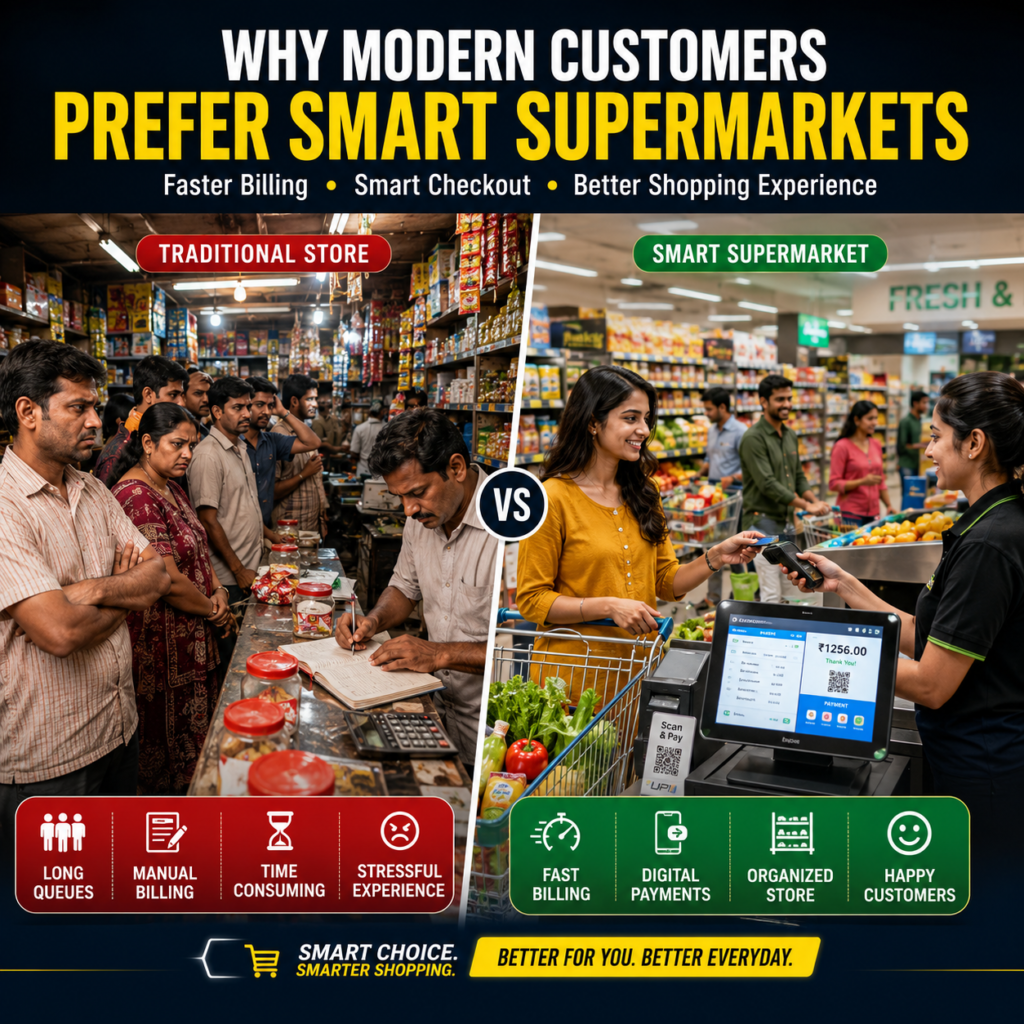
Grocery shopping habits of Indian consumers have undergone a rapid transformation in the past few years; whereas people used to primarily shop at nearby kirana stores for convenience due to established relationships with these retailers, customers today are looking for much more than just access to products. They demand an efficient checkout experience, well-organised products on well-maintained shelves, seamless electronic payment options, quality hygienic conditions, smart offers, and an efficient and pleasant shopping experience. This customer shift towards smarter supermarkets is one of the key trends impacting the retail industry today.
For all types of shoppers – whether it be a working professional shopping after-hours, a parent managing household purchases, or an older adult who wants a comfortable shopping experience – the wise shopper today seeks time-efficient and stress-free ways to shop. The smarter supermarkets understand these changing shopper needs and utilise a combination of technology, trained personnel, and optimised operational processes to help improve the shopping experience for their customers.
For grocery store owners and retail entrepreneurs, keeping abreast of changing consumer behaviour is no longer a matter of choice; it is essential for survival and long-term success.
In this article, we will look at the reasons causing shoppers to move towards smarter supermarkets, how modern retail convenience impacts shopper purchasing decisions, and how grocery retailers can improve the level of customer satisfaction and loyalty.
Expansion of Modern Supermarkets Trends in India
The grocery industry in India is rapidly changing. Customers have become much more informed, digitally connected, and quality/value conscious. They can compare prices on the web, check product ratings on the web, plus expect fast service even at local markets. This is where the smart grocery shopping experience is having a huge impact.
Modern type supermarkets not only sell products, but they also provide a better shopping environment by using:
- Faster checkout systems
- Barcode-based billing
- Efficient inventory management
- Digital payment options
- Loyalty Programs
- Improved Queue Management
- Personalized Offers
- Improved Staff Coordination
In contrast to traditional stores that generally operate on a manual basis (especially during peak shopping hours), smart supermarkets utilise a technology-based model that reduces the number of customers waiting to be served, plus increase the general level of efficiency.
The operational differences between traditional and smart supermarkets have a direct correlation to the level of customer satisfaction generated by each type of store.
How Customers Value Time Today More Than Ever Before
Retail consultants are seeing a huge change in shopper behaviour and the importance of shopping for items that save them as much time as possible.
Shoppers no longer will spend thirty minutes picking the items they want to buy just to stand in a long line to pay for their purchase. A delay of as little as 10-15 minutes when they get to the checkout can be enough to turn shoppers off and cause them to form a negative opinion about the retailer.
Real-Life Example: Supermarkets Situation
Let’s say a customer has had a long day at work and is very quickly looking for milk, bread, vegetables, snacks, household items, etc. The customer is shopping for daily essentials and heads to the checkout, but only finds two cashiers working with long lines of customers and cashiering by hand.
The lines are moving at a snail’s pace.
No barcodes are being scanned.
Using a credit card to pay takes longer than it should.
The customer loses his/her patience, and he/she chooses not to return to this store again.
This is very common, and it is one of the primary reasons that so many customers make the switch from shopping in traditional stores to shopping in modern supermarket formats.
The checkout experience is an extremely important part of keeping the customer after they have made the decision to purchase their items.
Customer Experience Benefits of a Faster Billing Process
Having a fast billing system isn’t a luxury anymore; it’s an expectation of customers.
Organisations such as food supermarkets use smart technology, including point of sale (POS) software, barcode scanning, and inventory synchronisation, to speed up and improve the accuracy of the billing process.
How Faster Billing Helps Grocery Stores
Reduced Waiting Time
When checkout is done quickly and in an orderly manner, customers tend to enjoy their experience shopping. Reduced waiting time when billing leads to less crowding and ultimately creates a greater sense of comfort while shopping.
Better Productivity
When using POS software and barcode scanning, employees spend less time manually entering pricing, which results in fewer errors in the billing process and greater productivity.
Increased Customer Satisfaction
Customers remember how they felt at the point of checkout. If they experience a quick and easy exit during the checkout process, they will more likely return to your store.
Managing Peak Periods
During peak periods of time (Monday – Friday evenings, weekends, holidays, etc.), there will be heavier customer traffic in supermarkets. In order to successfully manage peak periods of time, many supermarkets have multiple registers and utilise queue management systems.
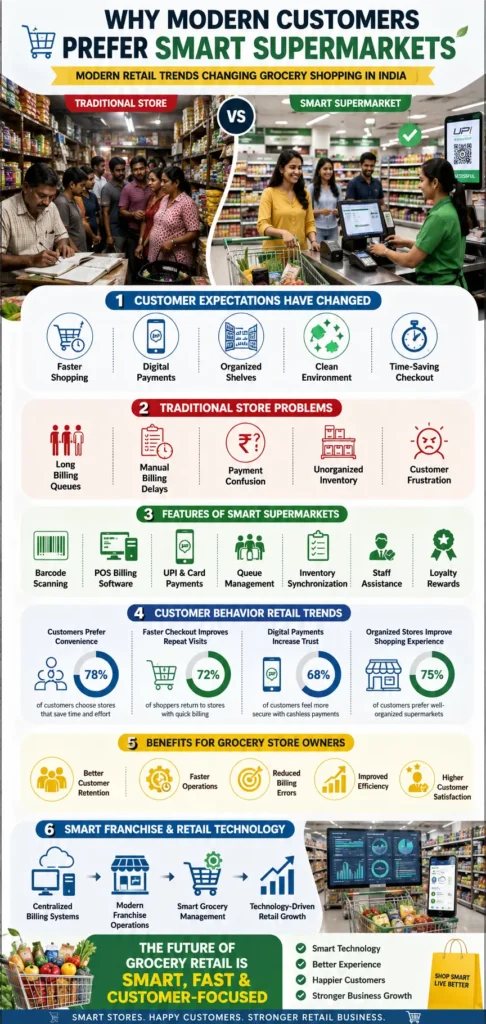
Smart Grocery Shopping Is Driven by Convenience
Customers today are more inclined to use a convenience method for shopping compared to their parents.
Supermarkets are designed to focus largely on the retail shopper’s convenience. Most shoppers want all types of products in one store and want to put in as little effort as possible.
These are some of the things that consumers want when shopping at Smart Supermarkets:
Well-organised Layouts
Customers shouldn’t have to continuously ask employees for help in finding items.
Many Payment Methods
UPC, credit/debit cards and electronic wallets/cashless pay are required for customers to have choices and the ability to make payments.
Clean Stores
Stores that are clean provide trust in a store as well as a comfortable feeling to customers.
Supplemental Offers and Rewards Programs
Highly personal discounts will encourage customers to return to your supermarket and increase the average total spent per customer.
Better Product Availability
Synchronisation of inventory ensures that consumers never have an issue finding products that they want.
Individually adjusting these attributes allows supermarkets to provide a premium store experience for customers that they can remember when they visit your store.
How Technology is Transforming Consumer Behaviour in Supermarkets
Consumers have high expectations for their shopping experiences.
In the past, shoppers had to wait in line because they had very few other options. Nowadays, when one store provides slow service to its customers, they simply go down the block to the closest grocery store, or they can order their groceries online.
The development of digital grocery shopping trends continues to change how retailers do business.
What Smart Technologies Are Being Used by Modern Supermarkets?
Point-of-Sale (POS) Software
Modern POS systems are designed to handle billing, sales tracking, inventory management and employee performance together.
Barcode Scanning
Barcode scanning systems improve the speed at which customers can check out and reduce errors associated with making manual purchases.
Real-time Inventory Synchronisation
By having real-time links between inventory and sales, grocery stores are able to know exactly how much of a product they have available for their customers and to minimise losses related to inventory.
Customer Self-Checkout
Some of the newest grocery store concepts allow customers to check out without going through the regular checkouts, dramatically reducing wait times.
Digital Payment Integration
Customers now expect to be able to use payment options like UPI (Unified Payments Interface) and QR codes almost everywhere.
If grocery retailers do not adapt, they may risk losing their customer base among younger and tech-savvy consumers.
Also Read: Converting a Kirana Store Into a Modern Supermarket
Common Mistakes Grocery Stores Make at Checkout
Most grocery stores do not understand how important it is to manage their checkout experience and therefore lose customers due to their lack of understanding.
By recognising these errors, grocery store owners can easily improve their operations today.
- Insufficient Number of Billing Counters
At peak hours, a lack of counters results in long lines, therefore irritating customers.
- Manual Entering of Prices
Without a barcode system, the process of entering each price into the register is slow and can be mistake-prone.
- Staff Members Not Trained Properly
Untrained staff will usually have a difficult time using a billing system and/or communicating with customers and may make mistakes when handling payments.
- Lack of Managing Queues at the Checkout Counters
Customers feel frustrated when their queue appears to be disorganised.
- Limited Payment Options
Many customers prefer cashless payment options. Stores that do not provide a proper digital payment system will lose those customers who want convenience in their shopping experience.
How Having Better Checkout Systems Can Increase Customer Loyalty
The amount of customer loyalty will depend on how comfortable customers feel when shopping at your grocery store.
While the customer may forget that they received a discount on an item, they will remember their negative experience with the service received.
A Fast Checkout Will Build Trust.
Once customers have had a positive experience with a smooth and fast checkout on a consistent basis, they will gain trust in the grocery store for their recurring grocery needs.
A Positive Shopping Experience Will Mean Repeat Visits
When customers have a good experience shopping, they will usually want to shop again on a weekly or monthly basis.
Happy Customers Will Tell Others About the Store
Word-of-Mouth is one of the strongest forms of marketing that exists in the grocery industry, and more so with grocery stores in the same local area.
Less Stress Will Build an Emotional Connection with Customers
Shopping in the grocery store should be easy to do and not an exhausting activity to do. Modern supermarkets realise there is an emotion tied to the behaviour of customers while shopping in their stores.
Reasons Why Shoppers Prefer Supermarkets Over Traditional Grocery Stores
Shoppers want to experience less hassle when shopping and more convenience. Thus, new grocery stores have implemented technology, efficiency, and comfort as part of their solution to create a positive shopping experience.
Although traditional grocery stores have nostalgic value to locals, there has been a noticeable trend in the types of grocery stores customers are choosing. New grocery stores are increasingly popular because they save time, have transparency about pricing, and provide an orderly approach to serving customers.
Several types of customers have been particularly influenced by this shift:
- Young Professionals
- Nuclear Families
- Digitally Aware Customers
- Urban Shoppers
- People Who Are Time Sensitive in Their Shopping Habits
Even in smaller towns, grocery stores of all sizes have been improving their offerings and becoming more modernised in order to keep pace with rapidly increasing customer demands.
How Modern Grocery Franchises Implement Advanced Checkout Systems
The success of grocery franchises has allowed many to expand rapidly due to their ability to offer customers an identical experience throughout multiple locations.
Grocery franchises today tend to use:
- Centralised Point of Sale Systems (POS)
- Real-Time Inventory Control
- Smart Billing Applications
- Customer Loyalty Programs
- Digital Payments Integration
- Data-Driven Inventory Forecasting
Using these systems allowed grocery franchises to minimise mistakes and maximise their profits.
When you begin your journey into grocery retail as a business owner, the best way to ensure that your operations will be efficient and scalable is to select the correct franchise partner or retail partner for your business. Many well-established grocery retailers now invite prospective new store owners to visit their “Partner With Us” page for more information on the operational support they provide, the way they integrate technology, assist with branding, and provide retail management systems before starting a business independently
Final Thoughts
The grocery business is transforming because consumers have changed.
Currently, more than just price comparison, customers now have higher expectations in relation to all aspects of a store’s operation.
Long lines at the checkout counter, inefficient checkout systems, and chaotic operations are negatively impacting customer retention. Alternatively, smart grocery supermarkets are successfully building customer loyalty through the development of convenience, speed, technology, and improved customer service.
In addition to implementing new technologies, owners of grocery stores should focus on understanding emotional responses to shopping, reducing shopping worries, and developing stores that customers will enjoy spending their money in.
Owners of grocery stores can significantly increase their customers’ cumulative satisfaction by making even small changes to how their stores operate (e.g., faster checkout procedures, providing additional customer service training for employees, implementing barcode scanning technologies, and accepting digital payments).
For entrepreneurs who wish to create a scalable grocery business, learning from experience and utilising best practices found in established grocery chains, as well as potentially partnering with a well-known franchise, will yield a greater level of operational understanding and support for future growth.
Stores that can effectively mix human experience with efficient retail practices will dominate the grocery industry in the years to come.