
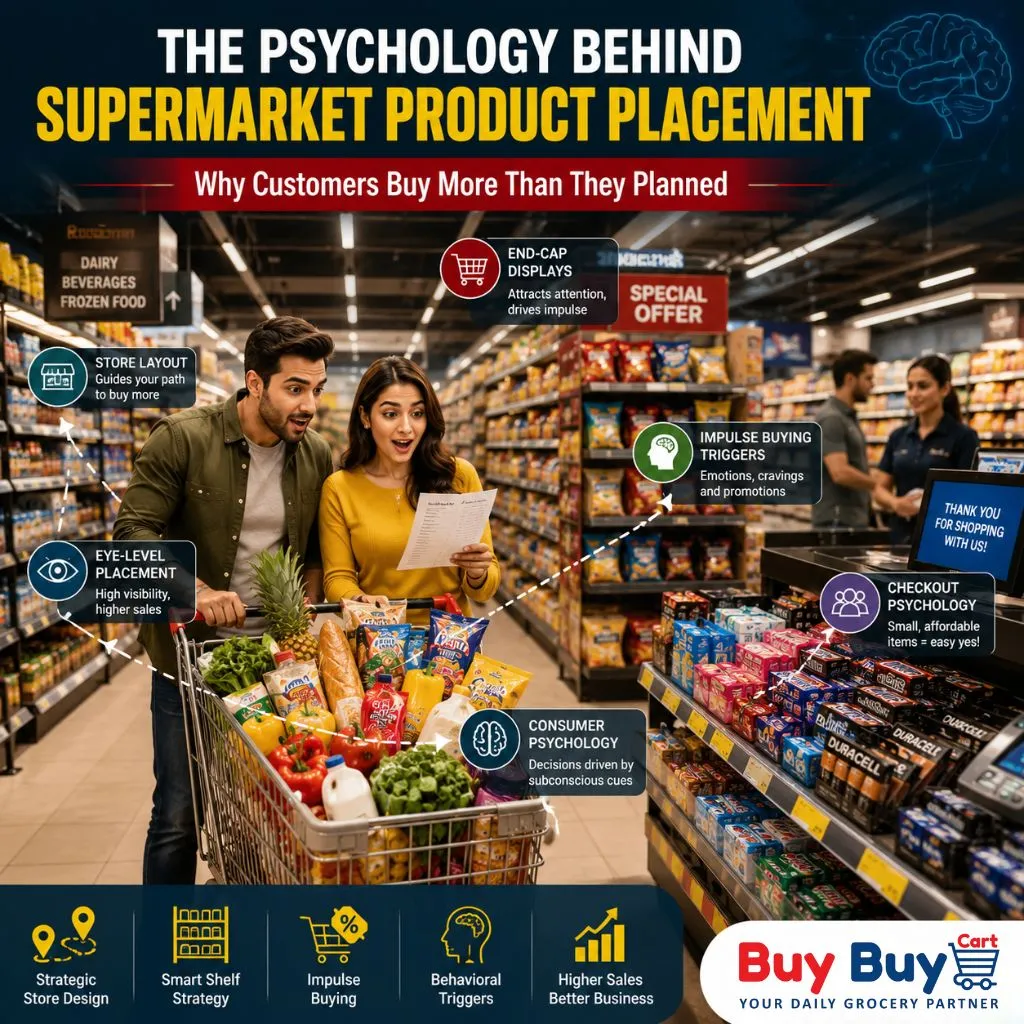
Supermarket product placement plays a powerful role in influencing what customers buy during their shopping trips. Have you ever gone to the grocery store with a small list (like just milk, some bread, and perhaps some miscellaneous vegetables) only to end up with snacks and drinks too, or even a full shopping cart of things you never intended to buy? You are definitely not alone in this experience; just about everyone has had something similar at least once in their lifetime.
This is not only due to a lack of self-control, but is the product of well-orchestrated product placement within supermarket environments by applying consumer psychology. Each aisle in a grocery store, each shelf, each end-cap display, and the register are intentionally placed to create a shopping environment that is easy for the customer and leads to increased profit for the supermarket retailer.
For entrepreneurs in the grocery industry, supermarket owners, or any other professional who has an interest in opening a franchise, an understanding of purchasing psychology will allow you to gain a competitive advantage by allowing you to create a better purchasing experience for your customers and, through proper merchandising, increase your sales volume without relying upon.
What Is Supermarket Product Placement?
Supermarket product placement is a way retailers arrange their shelves to get customers’ attention and make them buy more items, thus increasing their sales.
Supermarkets strategically place items on their shelves based on how customers behave in-store (e.g., the order in which people walk down aisles), how much the items cost those shoppers when they buy them, where the categories that these items fall into are located, etc. By doing this, supermarkets help customers find out what products are in the store and also implicitly direct them on how/why to purchase those products.
When shoppers enter a supermarket, they do so with the assumption that they won’t go down every aisle to see each item available in that store. Instead, they rely on visual cues from the way those items are placed on the shelves and from their memory of where they remember seeing items in that store in the past to assist them with making their purchase decisions.
When supermarket product placement works well, it benefits both the retailer by providing them with additional sales and the customer by having a more user-friendly shopping experience.
Psychology of Consumer Decision-Making in Supermarkets
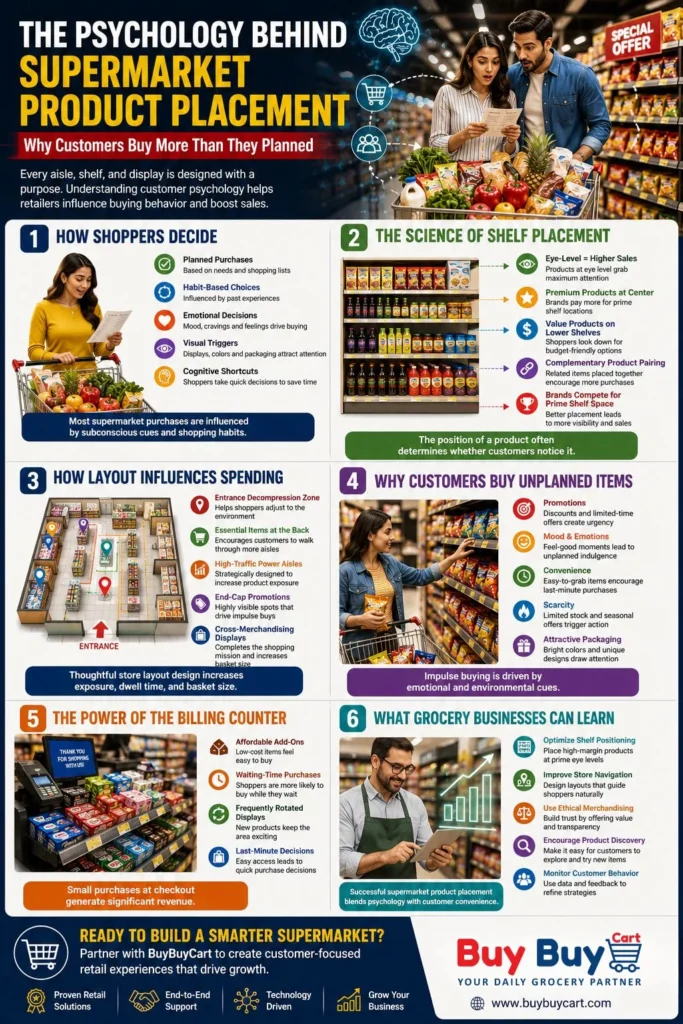
Most individuals believe their purchase behaviour is the result of rational decision-making. In reality, the way we shop is affected by both conscious or rational planning and by influences that we are unaware of.
Planned purchases come as the result of a shopping list or a specific need. Unplanned purchases occur as a result of emotional triggers, environmental cues and spontaneous urges.
When making choices, our brains are wired for efficiency. Most shoppers do not analyze every conceivable purchase option and use habits and cognitive shortcuts instead. The shopper trusts more familiar brands than unfamiliar ones. Packaging that looks appealing will capture attention. If it is easy to get to — shop for the right items in the store.
Additionally, mood impacts how much shoppers are willing to spend. The relaxed shopper who is casually browsing has the potential to be much more willing to try something new than does a shopper who has just finished a stressful day at work, who will likely purchase comfort or quick meal-type foods.
Visual stimulation plays just as critical a role. The bright colours of packaging, promotional displays, and the placement of products all have the ability to promote curiosity and encourage the consumer to explore. These subtle nudges can cumulatively increase the basket size.
By understanding the psychological factors that influence the consumer, retailers can effectively align their merchandising practices with the way consumers shop without having to inform consumers of their shopping behaviour.
Science Behind Retail Shelf Strategy
One of the strongest contributions to supermarket merchandising is retail shelf strategy. Shelves are seen as valuable locations for consumers, and the supermarket product placement on the shelf will affect its sales performance.
Eye Level Is Buy Level
The phrase “eye level is buy level” is still used today.
Products displayed at average eye level usually get the highest visibility, as consumers see them first and they are also the easiest for consumers to access.
Children’s products are typically located at children’s eye level in order for them to request the product from their parent.
Value vs Premium Product Placement
Shelf placement may denote perceived value.
Premium products are usually placed in a prominent and central location. Budget-friendly products are often located on lower shelves where price-conscious consumers will search for these products.
This allows retailers to effectively market to two customer segments while maximising the profitability of the entire category.
Adjacency on Shelves
Consumers associate products that are in proximity to one another.
Pasta sauces placed near pasta items make meal planning easier. Chips are located next to dip to encourage purchasing together. Breakfast cereals placed near non-dairy milk provide a more cohesive shopping experience.
These types of relationships provide assistance to consumers when solving problems and increase the average transaction value of a sale.
Techniques for Product Grouping
Utilizing different types of product grouping by their usage occasions will offer greater shopper convenience than if grouped only by their category.
For example, if you use a barbecue display with sauces, charcoal, disposable plates, and beverages all together, it will help consumers complete their entire shopping mission much more efficiently.
Shelf Space Competition
Manufacturers understand how critical visibility is to their business.
Manufacturers compete for the best shelf space in retail stores because even a small change in one location vs another can drastically alter consumers’ purchasing behaviour. Decisions on shelf placements are influenced by a combination of data/analytics, customer insight information, and sales performance metrics.
A retail store’s shelf strategy will achieve profitability, shopper convenience, and category management.
How Store Layout Design Shapes Shopping Behaviour
The way a store is laid out can influence how customers move around the store and how much time they spend in a store as well as what items they ultimately buy.
Store layout design addresses both operational and psychological aspects.
Essential Products Are Often Located Deeper Inside
Essential products such as milk, eggs, and other staple products are seldom located toward the entrance of the store.
Retailers place only high-demand essential items deeper into the store because customers will come upon several different types of items before they arrive at their destination item(s); for example, milk, eggs, etc. By providing additional exposure to all those products while customers navigate to get to the essentials, stores increase their customers’ chances for discovering and/or impulse-buying products.
Traffic Flow and Customer Journey Planning
Most customers have established patterns for movement throughout the store.
Retailers utilize these patterns of movement to determine where to place promotional items, seasonal displays, and other featured items. Wide aisles make customers comfortable, while clearly defining pathways makes customers’ journeys through the store less frustrating.
The ultimate goal for retailers is to provide a pathway for their customers’ natural journey through the store, without instilling confusion.
Decompression Zones
A decompression zone refers to the area immediately inside the store’s entrance that serves as a transitional area.
This area allows customers time to adjust to the various aspects of the store climate such as lighting, temperature, sounds, and overall environment before they fully engage with any merchandise within the store. By overloading the decompression zone with different types of messaging and/or distractions, it often reduces the overall impact of that messaging.
Conversely, retailers typically make the most of the decompression zone by establishing the shopping vibe or atmosphere within the store.
Power Aisles
Power aisles provide a means of connecting all major areas of the supermarket while at the same time, attracting a lot of activity.
In Power Aisles, promotional displays, new product launches, and limited-time offers perform particularly well because of their high visibility.
End-Cap Displays
End-Cap Displays are set at the end of each aisle to catch shoppers as they tend to stop or change their direction.
End-Caps typically display seasonal or high-margin products or promotional offers. The strategic positioning of these displays can lead to large incremental sales.
Cross-Merchandising
Cross merchandising refers to grouping together complementary products from different categories.
For example, taco shells placed with salsa and cheese or coffee positioned next to biscuits help customers make decisions more easily and provide them with meal ideas.
By thoughtfully designing the layout of your store, you not only enhance the performance of your sales but also provide consumers with a better shopping experience through the reduction of friction and increased convenience.
Also Read: Complete Supermarket Inventory Management Guide for Beginners
Understanding Impulse Buying Grocery Behaviour
Impulse purchases in Supermarkets are defined as spontaneous, unplanned purchases that have developed from an external stimulus that was presented to the shopper.
An impulse purchase occurs as a result of an impulse that triggers an immediate desire or perceived need by the shopper after exposure to a stimulus. Multiple factors can cause a shopper to engage in impulse buying.
A shopper’s mood is a huge contributor to impulse buying. Following a long day, a shopper who is trying to treat themselves will be more likely to make unplanned purchases of a treat.
Promotions are also an enticing reason for shoppers to take action. If there is a promotion that offers a limited-time discount, the shopper will develop a sense of urgency and act upon their desire to purchase.
Convenience also plays a part in impulse purchases. For example, resting or ready-to-eat snacks positioned next to prepared meals create convenience for the shopper who is looking for speed.
The perception of scarcity creates demand. The use of phrases such as “limited stock” and “seasonal favourite” lends to creating a higher desire to purchase an item by giving the shopper a sense that the item will no longer be available.
Visual presentations of products also play a significant role in the development of an impulse buy. The use of attractive packaging, display designs, and product arrangement will cause a shopper to be drawn to explore the product(s) displayed.
A shopper going into a supermarket for the sole purpose of purchasing cleaning supplies may pass by a well-displayed shelf with gourmet chocolates and gift packaging that triggers an emotional connection to celebration or reward. Therefore, the impulse buy becomes justifiable.
Impulse purchases for grocery items are not necessarily viewed in a negative manner. While they are often done without forethought, a responsible impulse purchase will give the shopper access to discover new products and/or to find products that will be of use to them.
Checkout Psychology and Last-Minute Purchases
The checkout area effectively illustrates behavioural science principles.
Checkout psychology explains how checkout areas generate a large amount of revenue despite being relatively small.
When purchases are completed, customers have little to no resistance when adding cheaper products after they have already spent money. The decision-making process has already occurred, and the individual has made a major decision; therefore, the amount of thought that has to be dedicated to purchasing smaller items is almost nonexistent.
When products are displayed in a checkout aisle, they will be very appealing because they are perceived to have a low risk factor.
Candy bars, gum, mints, batteries, travel-size products, and inexpensive accessories can be purchased quickly and without much thought. Additionally, the low price point of these products makes it easy to justify purchasing them.
The amount of time it takes to complete the checkout process will also increase the likelihood of an impulse buy. Customers in line will be able to look at the other products that they can impulse buy while waiting.
Checkout psychology strategies that will be effective include:
- Showing small items that can be added to purchases
- Regularly changing out the merchandise based on the seasons or holidays
- Displaying products that are convenience driven
- Maintaining a clear and organized display
- Limiting the number of products available for decision making
The purpose of a successful checkout area is to provide the customer with choices that complement their overall shopping experience and do not overwhelm them.
Ethical Considerations in Supermarket Product Placement
Retailers must take responsibility for influencing consumer behaviour. In order to achieve commercial objectives, retailers must balance this against creating trust with their consumers.
Manipulative tactics that exploit a consumer’s vulnerability (which may produce immediate benefits) can severely detract from the long-term relationship between the retailer and customer. Shoppers appreciate transparency in dealing with retailers, along with fairness.
Responsible merchandising aims to ensure that shoppers can easily find products that genuinely meet the needs of both the retailer and the customer. When healthy snacks are located next to indulgent snacks, it helps shoppers to make informed decisions. When pricing is clearly stated, it creates confidence among shoppers. When promotions are accurate and honest, it builds credibility with shoppers as a retailer.
Ethical supermarket product placement acknowledges that a consumer’s loyalty is built on more than sales volume, and that respect is a significant factor.
When retailers focus on the needs of a shopper, they typically see improvements in customer retention and positive word-of-mouth marketing.
Helpful Hints For Helping Your Grocery Retail Business Be Successful
One of the biggest misperceptions out there is that only large multi-nationals have very sophisticated merchandising methods available to them, yet many of the same principles can apply to independent retailers.
Independent and franchise retailers alike will find that even small adjustments to how they merchandise and present products can lead to significant improvements in retail results.
As an example, a retailer that is aware of the products that are sold out of a store, and which those products have a high volume of sales, may know which products to place on eye-level shelves. Seasonal favourites are also good choices for feature promotion as end-caps. Placing complementary merchandise together helps customers complete their shopping mission more easily.
Gaining an understanding of the demographics of a retailer’s customers will also help them make more merchandise decisions that cater to their individual needs.
Retail success is not determined by just the size of the store. Observation, adaptability, and continuous improvement will help shape a retailer’s success.
Entrepreneurs who want to be a part of the grocery industry should consider forming a partnership with an experienced retail operator so they can reduce the learning curve.
If you want to build, expand, or start a retail grocery store in the future, consider partnering with BuyBuyCart, exploring their franchise opportunities, or starting your grocery store with BuyBuyCart.
BuyBuyCart can assist you with operational support, technology support, merchandising support, and much more to help your grocery retail aspirations become profitable and sustainable.
Final Thoughts
Any time a consumer enters a grocery store with the intention of purchasing only a few key items and leaves with an overflowing shopping cart, it’s safe to say that psychological influences were at play during that process.
Whether it be strategic shelf placement, a thoughtfully designed store layout, impulse grocery triggers, or checkout psychology, each interaction can affect how customers view the value of their purchases and the decision-making process.
Proper product placement in supermarkets does not intend to trick consumers into purchasing more than they originally planned; instead, the goal is to provide consumers with a pleasurable, easy, and logical shopping experience while also benefiting the business’ bottom line.
By using actual consumer insights rather than their own preconceived notions, retailers will be positioned for continued growth. Supermarket operators can capitalize on the behavioural psychology of shoppers to create more efficient operations, enhance customer experience, and drive positive profits in an ever-changing retail environment.
Frequently Asked Questions (FAQs)
- What is supermarket product placement?
Supermarket product placement refers to arranging products inside the store in a way that will create greater visibility of the products, influence consumers’ purchasing decisions, and increase sales performance.
- Why do supermarkets put necessities at the back?
By putting necessities deeper inside the supermarket, consumers have to walk through many different aisles, therefore giving them more exposure to many different products along their way and as a result could also lead to more sales of other products.
- What is retail shelf strategy?
The retail shelf strategy is how retailers arrange products on shelves based on principles of visibility, profitability, consumer behaviour, and category relationships to optimize the effectiveness of retail shelving.
- How do impulse purchases occur in grocery stores?
Impulse purchase behaviour in grocery stores may be caused by a variety of emotional triggers, including but not limited to, promotions, convenience, product appeal, scarcity of product, and environmental factors relating to the experience of shopping in the grocery store.
- Why is it important to consider checkout psychology?
Checkout psychology assists retailers in maximizing sales during the checkout process through both the length of waiting for service and the placement (i.e. price) of specific products at or near the checkout area, which can significantly increase store revenues overall.