
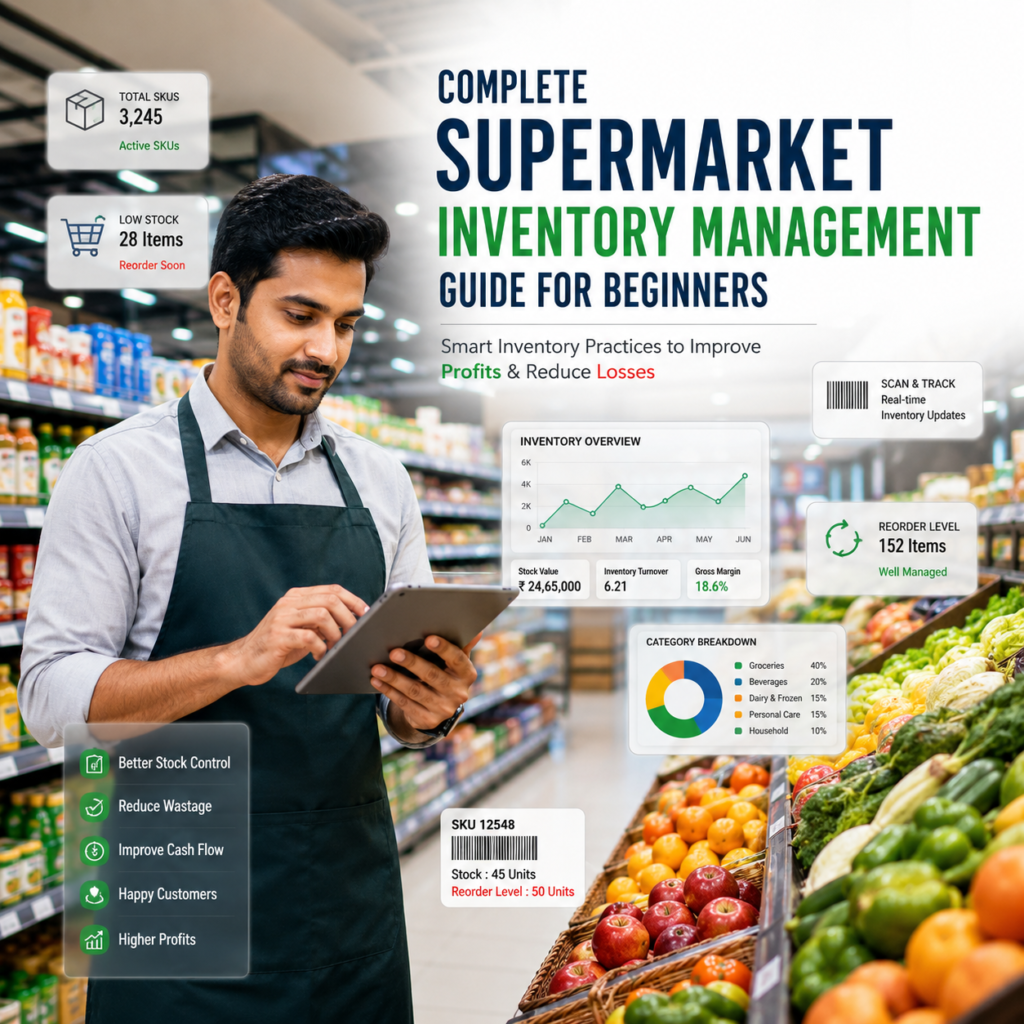
Consider a customer who walked into your grocery store intending to purchase some milk only to discover that the shelf is empty. After being disappointed by their experience, this customer will not return to shop at your store. Now think about all the unsold product you have in a back room about to expire; not only have you locked up your cash flow by having too much expired product, but these unsold items also represent a loss. Therefore, you see that Supermarket inventory management is one of the most important things when running a successful retail operation.
Whether you own your own grocery store, manage your own supermarket, or have aspirations of starting your own grocery store business, if you fully understand how your inventory works, you will separate yourself from a profitable vs a frustrating experience.
By reading through this inventory management guide, you will learn what supermarket inventory management is all about, why it is so important, what components are involved, how you can easily implement some basic inventory management techniques, some common mistakes that most people make, and how technology can help make the entire process easier for you.
What Is Supermarket Inventory Management?
Supermarkets need to manage their inventories to track and control the products they order, receive, store, and restock to maintain a good balance between what is available to customers and what they have invested in inventory.
While many retail stores do not carry as many different products as supermarkets do and carry both perishable items (like produce and milk) and non-perishable items (like packaged foods, toilet paper), each item will take a different amount of time to sell (some items may take 24 hours to sell; others may take a months to a years to sell) and will have a different shelf life (some items may expire within a few days; others may expire more than a year after they are purchased).
If properly managed, a supermarket’s inventory will allow the business to have enough products so that when customers come to the store, they will be able to find the items they want and also allow the business to have limited amounts of excess inventory and improve operational efficiencies.
If done correctly, the following will positively impact a supermarket’s business:
- Customer satisfaction
- Profit margins
- Cash flow
- Operational efficiencies
- Supplier relationships
- Brand reputation
Simply put, inventory is not just product on a shelf; it is also the investment in your business and the commitment to your customers to provide the products they are looking to buy, and an indication of your company’s ability to operate profitably.
Why Inventory Management Matters in Supermarkets?
When it comes to grocery stores, managing inventory is much more than just counting how much product you have; it affects virtually all aspects of grocery store operations.
One benefit of managing grocery store inventory is preventing stockouts. Customers want to have convenience; when a frequently purchased product is out of stock, they lose faith in that grocery store, and many will turn to competitors.
Another issue with grocery store inventory management is caused by overstocking. A grocery store that has an excess of inventory has money tied up in that inventory, which could be used elsewhere, and has higher storage costs. In grocery stores that have many perishable products, overstocking frequently results in spoilage and waste.
Eliminating waste is another benefit of inventory management at grocery stores. Grocery store inventory management is essential; it requires understanding the expiration date of products, consumers’ purchasing patterns for various products, and using proper stock rotation. Even slight improvements in these three areas can drastically affect the grocery store’s profitability.
Having good inventory control will also help improve cash flow. When grocery stores don’t lock all their money in unsold products, they can improve their working capital and make better purchasing decisions.
Organizing shelves and keeping them stocked improves customer experiences. Customers like finding things quickly, which increases repeat customers and loyalty.
Implementing efficient inventory control in grocery stores will also make store operations more efficient. The employees will spend less time looking for products and placing emergency orders and more time serving customers.
Key Components of Supermarket Inventory Management
To operate efficiently, supermarkets must have many components interconnected as part of their overall inventory system.
Stock Monitoring
The first component is tracking inventory levels of stock on hand. Supermarkets need to know how much of each product they have available for sale; how many remain in stock, and their exact location in the store.
Without having an accurate count of what products are in inventory, supermarkets risk either ordering too much inventory or not enough.
Forecasting Demand
Demand forecasting uses data on historical sales to predict future demand based on seasonal buying patterns, specific promotions being run, and the buying habits of consumers in the neighbourhood.
For instance, during the summer months, cold beverages often sell more than during any other time of year. Similarly, during the winter months, holidays often create an increase in purchasing packaged foods as well as gift items.
Accurate forecasting allows supermarkets to plan their future inventory needs proactively rather than reactively.
Reordering Processes
Reordering processes help ensure that products are ordered before they are completely out of stock. Establishing reorder points based on average sell-through rates and supplier lead time is important to the smooth functioning of the store.
Supplier Relationships
A strong relationship with suppliers improves a supermarket’s ability to receive inventory in a timely manner, improve negotiation terms, and have better availability of stock.
Strong relationships and good communication with suppliers can help minimise interruptions in delivery schedules and improve stock replenishment strategies.
Stock Audits
Stock audits are a method of verifying your physical stock against the stock you have recorded in your inventory system.
Stock audits can help identify discrepancies in your inventory due to theft, administrative error, product damaged in the store or on its way to the store, or inventory being recorded incorrectly when received into inventory.
Managing Shelf Space
The placement of products on shelves influences how much customers purchase.
Products that are frequently mis-sold should remain available to consumers while shelf space is allocated based upon customer desire or the profitability of an item.
Monitoring Expiration Dates
How To Manage Perishable Products Effectively.
The warehousing of perishable products requires special consideration.
By using the First Expired, First Out (FEFO) system, perishable goods are sold in the order in which they were received. This is beneficial because it will help to reduce losses to the company and also allow you to sell your products to your customers.
Step-by-Step Guide to Supermarket Inventory Management for Beginners
New to Inventory Control? Use These Easy Steps
Many new store owners feel that controlling inventory is a difficult task. Breaking the process up into steps makes it easier to implement.
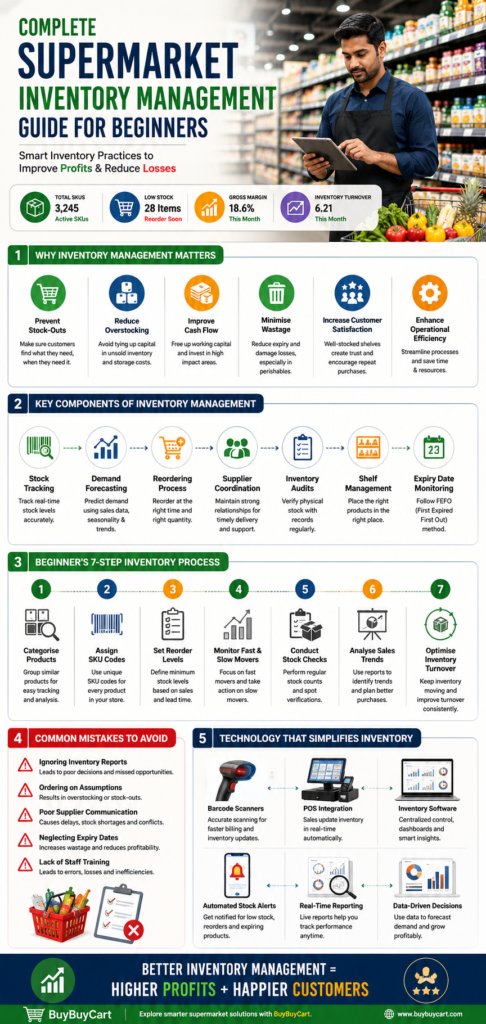
Group All of Your Products into Logical Categories: Grocery items make sense to group together, dairy products together, drinks together, household items together, frozen products together, and personal care items together. Grouping items gives you better visibility and an easier way to analyse your items.
Create an SKU Code for All Your Products: This is the unique number assigned to your products for tracking purposes, as well as to eliminate confusion about the many products that are similar in nature.
Set Reorder Levels for All of Your SKU Codes: Utilising the average daily sales and delivery time frames from your supplier will help establish the reorder threshold for each SKU code and will help eliminate the possibility of running out of stock unexpectedly.
Re-evaluate Your Inventory Regularly: Fast-moving products require a more frequent review than slow-moving products, since the fast-moving products may need to be reordered quickly, while slow-moving products may need to be promoted, reconsidered for future purchases, or eliminated from the inventory altogether.
Don’t Rely on Computer Inventory Reports for Monthly Physical Counts: Each week, perform a cycle count on specific categories and perform complete physical counts of your inventory each month to verify the accuracy of the reports.
Analyse Your Sales Data Regularly: Weekly and monthly reports will help you determine what products are becoming more popular with your customers, what products might sell better depending on the time of the year, and what products are losing popularity with your customers.
Optimising Inventory Turnover
Inventory turnover is the measure of how often a company’s inventory stock level is replenished by sales or other means; therefore, high rates of inventory turnover should be viewed as strong indicators of both healthy stock movement and good capital use.
To increase inventory turnover:
- Establish priorities for buying higher-demand items;
- Limit buying excess merchandise;
- Create sales promotions for slow-moving items; and
- Regularly review your purchasing practices.
The goal of increasing inventory turnover should not only be to sell through your customer base quickly but also to achieve an optimum balance of product availability and operational efficiency.
Also Read: How to Increase Supermarket Sales Without Increasing Prices
Common Inventory Management Mistakes Beginners Should Avoid
Avoid These Common Mistakes When Managing Your Inventory. Inventory management issues arise from preventable errors.
Some of the most common ways to avoid making mistakes include:
- Ignoring your inventory performance reports.
- Ordering products based on your own assumptions
- Poor communication with your supplier.
- Never checking how long items in your inventory have until expiration.
- Not properly training your staff.
These reports can provide valuable information about how your inventory is performing and identify trends that can ultimately help you make your purchasing decisions more effectively (and allocate your stocks more appropriately).
If your ordering process is based on instinct instead of analysing data, you’ll run into an excess amount of inventory as well as possibly not having enough. Use your historic sales trends as a reference for what to order. By not communicating well with your supplier, you may not receive deliveries in time and miss out on possible shortages (wildcard).
Not checking the expiration dates of perishable items in your inventory will result in having impractical waste and a negative impact on your profit. The staff needs to routinely check perishable inventory items.
If you don’t train your employees, you aren’t utilising a good supermarket inventory system (poor training = poor workers). Employees receiving products, stocking products, and inventory auditors must learn the processes defined by your company’s standard operating procedures.
How Technology Simplifies Supermarket Inventory Management
The way supermarkets manage their inventory has changed thanks to technology:
Using barcode scanning, you can eliminate manual errors when selling or updating stock levels. Each time an item is scanned, it updates the inventory in real-time.
By integrating POS systems into your inventory management, all sales activity is automatically updated with your inventory records, saving time as stock levels automatically update once a sale occurs.
Inventory management software provides you with easy-to-view dashboards showing current inventory levels; what you sell most often; when you are running low on stock; and suggestions for purchasing more of that item.
Automated restock notifications notify retailers when they reach a certain quantity threshold, thus reducing reliance on manual inventory tracking.
Real-time reporting gives managers an excellent view of inventory turnover. They will also have insight into the performance of each category and how well suppliers are performing.
Smaller supermarkets can use data to make decisions like larger supermarkets, allowing them to improve their ability to forecast and operate in a disciplined manner.
Technology doesn’t replace the intuition of a merchant but instead gives the merchant the ability to make faster, more intelligent decisions by providing all of the information required to do so.
Thinking of Starting Your Own Supermarket?
Once you begin building your own supermarket, inventory management becomes critical.
Many new retailers have the desire to open but don’t usually have much experience in procurement systems, inventory management, working with vendors and basic operational processes. It’s important to take advantage of having professionals continuing to help support you while eliminating mistakes that could be an expensive process.
Whether you have everything you need to launch your supermarket with professional guidance, proven systems, and support from beginning through end, look at the franchise opportunities available through the BuyBuyCart Franchise Page and find out how to become a franchise partner with BuyBuyCart.
You can build a successful supermarket by making sure you have more than just your location and your merchandise on the shelves. You’ll need systems, discipline and the ability to continue improving your business.
When you have the right support structure in place, you will greatly improve your opportunity for long-term success.
Conclusion
Professional Management of Grocery Store Inventory is not a ‘one-time’ fix, but rather a process that encompasses the creation of good habits, using accurate information, knowing customers’ needs, and making rational choices.
Whether you seek to eliminate out-of-stock issues or decrease the amount of wasted food, maximise available cash flow or improve customer experience, you will find that good grocery store inventory management will impact every aspect of your grocery store’s success.
New stores that place a strong emphasis on monitoring inventory and forecasting demand, coordinating with suppliers and performing regular audits will ensure their long-term viability.
By implementing these procedures on a daily basis, even small enhancements will lead to improved operational performance, increased profits, and establish a grocery store shopping experience that customers trust and appreciate.
When you think of the grocery inventory in your grocery store, think beyond just shelved items. Grocery inventory can be an extremely powerful tool for your grocery store’s long-term success!
Frequently Asked Questions (FAQs)
Most Commonly Asked Questions (FAQs)
- What is supermarket inventory management?
Inventory management in the supermarket is how stores keep track of how much has been purchased and how much they have in stock, and will reorder as necessary to maintain their desired level of inventory while also reducing the losses on products and increasing their profit.
- Why is supermarkets’ inventory management necessary?
Inventory management helps the supermarket with the prevention of stock-outs, prevention of overstocking, management of cash flow, decrease in waste, and better customer satisfaction.
- How often should inventory audits be conducted by supermarkets?
Weekly cycle counts will be done based on the category of the product, while a full inventory audit may be done once a month to a quarter, depending on the time frame of the audit.
- What does inventory turnover mean in the supermarket?
Inventory turnover is the number of times the store sold and re-stocked its inventory over a certain time period to reflect how efficiently the store is using its inventory.
- What tools and technology can supermarkets use to help with inventory management?
Barcodes, POS system integration, inventory software, automatic alerts, and real-time reporting help to streamline the supervision of supermarket inventory.