
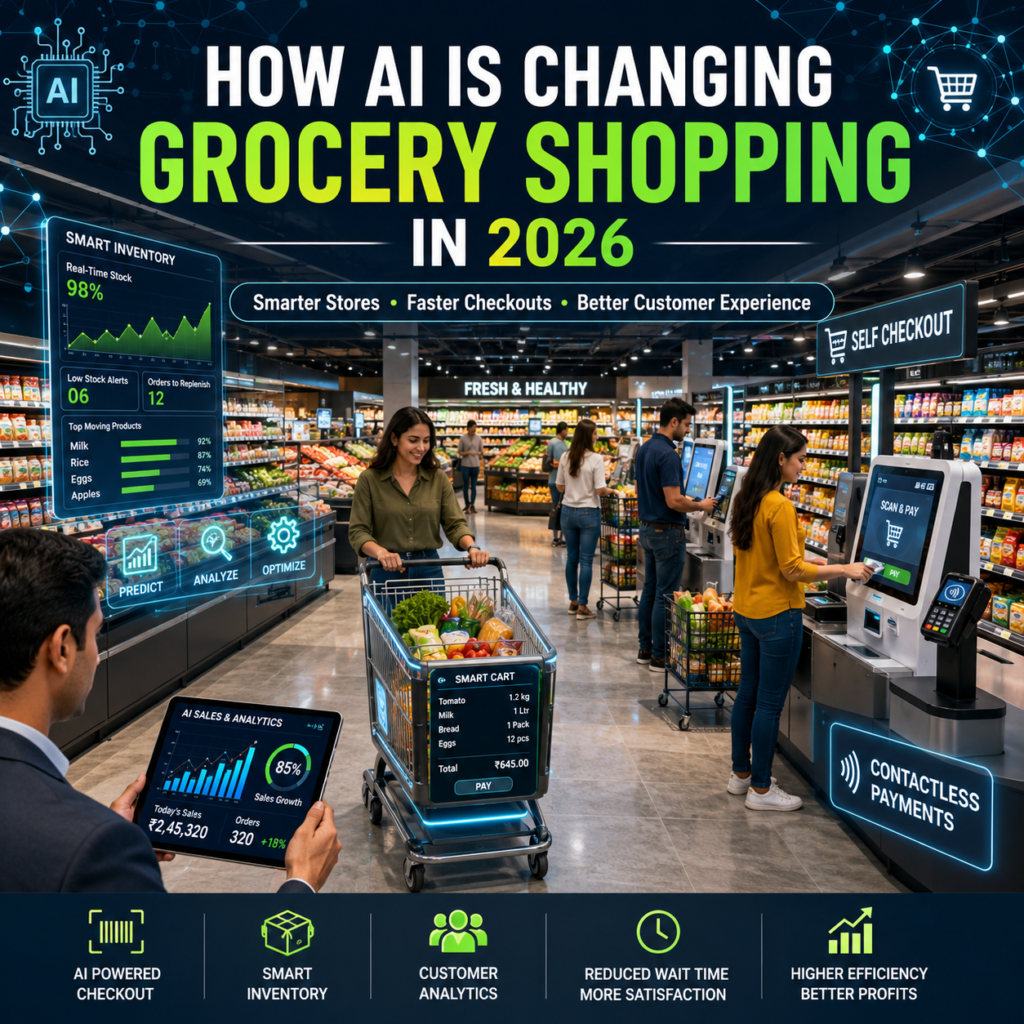
AI in Grocery Retail: A while back, people used to go grocery shopping at their local store, pick what they needed, join a very long queue, check out, and go home—all within a reasonably short amount of time. In this day and age, when shoppers go grocery shopping, customer expectations are different.
Shoppers expect to get through checkout faster, get personalised offers, and have their product availability requirements met accurately, as well as have an easy digital payment transaction, to give them a hassle-free experience when they go to purchase groceries. If it takes a customer 15 minutes to wait in line at a store to pay for groceries, customers are more likely to choose to shop at another store the next time they need groceries.
Because of these changes, grocery providers are looking to technology to help them, and one of the tech-related innovations that is driving the transformation of grocery shopping is grocery retailers’ use of AI.
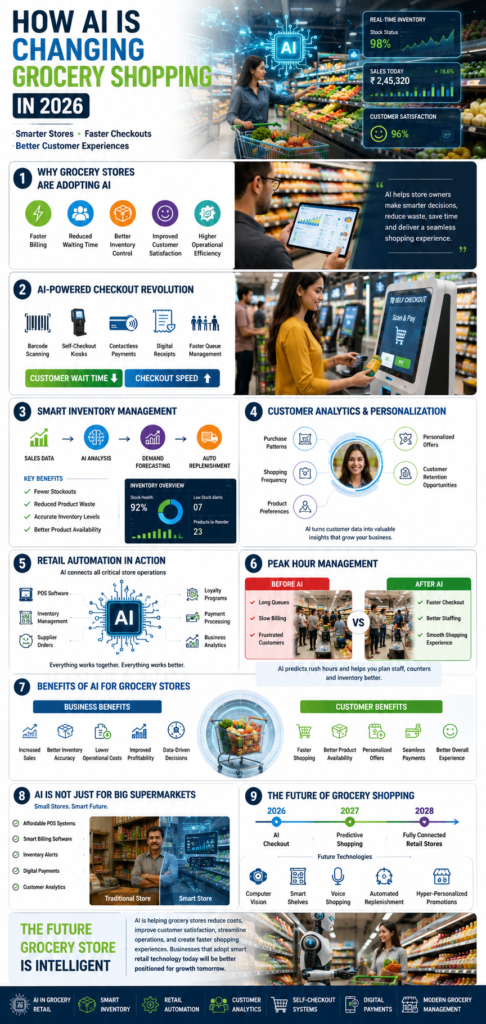
AI is being used for many grocery retail operations and processes such as store inventory management (with the help of computers), office and store automation processes, application of customer analytics, and grocery retailers using machine learning or AI for customer checkout (when customers pay for the groceries that they purchased).
Regardless of whether you operate a kirana store, run a grocery supermarket, or you’re looking to open a grocery franchise in the future, you must understand how AI is changing grocery shopping for consumers by 2026 to compete effectively in the rapidly changing retail grocery marketplace.
What is AI in Grocery Retail?
AI in Grocery Retail refers to the use of artificial intelligence technologies to improve grocery store operations, inventory management, customer analytics, demand forecasting, and checkout efficiency.
The grocery industry uses AI to assist retailers with:
- Predicting demand from customers
- Reducing instances of out-of-stock items
- Improving inventory management
- Speeding up the time required to process sales at the register
- Analysing how customers buy items
- Automating repetitive tasks
- Enhancing the overall customer experience
Grocery retailers are now relying much less on manual processes to make smarter, data-based decisions about their customers in real time.
Why Are Grocery Retailers Investing in AI in Grocery Retail Solutions in 2026?
Within the grocery retailer space, the average profit margin is such that small inefficiencies have large impacts on the overall level of profitability.
As an example, a worker who frequents a grocery store between their work hours visits the store after work to grab a few items, makes their selections quickly, but has to wait for several minutes in a checkout line because of the length of that line. In that situation, their frustration levels have built up.
As a result, that worker now thinks to themselves: “I like the groceries I purchased, but shopping there just took too long.”
That one experience might make that worker avoid shopping at that grocery retailer in the future.
Today’s grocery retailers see the connection between how convenient customer visits to their store are and the degree of customer retention the retailer experiences.
AI can also assist grocery retailers with these operational issues by enhancing overall speed, accuracy, and efficient operations within stores.
Reduces Waiting with AI-Powered Checkout Systems
Checkout counters are seeing one of the largest transformations within grocery shopping.
Why You Should Care About Your Checkout Experience
The last touchpoint that a customer has with your store is at checkout, and the experience during this last interaction is one way in which a customer determines their perception of your business. If your customer has a poor billing experience and is waiting for long periods of time, this can negatively impact their impression of all the great products and pricing that they’ve purchased.
Customers typically expect:
- Quick and Convenient Billing
- Correct Pricing
- Payment Options
- Short Wait Times
AI-Powered Checkout Systems will support retailers in meeting these customer expectations.
How Checkout AI Works
Modern Checkout AI systems do the following:
- Instantly Identify Products
- Identify Pricing Errors
- Speed Up Barcode Scanning
- Support Self-Checkout Stations
- Minimise Errors in Manual Billings
As a result, stores can service more customers during high traffic times and not significantly increase their labour costs.
How AI in Grocery Retail Improves Inventory Management and Prevents Lost Sales
Inventory management has always been a challenge for grocery retailers.
One problem that occurs is when a customer specifically goes to your store for a product and finds that it is sold out. There is a tendency that, if this customer has to deal with multiple stock-outs, they would stop coming in to your store altogether.
How AI Solves Inventory Challenges in Grocery Retail
Smart AI inventory systems analyse:
Previous Sales Trends by Time of Year
Averages – How Much a Product Sells
When to Buy Festive Items (i.e. Easter Products)
Purchasing Trends Due to Weather
How Quick a Product Moves (i.e. Week-End vs Week Day)
Example
If a grocery store observes during every summer weekend an increase in the number of cold drinks sold.
A normal way to forecast purchasing is by using historical data, which might miss this kind of purchasing behaviour.
AI inventory management can automatically identify these trends, thereby ensuring that there will be enough stock available to satisfy demand for cold drinks.
When you have more products available to sell, your sales and satisfaction are likely to both increase.
Customer Analytics: The Growing Role of AI in Grocery Retail
Every transaction tells a story.
AI-powered Customer Analytics allow retailers to understand:
- What items go together when customers shop
- How often customers visit the store
- Which promotions produce the most revenue
- What factors contribute to a customer making additional purchases after their first visit
Example of how this type of data can help a supermarket make better business decisions.
If a supermarket learns that customers who purchase breakfast cereal often buy milk in the same transaction, they may create targeted promotions or reorganise their products to enhance total basket size.
Customer analytics can provide retailers with insights so they don’t have to rely on guesswork when determining which products to stock and how to price them.
The Rise of Automation in the Retail Sector
In 2026, retail automation will be a growing competitive edge in the industry.
Today, the retail industry makes up approximately $5.1 trillion in revenue, and many grocery store owners can spend countless hours on repetitive tasks. Some frequent tasks that nearly all owners have to perform include:
Counting inventory
Managing orders
Reconciliation of billing
Updating inventory
Through automation using Artificial Intelligence (AI), routine manual tasks can be accomplished faster and with increased accuracy.
With these types of systems, grocery store owners can spend more time on customer engagement and growing their business.
Self-Checkout Systems
What Are Self-Checkout Systems?
Self-Checkout Systems allow customers to scan items and pay for their purchases without the assistance of a checkout employee. They can be found in more than half of all grocery stores today and are becoming more frequently seen in other non-grocery stores.
Self-checkouts provide customers with a number of advantages:
- Quick shopping experience
- Less waiting time
- Convenience
- For Customers, self-checkout provides:
For Retailers, self-checkout leads to:
- Greater efficiency in queue management
- Greater operational efficiency
- Reduced congestion in the checkout area
Consumer use of self-service technologies is increasing in India and other countries as the use of AI technology improves in grocery and retail stores around the world, accelerating the acceptance of self-service technologies in the market.
Mistakes Often Made at Grocery Store Checkouts
Grocery stores continue to encounter avoidable checkout errors despite having access to new technology.
- Slower Billing System
Older billing software means that the average transaction takes longer to process, frustrating customers.
- Missing Barcodes
If a product doesn’t have a proper barcode or label, the cashier must enter items manually, taking longer than expected and increasing the chance of an error.
- Fewer Payment Methods
Customers are using UPI/digital wallets instead of cash because of their availability and convenience. It is common for customers to use cards and contactless payment methods in addition to cash.
- Poor Planning for Rush Hours
Many times there are long lines at checkout because there aren’t enough staff working at the counter during busy hours.
- Lack of Training for Employees
No matter how sophisticated the technology used at checkout, if employees are not trained well how to use that technology, it will not be effective.
Grocery store owners should regularly evaluate their checkout processes to identify ways they can improve them.
How a Better Checkout System Will Increase Customer Loyalty
Many retailers invest heavily in acquiring new customers, but keeping customers is typically more profitable.
The checkout process can help shape a customer’s experience with your store.
Customers are more likely to return to a store where the checkout process is efficient and easy.
A customer feels that a store is easy to do business with if the store offers:
- Quick checkout
- Correct pricing
- Good checkout staff
- Several payment methods available
- Consistent stock on hand
AI-powered checkout systems can help achieve these goals.
The better the customer experience over time, creates loyal customers and increase a customer’s lifetime value.
AI-Based Peak Hour Traffic Control
Traffic control during peak hours is one of the most difficult operational challenges in the grocery industry.
How AI Can Help Solve the Problem
AI systems can assess:
Traffic trends (number of customers in a store)
Historical sales trends
Checkout line wait-time trends
AI software can suggest:
Staffing adjustments
Best checkout lane assignment
Best placement of queue management solutions
These recommendations will help stores provide customer service more effectively during evenings, weekends and holidays.
AI, POS Software and Overall Store Efficiency
Modern POS Software is becoming a central operating system in grocery stores.
Advanced POS systems integrate:
Billing
Inventory management
Customer analytics
Loyalty programs
Digital payment processing
With AI, these systems provide decision support to improve the overall efficiency of the store.
With this data, store owners have greater insight into trends in sales, inventory, and customer preferences.
How Modern Franchises Use AI in Grocery Retail
Modern grocery franchise brands have been making significant investments in technology.
They offer:
- A standardised and uniform POS system
- Inventory synchronization
- AI-powered analytics
- Faster structuring for checkout operations
- Centralised operational support
This technology works to keep franchise partners consistent across each location while amplifying customer satisfaction.
For a good entrepreneur looking for grocery business opportunities, understanding and assessing franchisees’ technology infrastructure is as important as checking the brand establishment.
Before entering into business with any grocery franchise, it is necessary that one carefully review the operations support, the retail technology capabilities, as well as the training systems and opportunities for long-term growth. Hence, many prospective business owners explore the “Partner With Us” section on a brand’s site to glean some insight into its franchise partners’ support systems.
Final Thoughts
AI in Grocery Retail has transformed the grocery industry into a smarter, more connected, and customer-centric sector. Retailers that embrace AI-powered solutions can improve efficiency, increase profitability, and deliver exceptional shopping experiences.
Grocery retailers are using artificial intelligence to reduce operational costs and improve inventory accuracy and throughput times, while also improving customer experience.
Whether you run a small kirana (grocery store), manage multiple supermarkets, or are considering a grocery franchise opportunity, leveraging AI-based retail solutions will provide you with significant competitive advantages. In 2026, successful grocery retailers will provide customers with a superior shopping experience by being faster and easier to shop with than their competitors.
Therefore, to develop a strong and profitable grocery business in the years ahead, grocery retailers should invest in AI technology, train employees, enhance their point of sale capabilities, and create customer-friendly processes.
Frequently Asked Questions
- What is AI in Grocery Retail?
Artificial Intelligence (AI) refers to the use of AI technology to improve retail operations, inventory control, customer analysis, demand forecasting, checkout systems, and the overall shopping experience by creating a data-driven decision-making capability that reduces manual entry and operational inefficiencies.
- How does AI in Grocery Retail improve inventory management?
AI can analyse historical data and establish sales patterns based on seasons and times of year, and provide data based on the shopping history of customers to help store owners understand how to manage their future inventory supply and assist in preventing stock shortages, reducing overstock and wasted products, and maintaining a proper amount of inventory throughout the year.
- Are checkout systems powered by AI in Grocery Retail worth the investment?
Yes, AI-powered checkout solutions provide retailers with lower customer wait times, fewer errors in transaction processing, better management of customer queues, and improved customer satisfaction. Giving customers a fast checkout experience leads to improved customer retention rates and increased operational efficiencies for retail stores.
- Can AI technology be used by small grocery stores?
Yes! Many point of sale software companies now offer affordable AI features for inventory management, automatic notifications to the store owner about low inventory levels, customer analysis, and sales forecasting. Small grocery stores can benefit greatly from using AI without needing to invest heavily in technology.
- How do grocery stores utilise AI and automation in retail via franchise?
Many of today’s modern grocery franchises make use of artificial intelligence (AI) for things like synchronising their inventories, analyzing customer behaviour, optimising pricing, forecasting future sales, managing customer loyalty programs, and automating the checkout process. These different AI technologies allow the franchise owner/operator to operate more efficiently while providing customers a consistent shopping experience no matter which of the various locations they shop at.