
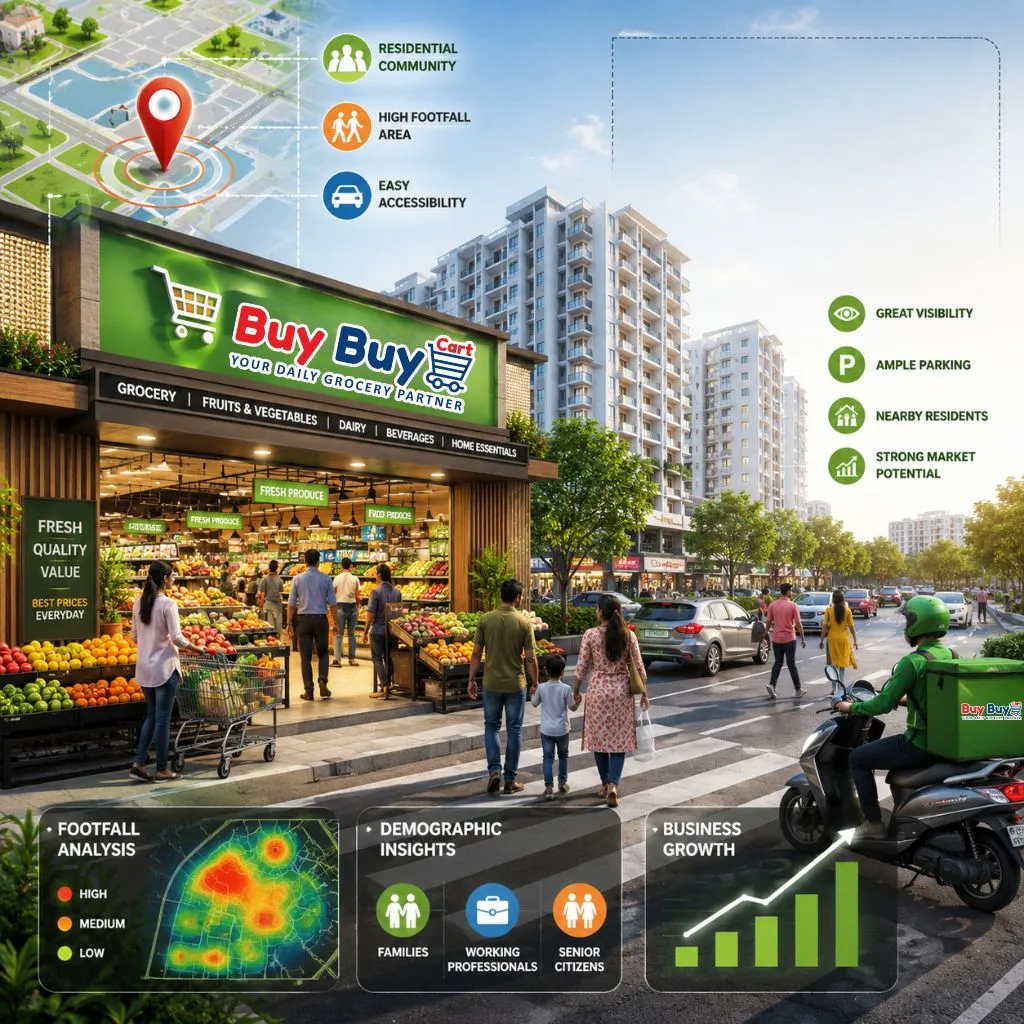
Starting a grocery store can be an exciting opportunity, but there is one decision that may determine whether or not your grocery store will be visited regularly – where to put it!
Many grocery store owners spend a lot of money on inventory, interior design, technology, and marketing, but then fail to make enough money because of their choice of location. A good grocery store location can provide you with frequent customer traffic, loyal customers, visibility, and expanded growth potential over time. On the flip side, a poor grocery store location can lead to increased operating costs and lower sales potential.
If you are considering opening a small kirana store, a neighbourhood grocery store, or a supermarket franchise outlet, you should make the best grocery store location your number one objective.
In this guide, we will look at practical tips for choosing grocery store locations from actual experiences of retailers, customer behaviours, and trends of the market.
Why Grocery Store Location Matters More Than Anything Else
The majority of customers who buy groceries are motivated by convenience; therefore, compared to businesses in which customers are willing to travel numerous miles for their product, convenience is much more important to a grocery store customer.
When customers can find a grocery store that is convenient in:
- Proximity to home
- Easy to get free parking available for simple access
- Stocked with products that they can get multiple times a week – many times daily
- Fast shopping experience – grocery shoppers like to shop in a fast manner
- Convenient for daily/weekly grocery shopping
They will oftentimes accept a slightly higher price for the products, because the store saves them time.
This is the reason that grocery retail companies spend considerable time developing their location strategy prior to opening a store.
A strong location can:
- Bring more foot traffic to the store daily
- Increase customer loyalty to return
- Decrease costs for marketing
- Allow for quicker sales growth
- Provide for longer-term profitability
Understanding Your Target Customers Before Selecting a Location
Know what kind of customers will shop at your store before starting to search for a location.
Questions to Consider:
Who will be purchasing from your Grocery Store?
Different types of customers have different preferences when it comes to shopping.
Example:
Business professionals like to be able to quickly make purchases and have digital methods available to pay for items.
Families want larger stores with more variety in the product line.
College-aged students want low prices and close locations.
Seniors like to shop where they live.
Stores located near areas primarily possessed of residential structures may outperform locations primarily positioned near business establishments when it comes to the daily purchasing of groceries.
Understanding the demographics of your target customers will guide your decisions on how you want to position the grocery store for the best overall results.
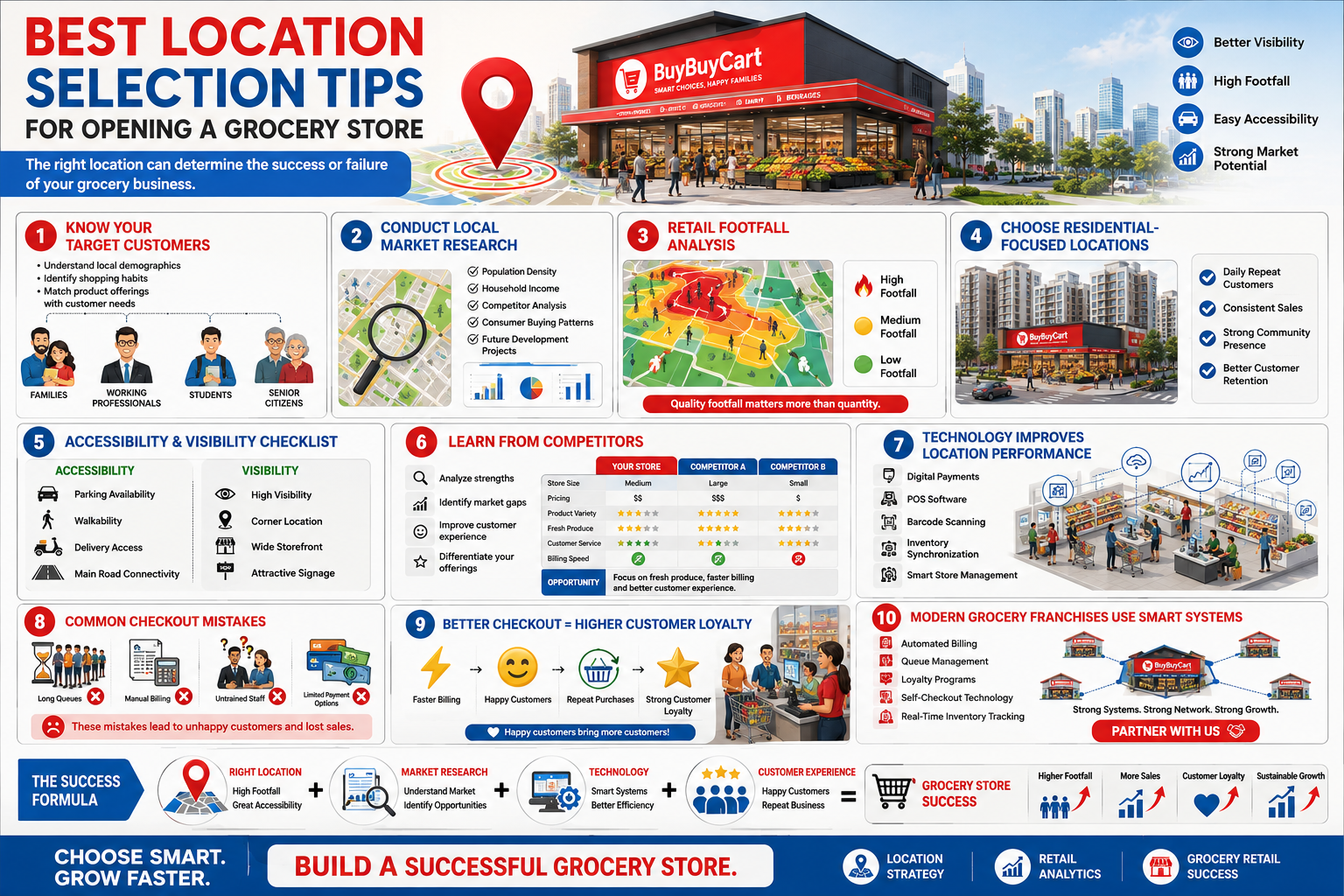
Conduct Local Market Research Before Finalising Any Property
One of the biggest mistakes new grocery entrepreneurs make is choosing their shopping location based purely on rent.
Just because a place has low rent does not mean it will be a profitable business.
What is included in local market research?
Areas to analyse:
- pop density
- household income levels
- buying patterns
- current competitors
- traffic
Spend time reviewing the area during the following times of the day:
- morning hours
- afternoon hours
- evening peak hours
- weekends
You will find consumer movement patterns that are not visible in the reports.
Also Read: How to Start a Profitable Grocery Store Business in India
Analyse Footfall Very Carefully
What is footfall analysis?
Footfall analysis measures the number of potential customers who walk past your location on any given day. A busy site will generally create a greater number of opportunities for impulse buying and re-visits.
But not all footfall is created equal.
For example, someone walking past your location by a busy bus stop will have thousands of customers a day passing through the site, but if those customers are all just commuters on their way to or from work, grocery store sales will still be limited.
On the other hand, if you are located in a residential area with only average foot traffic, you will most likely sell more groceries than you would at a bus stop because the residents will always need to buy groceries every day.
The objective is to find relevant footfall instead of just high footfall.
Choose Grocery Store Locations Near Residential Areas
Residential neighbourhoods are one of the top types of grocery locations.
Why?
Because grocery items are bought over and over again.
Typically, people will use grocery stores closest to their homes for items such as:
- Milk
- Bread
- Fresh produce
- Essentials for home
- Snacks & drinks
Grocery stores positioned near residential developments (apartments, gated communities, and residential neighbourhoods) enjoy daily consistent sales.
Many successful supermarket chains have opened grocery stores close to residential clusters, due in part to this fact.
Check Accessibility and Parking Availability
And while a grocery store may have great product offerings and low prices, shoppers will avoid a grocery store if it is not easy to get to.
Look for properties that have:
Easy Access to Roads
Shoppers should have ease of access for both entering and exiting the grocery store.
Availability of Parking
The availability even of a small number of parking stalls can have an extremely positive impact on the customer experience.
Easily Walkable
Pedestrian-friendly locations also increase the number of times a grocery store is used.
Delivery Convenience
If you provide home delivery, ease of access enhances the efficiency of your delivery personnel.
The ability for customers to access your grocery store location has a direct impact on the level of customer satisfaction and repeat patronage.
Competitor Analysis Will Help You Learn What the Market Wants
Most first-time store owners don’t want to take a location that already has existing competitors.
This is a mistake!
Studies have shown that a level of competition often translates to some level of demand.
Instead of staying away from the competition, spend time analysing their business.
You want to look closely at:
- Product mix
- Pricing
- Customer service
- Size of the store and
- Peak times for shopping
When you find competitors offering the same products as you, look for ways you can differentiate your store from the competition.
Should the competition offer limited options for fresh produce, use your store to specialise in high-quality produce.
If your competition limits the speed of their checkouts, you could attract customers with fast, efficient checkout methods.
Visibility Can Increase Walk-In Customers
A business located in a “hidden” location will have a more difficult time attracting customers regardless of how good the products being sold are.
As a general rule, the best grocery store locations are highly visible.
Here are some keys to locating your business in a high-visibility location:
- On major roads
- At a street corner
- From a street view in a shopping market
- With a large storefront presence
- With good signage options
Consumers are more likely to find and frequent a store that they see every time they drive or walk by.
An easily visible store will have less need to spend large amounts on advertising.
Future Growth Potential Matters
Most retail stores only look at current conditions.
Smart retailers will also be looking at growth in the future.
Some good examples of where to look for growth through research would be:
- Upcoming housing projects
- Infrastructure improvements
- New schools/colleges
- Plans for commercial growth
An area that has low foot traffic today may become a highly sought-after area for retail in a few years.
Finding and developing these types of locations early on will help create long-term benefits.
How Technology Influences Location Success
Today, simply having a location is not enough anymore.
A modern-day grocery store will include not only a great location but also the ability to operate efficiently by utilising technology.
Today’s common expectations of customers include:
- Quick checkouts
- Scanned barcodes
- Digital Payments
- Accurate Prices
- Stock availability
Grocery stores in great locations can quickly lose customers if they do not operate efficiently.
Technology can enhance the benefits of a great location.
People Also Ask:
What Is The Best Grocery Store Location?
The ideal grocery store location would be close to dense residential areas that have high pedestrian traffic. The store has to be easily accessible, be highly visible, and have enough parking for customers. It also should be in a location that would be suitable for everyday shopping and have the potential to grow over time.
How Important Is Foot Traffic For A Grocery Store?
Foot traffic is very important, but quality is more important than quantity. A store in a high-traffic area where consumers do not typically shop for groceries can yield lower sales results than a store that is located in an area that has a lot of local grocery shoppers.
Should I Open A Grocery Store In An Existing Market?
Yes, as long as the market has enough demand. The presence of competitors usually indicates that there is a large number of customers to serve. In order to succeed, you need to create a business that is differentiated from your competition through customer service, product selection and operational efficiencies.
How Much Local Market Research Do I Need To Do?
You should conduct market research for several weeks to identify your competitors’ demographics, purchasing habits, foot traffic and future development plans before committing to a location for your grocery store.
Does Technology Help Grocery Stores Succeed?
Certainly, using an advanced POS system, barcode scanner, inventory management system, digital payment and an efficient checkout system will help create a better overall customer experience while enhancing your store’s overall efficiency.
Final thoughts
Selecting the best location for your grocery business is critical to its success. Finding a location that is not only convenient but also accessible by customers; has good visibility; has a sufficient number of homes nearby to support demand for your products and services; and there is room for future growth potential all combine together to create a successful location.
Although selecting a successful location will help achieve success, it is up to the retailer to achieve operational excellence through the use of modern POS software technology, barcode scanning, inventory syncing, digital payments, training the employees properly, and efficient checkout processes.
You should spend some time doing local market research before making your final decision on which property to lease for your grocery store business. This research could include evaluating the local retail foot traffic; analysing competing grocery stores in your area; and determining how well customers in your area will shop at your grocery store based on their behaviour patterns.
The best grocery stores do not necessarily have to be the largest grocery stores; rather, they are the grocery stores that thoroughly understand the customer demographics (i.e., where the customers live); how they shop; and what situations create a hassle-free shopping experience for them.
Consequently, by making decisions regarding the choice of grocery store location based on data, customer needs, and long-term strategy, your grocery business will have a solid foundation on which to grow sustainably over time.
Pingback: Grocery Store Location: 7 Factors to Consider