
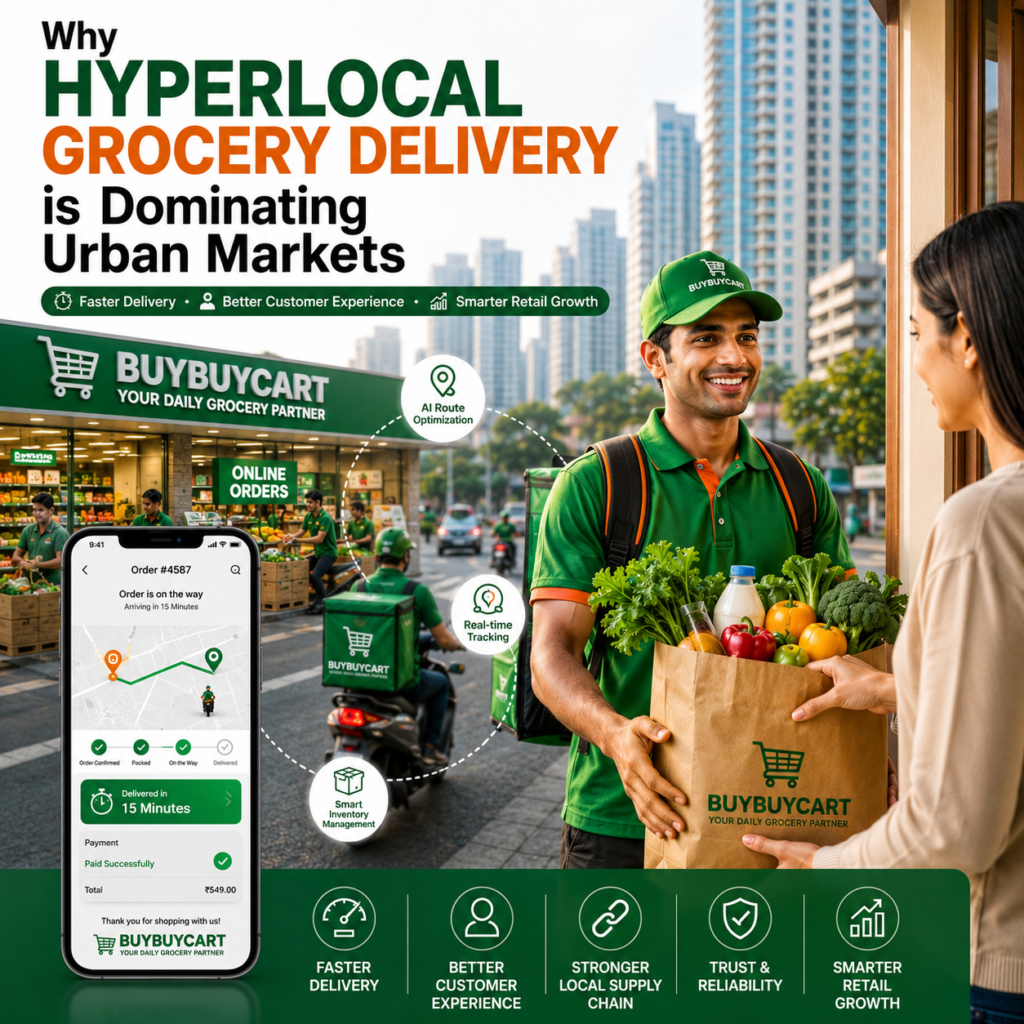
The way people buy things has changed in urban areas. For example, convenience and speed now drive most people’s purchasing choices, particularly when shoppers are buying essential items daily. Therefore, grocery delivery services have become one of the fastest-growing types of retail business today.
People do not want to take hours driving to a grocery store, spend time in long lines at checkout, or lug heavy grocery bags home. Instead, they want to order items from a grocery store via smartphone, and have their order delivered within minutes or hours.
The change in shoppers’ habits has led to rapid growth of hyperlocal grocery delivery models in cities around the world. Supermarkets, retail entrepreneurs, franchise seekers, and investors must know about this trend in order to compete in the modern urban grocery marketplace of today.
Defining the Hyperlocal Grocery Delivery
When we speak of hyperlocal grocery delivery, we are referring to a retail practice of delivering groceries to customers that is completed using grocery stores or supermarkets located near the customer’s home or an area close by, rather than being done from a large warehouse many miles away from the customer. In other words, hyperlocal grocery delivery is based on how close the grocery is in relation to the customer and how quickly the grocery can be delivered to the customer.
In other types of grocery e-commerce, customers can sometimes wait several days before receiving their groceries. With hyperlocal grocery delivery, this wait period is dramatically reduced, allowing some customers to receive their groceries in just minutes or a few short hours.
The success of this business model results from the ability to use local inventory and to optimize route planning using local inventory based on providing accurate real-time product availability to the customer. Because urban populations continue to grow, the expanding number of customers living in a metro area means that the demand for convenience continues to grow, and therefore, hyperlocal grocery delivery is becoming a preferred way to shop.
The Rise of Urban Convenience Culture
Today, urban environments that prioritize acceleration define modern cities. Many maintain fast-paced lifestyles, juggling multiple careers, families, and fun social schedules. As a result, many people are left with limited opportunities for time-consuming shopping tasks.
Several elements have combined to promote increased demand for convenience-oriented retail:
- Widespread adoption of smartphones.
- Widespread acceptance of electronically-based payment options.
- Increased utilization of mobile applications.
- The desire for instant services.
- The desire to shop using a less-physical means.
Modern-day consumers want the same level of convenience when shopping for groceries as when they do for ordering food, rides, or watching movies online. This level of accessibility has transitioned grocery delivery services away from being a luxury to an everyday need.
Furthermore, younger generations view time savings as more important than traditional shopping experiences. Therefore, there is now a substantial competitive advantage for retailers that can provide products to customers quickly and efficiently.
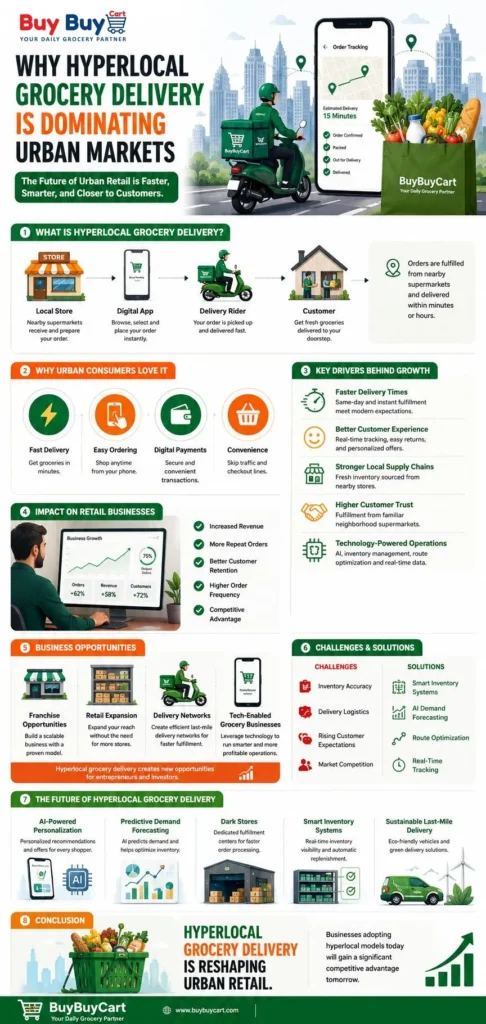
Key Reasons Hyperlocal Grocery Delivery is Winning Urban Markets
Rapid Delivery Times
Speed appears to be the most prominent benefit of hyper-local grocery delivery.
Today’s market presents consumers with many choices and price differences, allowing them to buy and decide with whom to buy based on how fast they can get an item. For example, someone forgot to pick up some milk, needs supplies at home for dinner, or urgently needs food… in many cases, because they have speedy delivery, an immediate need is fulfilled.
Because delivery service/fulfillment centers are situated in close proximity to consumers, delivery routes are shorter and logistics efficiency improves. Thus, businesses deliver on the same day, in one hour, and in 15 minutes (in some big cities); same-day delivery is possible.
By providing immediate solutions to people, consumers make repeat purchases and develop greater loyalty as a consumer base.
Superior Customer Experience
One of the most critical factors influencing whether customers will return to a platform is the customer experience.
The customer journey is improved by utilizing hyperlocal grocery delivery through:
- Convenient Ordering via Mobile Applications
- Real-Time Order Tracking
- Flexible Delivery Options
- Convenience of Payment Options
- Quickly Resolve Customer Service Issues
Transparency and control throughout the entire process are hugely valuable to customers. Features like live tracking and instant notifications provide reassurance and are key components of overall satisfaction.
In addition, personalized recommendations and special promotions provide a more enjoyable shopping experience for customers.
Local Supply Chain Strengthening
Hyperlocal grocery delivery offers one thing to businesses: The ability to create stronger local supply chains.
By sourcing local products from nearby stores and suppliers, companies can reduce transportation costs, increase freshness, and decrease delivery delays. Also, being able to source products locally gives retailers quicker access to changing customer needs.
The ability to source locally leads to shorter supply chains, which typically result in the following benefits:
- Lower operating costs
- Better inventory turns
- Reduced spoilage of products
- Increased access to fresh produce
Both businesses and consumers benefit from these efficiencies.
Greater Trust in Local Businesses
Consumers generally trust businesses they see in their hometowns.
When an order is fulfilled by supermarkets or stores in the customer’s community, the customer can have a higher level of confidence in quality and reliability due to familiarity. Trust built on familiarity is especially applicable to fresh foods, dairy products, fruits, vegetables, and everyday household items.
Additionally, by fulfilling locally, retailers build and maintain stronger ties with their local communities, thus creating a unique competitive advantage in today’s increasingly competitive online marketplace.
Tech-Based Business Operations
The success of hyperlocal grocery delivery systems relies heavily on their underlying technology.
Advanced grocery retail technology platforms help retailers operate more efficiently, improve inventory management, and give customers a better experience.
The following technologies are key drivers of growth for retailers:
- Mobile commerce apps
- Artificial intelligence (AI) has helped companies with their recommendation engine
- Route optimization software
- Real-time inventory tracking
- Automated order management systems
- Predictive analytics
Each of these tools enables retailers to operate more efficiently and at lower cost and to reduce delivery times.
Also Read: Top Grocery Store Technology Trends Every Retailer Should Know
Impact on Supermarkets and Retail Businesses
The rise of hyperlocal grocery delivery services is resulting in significant new opportunities for supermarkets and retail businesses.
Historically, retailers had greatly depended upon foot traffic as their primary means of generating revenue; however, in the current era of increased reliance upon digital channels, many retailers are now reaching out to customers who are not physically visiting their stores. This increased reach provides an opportunity for retailers to increase sales volumes and grow customer retention rates.
Hyperlocal retail models encourage customers to make additional purchases, as they have the ability to order smaller quantities as needed, typically leading to greater frequency of ordering than traditional weekly shopping trips.
Other potential advantages of hyperlocal grocery delivery services include:
- Higher lifetime value per customer
- Enhanced brand awareness/visibility
- Improved operational efficiencies
- Better demand forecasting
- Increased competitiveness with large retailers
Adopting supermarket delivery services will create a more level competitive environment for independent retailers, enabling them to better compete against large national brand competitors.
Hyperlocal Grocery Delivery Creates Business Opportunities
Urban grocery markets are experiencing an unprecedented growth rate, creating a multitude of new business opportunities for entrepreneurs, venture capitalists, and retailers alike.
Entrepreneurs Creating Local Businesses
The explosion in demand for grocery delivery has created a plethora of opportunities for entrepreneurs to create their own, technologically-enabled grocery businesses to serve a defined neighborhood and/or community.
Utilizing appropriate technology infrastructure and operational strategies allows local businesses to develop profitable and scalable business models.
Franchise Opportunities on the Rise
With growth in demand comes increasing interest in grocery franchise opportunities. Franchise opportunities provide entrepreneurs with proven systems, established brand identity, operational support, and access to technology.
This reduces business risk and ramps up growth opportunities.
Retail Opportunities in Expansion
Using hyperlocal delivery services allows existing supermarkets to expand their customer base by reaching customers without ever needing to open additional brick-and-mortar locations. Retailers can use digital channels to generate revenue from customers who would never visit their brick-and-mortar store.
Technology Enables Grocery Retailers to Launch Businesses
Many retailers, due to advances in technology, have dramatically reduced their entry barriers to opening a grocery retail business. Cloud-based inventory management systems, mobile ordering applications, and delivery management tools have allowed many retailers to launch and grow their grocery retail business in record time.
The Partner With Us page of BuyBuyCart Franchise features Partnership Opportunities for Businesses and Entrepreneurs interested in the quickly growing Hyperlocal Grocery Ecosystem!
Challenges in Hyperlocal Grocery Delivery
To maintain customer satisfaction, accurate inventory information is necessary; therefore, if inventory levels in-store do not match what customers see online, it may result in low levels of customer satisfaction.
Also, during high-demand periods, the logistics surrounding deliveries can become highly complicated; therefore, if a delivery is late, it may negatively affect the customer’s trust and their desire to continue to use your service.
Some other common Hyperlocal Grocery Delivery challenges include:
- Managing delivery costs
- Meeting customers’ increasing demands
- Handling order surges
- Maintaining product freshness
- Competing with other retailers in overcrowded retail markets
The best solution for overcoming these challenges is to invest in technology, train employees properly, implement inventory management automation, and make business decisions using data.
To help improve performance metrics, companies should provide accurate inventory management tools and implement route optimization systems that provide adequate delivery routes.
Hyperlocal Grocery Delivery’s Future
Technology is projected to play an increasing role in grocery delivery in the future.
Retailers will continue to use artificial intelligence (AI) for personalizing shopping experiences, forecasting demand, managing inventory levels, and many other areas of their business.
Some of the trends that will continue to shape the future are as follows:
Hyperpersonalization using AI – AI technologies will help retailers offer more personalized product recommendations, promotions, and shopping experiences.
Dark Stores – These facilities will be used exclusively for fulfilling online orders, improving delivery timeframes and reducing operational costs associated with deliveries.
Intelligent Inventory Controls – Intelligent inventory management will allow retailers to monitor inventory in real-time, making it easier to maintain high levels of accuracy and minimizing stock outages while increasing customer satisfaction levels.
Predictive Demand Projections – Retailers will have access to predictive analytics tools that will allow them to predict the demand fluctuations in the marketplace and adjust their inventory levels accordingly.
Sustainable Last-Mile Delivery – Efforts will be made to decrease the environmental impact of the delivery process through the use of electric vehicles, bicycles, and eco-friendly packaging solutions.
As cities continue to grow in population density, these advancements will make hyperlocal grocery delivery a more integral part of the retail landscape.
Conclusion
With growing awareness about grocery delivery, there is a larger tendency toward a shift in consumer behavior, focusing on convenience. Urban shoppers are reinforcing an expectation of quick, reliable, and seamless access to daily essentials, with hyperlocal delivery models working efficiently to meet them.
Hyper-Local Grocery delivery can lead to faster fulfillment and building better relationships with your customers, tapping into supply efficiency for retailers, and creating new opportunities for entrepreneurs.
However, a clear opportunity for supermarket owners, entrepreneurial-minded investors, and franchise seekers. Those businesses that will embrace hyper-local strategies today are better poised to compete, grow, and prosper in a rapidly evolving retail landscape.
If you are exploring opportunities in the modern grocery sector, it would be useful to note the grocery business solutions and partnership opportunities that BuyBuyCart offers to help you shape the future of retail.
Frequently Asked Questions (FAQs)
What does Hyperlocal Grocery Delivery mean?
Hyperlocal Grocery Delivery means delivering groceries from local shops or warehouses to customers within a short distance of delivery, so that they can have their groceries delivered quickly.
What has caused the rapid growth of grocery delivery in cities?
With busy lifestyles, the increase in smartphone ownership, more people using digital payments, and a high demand for convenience, grocery delivery is becoming the preferred way for urban consumers to shop.
How does Hyperlocal Grocery Delivery Help Supermarkets?
Hyperlocal Grocery Delivery helps supermarkets to increase their revenue, maintain their customers, increase their reach, and more directly compete with bigger retailers.
What technologies enable Hyperlocal Grocery Delivery?
Mobile applications, artificial intelligence (AI), data and analytics, systems to manage inventory, software for optimizing delivery routes, systems for tracking stock in real time.
Are there business opportunities in grocery delivery?
Yes. Entrepreneurs can take advantage of several business opportunities in grocery delivery, including opening a grocery franchise, expanding retail stores, and starting a new business using technology-based grocery delivery solutions.