

The retail sector in India is booming, and this is giving rise to new business opportunities within the supermarket industry. As customers increasingly choose to buy from chains of grocery stores (i.e., organized retail) rather than from individual family-owned businesses or small shops, the supermarket business is becoming a viable investment opportunity for aspiring entrepreneurs.
Although there is significant growth potential in the supermarket industry, successful store operations require that you adequately plan for and fund all the expenses associated with opening and operating your store. Entrepreneurs typically under-estimate their startup costs by focusing only on rent and inventory when starting a supermarket. The other costs related to starting a supermarket include the costs of setting up your store, acquiring equipment, hiring associates, and paying wages; fees for licences and permits required to operate your business; marketing expenses; and working capital.
To help avoid costly surprises that could derail your supermarket business, you must understand the cost structure associated with operating a supermarket prior to opening your business and develop a sustainable business plan. This article will provide an overview of the major expenses associated with launching a supermarket in India and an estimate of the funds required.
Why the Supermarket Business Is Growing in India?
The demand for organized retail is increasing across major urban and semi-urban areas due to population growth, increases in personal income levels, and changes in consumer lifestyle; this has led many customers to choose modern supermarkets that provide a greater level of convenience, product range, and overall shopping experience over the traditional kirana store method of doing business in India.
A growing trend among today’s consumers is to buy most of their groceries, household goods, personal care products, and packaged foods from a single location; therefore, this trend presents a great opportunity for someone to successfully enter the supermarket business in India.
Another factor contributing to the expansion of supermarket businesses is the increase in local delivery services; consumers are becoming more comfortable with having the option to have their groceries delivered to their homes. Many supermarket operators that also have a presence on the Internet or use technology in their stores have been able to increase their sales volume because they provide a greater number of options to potential customers.
Therefore, supermarket investment opportunities in India are providing one of the best opportunities today within the retail marketplace.
What’s the Average Cost of Opening a Supermarket in India?
The startup costs for a supermarket vary greatly depending on factors such as location, tier of city, store size, product assortment, and operating model. Smaller format or neighbourhood-based supermarkets could require significantly less investment than larger format or larger scale supermarkets.
Typically, an entrepreneur looking to establish a mid-size supermarket (between 1000 – 3000 sq. ft.) would spend between ₹15 Lakh and ₹60 Lakh or higher.
Type of Expense Estimated Expense Range
- Rent/Deposit ₹2 Lakh – ₹10 Lakh
- Store Interior ₹2 Lakh – ₹8 Lakh
- Shelves/Furniture ₹1 Lakh – ₹5 Lakh
- Product Inventory ₹5 Lakh – ₹25 Lakh
- Billing/Point of Sale System ₹50,000 – ₹2 Lakh
- Employee Salaries ₹50,000 – ₹3 Lakh/month
- Licenses/Registrations ₹25,000 – ₹1 Lakh
- Marketing/Promotion ₹50,000 – ₹3 Lakh
- Working Capital ₹2 Lakh – ₹10 Lakh
Rent and security deposits for stores can vary widely based on the city and location within the city. The development of the store’s interior includes flooring, lighting, branding items, a storefront counter, and store design.
Products or inventory will account for a large portion of the costs of grocery supplies or retail grocery businesses, as supermarkets are required to maintain an adequate stock of products in many different categories. Technology purchases will include billing software, POS software, barcode scanners, and inventory management systems to assist with improving operational efficiency.
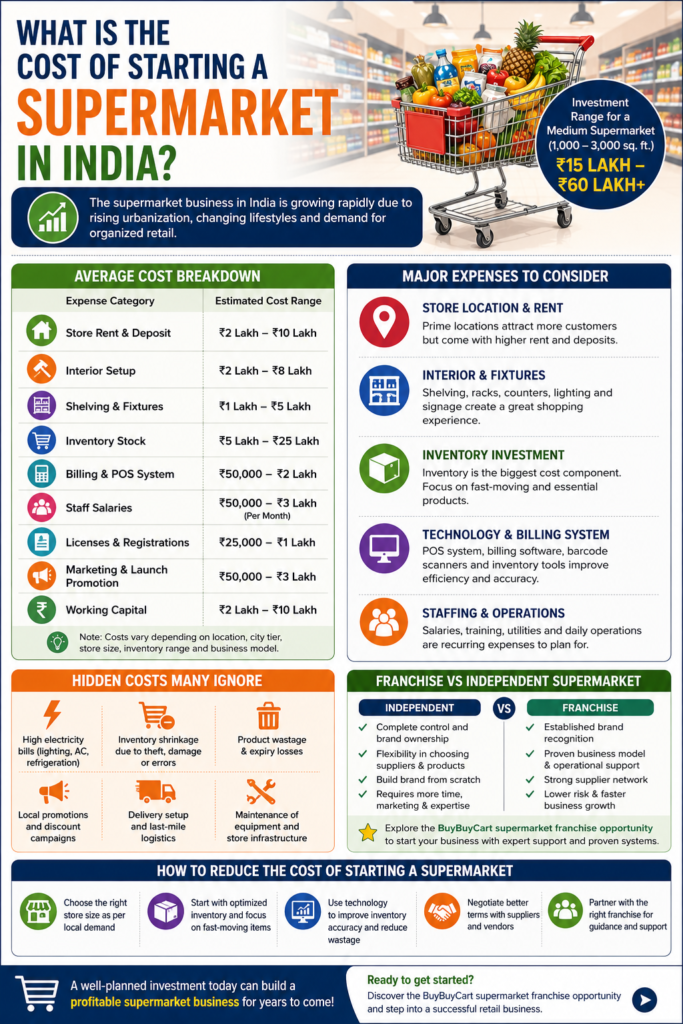
Major Expenses You Must Consider Before Opening a Supermarket
Store Location & Rent
The location of a store has a large impact on the overall success of a supermarket business. For example, if you have a store set in a highly populated area with lots of residences, there will be greater foot traffic and repeat customers compared to if you were to have a location somewhere farther away from any people. However, very good locations will cost significantly more to rent and will require you to come up with a much larger deposit.
Prior to making a final decision on a location, be sure to analyze potential customers, your competitors, the parking situation for your customers, and how accessible your supermarket will be.
Interior Design & Store Fixtures
If your supermarket’s interior is designed well, it will create a positive experience for your customers and help them spend more money in your store. Interior design/fixtures will consist of shelving, display racks, cash registers, storage systems, lighting design/installation, signage, and branding items.
An organized store layout will change how your customers make purchasing decisions while also helping to improve efficiency in your operations.
Also Read: Complete Supermarket Inventory Management Guide for Beginners
Investing In Inventory
Supermarket start-up costs will generally include a high percentage of investment to obtain the inventory needed to run your grocery store. These products may include food, beverages, dairy, packaged foods, cleaning supplies, personal care items, and other household goods that will need to be stocked in sufficient quantities for your grand opening.
Too many retailers stock too much of a slow-selling item. Starting off with a good inventory level will help keep cash flow healthy.
Technological & Software Programs
The supermarket industry has grown to depend on technology. Software, such as point-of-sale systems, inventory management, barcodes, and sales reports, will all help minimize errors and improve the overall quality of the decision-making process.
If you invest in solid technology from the beginning, you can expect to save money on your operations in the future.
Costs Associated With Employees and Operations
Even the smallest grocery store will have to hire employees to operate your grocery store in the areas of checkout, inventory control, customer service, store maintenance, and delivery.
Other recurring monthly financial obligations you should be prepared for, as well as include in your grocery store business plan, are salary and benefits for your employees and all utilities, including telephone, electricity, water, and transportation for employees and deliveries, internet, store security, and store maintenance, etc.
Infinity Costs Several New Grocery Store Owners Overlook
Many entrepreneurs consider their setup costs only, but fail to take into account all of their ongoing expenses that will affect their profits.
Your electricity bill will increase significantly, and is usually one of the highest operating costs in a supermarket, due to the amount of lighting, refrigeration units, air conditioning, and equipment you will use.
Wastage and product loss due to expiration are prevalent, especially in high-perishable areas like dairy, bakery, and fresh food.
Employee theft and inventory shrinkage due to damage or administrative error can result in decreased margins. Other costs, such as local marketing, promotional offers, customer loyalty programs, and delivery infrastructure, will also need to be continually reinvested.
Maintenance costs incurred due to your shelving, refrigeration equipment, billing systems, and store fixtures must be included when estimating the cost of setting up your retail grocery store in total.
Is Starting an Independent Supermarket Better Than Taking a Franchise?
The advantages of being a Supermarket franchisee include the ability to start from the ground up in your own independent supermarket and having complete operational control over how you operate your business. You can define your own suppliers, customer product choices, pricing strategy, and store structure, all based on what works best in your local market.
However, developing a brand from scratch is an extremely large undertaking that requires a lot of investment in marketing, along with years of business experience operating a supermarket.
On the other hand, if you choose a franchise model, you will benefit from having access to an established business format, marketing resources, supplier relationships, inside knowledge of how to run a successful supermarket, and access to the latest technology available. Franchisees who choose to open a supermarket typically find that the ongoing support they receive from the franchisor has helped them minimize risk and expedite the process of building their successful supermarket business.
If you are looking at retail opportunities based on franchising, then the BuyBuyCart Franchise offers an opportunity to take the guesswork out of launching and operating a profitable supermarket and do so with professional support and the benefit of established systems.
How to Reduce the Cost of Starting a Supermarket
Make sure your size fits your local market, to avoid wasting money on rent and setup. When stocking your supermarket, only include those fast-selling items you can afford.
Improving your inventory accuracy and reducing costs by streamlining operations with retail technology can help reduce the costs of starting a supermarket.
Be sure to negotiate favourable terms from suppliers and payment schedules to improve your working capital management.
Many new supermarket entrepreneurs are reducing their risk by working with experienced franchises that will assist them in the areas of store development, purchasing, technology, and running their new businesses appropriately. Finding a good franchisee can greatly improve your return on investment in the supermarket industry in India.
Conclusion
Supermarkets’ established startup costs are dependent upon varying factors such as their geographical location, inventory strategy, staffing needs, etc. Initial investments can vary greatly (₹15 lac – ₹60 lac and above). With proper planning, costs can be managed effectively and ultimately can increase long-term profit.
If you are interested in opening a supermarket in India, develop a clear business model, outline all startup/ongoing operating costs, and develop a plan for continued growth.
For individuals seeking support from experts, proven systems or operational support, consider the BuyBuyCart supermarket franchise and take action to become a successful supermarket owner today.