
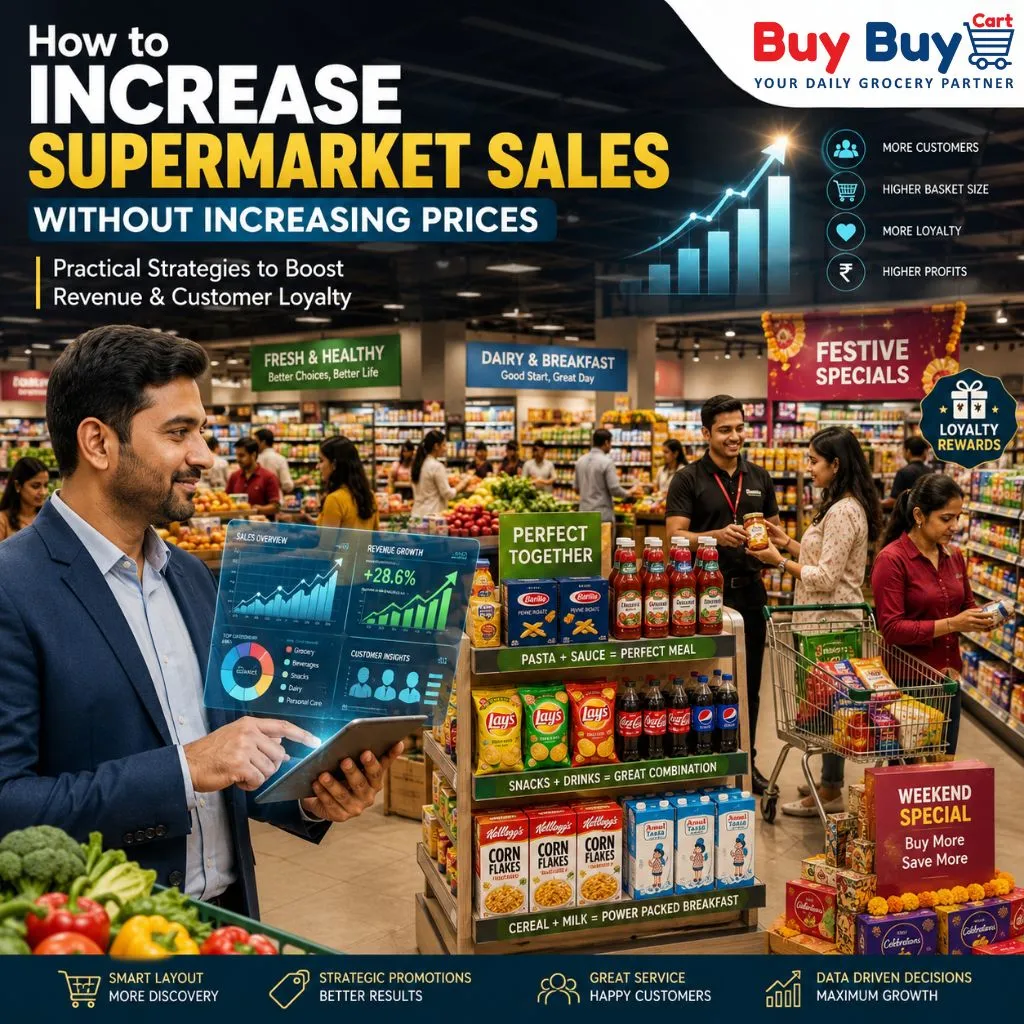
To run a successful supermarket, the only thing you need is a lot of customers and low prices. Today’s shoppers are much more informed than ever before. They want quick, easy shopping and a fun experience when they are in your store; they want great customer service and to feel like they have received the best value for every penny they spend on their purchases, even if that means paying a little more.
Many grocery retailers feel that lowering their prices will help them be more profitable and make more sales; however, very often, by cutting prices to the bone, your margins will also go down, and eventually your store will be in a price war with every other grocery store in town.
Fortunately, there are better strategies that grocery retailers can implement to grow their businesses without hurting their bottom lines. All of the many small changes found in this guide, such as changes in how stores are run; how customers are interacted with; how products are displayed; and how employees work together, have a very large effect on how customers buy from the grocery store, which thereby increases average purchase size.
Whether you operate a single store or a multi-store grocery chain, or you are just interested in growing your grocery store, you can build a profitable, long-term grocery business by following simple strategies to continue to grow your grocery store.
In this guide, we will examine how some of the most successful grocery stores operate and use proven methods to grow grocery store sales and maintain a consistent selling price.
Why Lowering Prices Is Not the Only Way to Increase Supermarket Sales
Increasing supermarket sales is not just about lowering prices. Most retailers assume that customers think only of price when making purchase decisions, but that is seldom the case. Many other factors influence where customers choose to shop.
When you think about your own shopping behaviours, you probably visited one store and stayed longer because it was a friend’s staff were friendly, clean or provided a better shopping experience for your needs. The majority of shoppers enjoy returning to places where they can find everything they need, and shopping is enjoyable.
By depending solely on discounting as the primary way to improve supermarket sales, many retailers create a reduced return on investment. But by making improvements in customer experience and operational efficiencies, you will retain and build long-term customer loyalty and create a better margin for yourself.
Five primary strategies will allow a supermarket to increase volume sales without increasing prices:
- Encouraging customers to purchase additional items during each visit
- Improving the shopping experience for convenience
- Building a stronger relationship with customers
- Improving your store’s product presentation
- Training your employees to provide a better level of customer service
These methods tend to contribute to a higher profitability level for a supermarket than reducing merchandise to customers through regular markdowns.
Understanding Customer Buying Behaviour in a Supermarket
First learning about the factors that lead to a customer’s purchase gives you the impression of how you can help your customers develop an ethical shopping habit.
Most shoppers can be grouped into two categories.
Planned Buyers
People who buy things create a shopping list to buy certain items based on need, habitual behaviour or convenience.
Unplanned Buyers
Customers who love to shop make impulse buys based on what they see, big sales, attractive packaging and/or who are moved to purchase based on their thoughts at that moment.
The most successful grocery stores appeal to both buyer types
As an example, a parent going into a grocery store to purchase milk would also find themselves buying snacks that may be displayed around the milk case, as well as someone going in to buy vegetables could see ready-made meal kits next to the vegetables.
The Reason Why It’s Successful
By understanding how a customer thinks, you will get an idea of how to create an experience that ultimately encourages a customer to make another unplanned purchase.
Practical Examples of This Happening
At a grocery store in a neighbourhood, the owner put healthy snack bars next to the checkout counters instead of placing items that are traditionally found there, which gave the health-conscious customer another alternative.
Suggestions for Implementation
For small grocery stores
- Manually watch how customers are shopping
- Find out from your front-line staff what common customer requests are
- Watch what items are sold and how they are sold
For large grocery stores
- Evaluate your POS data
- Identify customer groups from segmentation of customers
- Use the loyalty program characteristics to identify common shopping behaviours
Making Your Store Better to Help Drive Impulse Purchases
The way you design your store will have a direct impact on how your customers will navigate through your store.
A lot of customers go into the supermarket with a list and only want to get a few items but based on how they walk through the store will determine what they spend.
Build Your Supermarket Around Discovery
When you create a strategic layout, it allows for each customer to see more products without the feeling of being overwhelmed.
Some common design practices are:
- Place necessary items like milk or bread towards the back of the store
- Keep the pathways clear
- Create eye-catching displays located on the end of an aisle
- Maintain open and easy-to-navigate aisles
How This Helps
The longer customers are involved in the store environment, increases the chances of them discovering additional products, leading to impulse purchases.
Business Move Bakery Department to Entryway
When this supermarket moved its bakery department to the front of the store, the scent of delicious baked goods created a warm, inviting atmosphere, enticing customers to shop in more departments.
How to Make This Work in Your Business
For small supermarkets:
Rearrange products that are highly demanded regularly
Improve your aisle signage
Remove unnecessary visual clutter
For Big supermarkets, you can:
- Conduct heat map analysis
- Test multiple store layouts
- Analyse traffic flow regularly
Effective Strategies for cross-selling and upselling in Retail
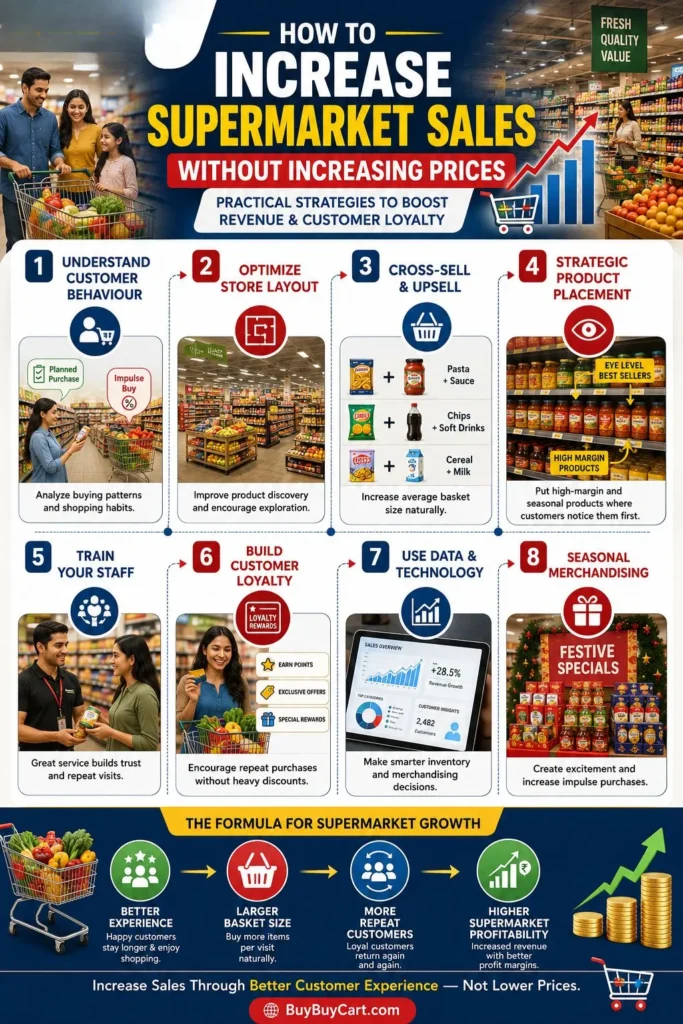
Cross-selling and upselling are two of the best retail marketing techniques available to retailers today, and they greatly increase basket size. Cross-selling involves suggesting complementary products to consumers.
Upselling encourages shoppers to purchase premium-level products that add value to their order.
Why does this work?
Convenience is important to consumers, and suggesting complementary items makes shopping easier and a better experience.
Real-world examples
When a customer buys pasta, they are much more likely to purchase complementary items such as pasta sauce, cheese, and seasonings when they are grouped visually.
When a consumer chooses standard-size bottles of cooking oil, they may be influenced to upgrade to the larger family-sized bottle if the value to the consumer is clearly articulated.
Tips to implement:
For small grocery stores:
- Bundle complementary products together
- Train cashiers to make quick recommendations
- Use shelf-talkers to suggest complementary products
For large grocery stores:
- Use Point of Sale prompts
- Utilise customer loyalty program data
- Create merchandising strategies by department
Importance of Staff Training and Customer Service
The manner in which someone treats others will remain in their memory forever. Outstanding customer service can turn the occasional shopper into an advocate for your supermarket.
Your employees are frequently the face of your supermarket. More than most supermarket owners believe, their customer service influences customer satisfaction.
Why does this work?
Staff who provide customers with assistance will create fewer barriers for them, build rapport with them, and enhance their overall grocery experience.
A good example of this would be when an employee assisted a customer in locating a certain speciality item, after which they also recommended items that augmented the customer’s original purchase—a positive interaction that increased the customer’s purchase value and solidified their loyalty.
Product Placement Techniques That Increase Basket Size
The art and science of product placement. The position of an item on a shelf can greatly impact how well it sells.
Eye Level = Buy Level
For products at eye level, the likelihood that they will be purchased is often far greater. Products that are placed at a level where shoppers are naturally looking tend to be higher-margin products.
How It Works
Products that are clearly visible and easily accessible will allow customers to make a quicker decision to purchase.
Case in Point
When a supermarket moved high-priced breakfast cereals to eye level from a lower shelf, it had an increase in revenue for that product category month after month.
Building Customer Loyalty Without Heavy Discounting
Customer loyalty is one of the largest misperceived concepts in retail today; many believe that customer loyalty is built primarily on the basis of discounts. Although discounts may draw customers into your store, they do not foster a long-term connection with you. In fact, customers who buy from your store only because of a discount often switch to a competitor because they can find a slightly lower price.
In supermarkets, the key to loyal customers is a combination of three items – consistent experience, establishment of trust, and repeat experiences – which leads to loyal customers.
Loyal customers tend to come back more often, spend more across the total time they are an active customer and are more inclined to recommend your supermarket to other people. It costs significantly less to continue to keep your existing customers than to continuously add new customers.
Example from the real world:
A local supermarket introduced a loyalty card that rewarded customers for every dollar spent with a point. These points were then used to reward customers with different rewards (e.g., delivery services, birthday vouchers, etc.). The loyalty program did not have a significant impact on the supermarket’s profit margin even though customers continued to return to purchase items from the store.
Also Read: Why Customers Prefer Modern Supermarkets Over Traditional Stores
Actionable Strategies Supermarket Owners Can Implement Immediately
Supermarket owners can begin utilising the following strategies to enhance the profitability of their business without having to make substantial expenditures.
Here are eight simple, practical things you can do today:
- Review Your Store’s Floor Plan To Identify Areas Of Your Store That Can Be Improved.
- Rotate Cross-Merchandising Displays Every Week By Setting Up At Least One New Cross-Merchandising Display Per Week.
- Encourage Employees To Help Customers Before They Ask For Help.
- Implement A Simple Loyalty Program For Your Customers.
- Keep Track Of Your Sales By Tracking Your Top Selling Items Every Month.
- Use Advance Planning To Create A Seasonal Display At Your Supermarket.
- Gather Customer Feedback And Utilize It As A Source Of Information For Your Business.
- Initiate A Strategic Promotion And Measure The Results.
Retailers are frequently able to achieve great success as a consequence of their use of a continual process of incremental improvement.
Scaling Your Supermarket Business for Long-Term Growth
After establishing operational efficiencies, many entrepreneurs will begin thinking about possible ways to expand their businesses. When considering expansion in the supermarket industry, however, it is essential that you concentrate on systems and processes, as well as customer experience, prior to opening new locations.
Most would-be entrepreneurs who are investigating franchising opportunities in the supermarket business want proven operational systems that will help them mitigate risks while also providing continuing support from the franchisor. Having an understanding of how a supermarket franchise model works can provide valuable insight into inventory controls, merchandising standards and customer experience elements.
Individuals interested in a retail franchise opportunity can use research on successful retail models to learn fast and execute better. Similarly, people wishing to build a supermarket business can benefit from studying successful methods of running supermarkets or growing supermarket businesses.
Individuals wishing to buy a BuyBuyCart franchise should understand that franchising is more than just an opportunity to expand their stores; they must be committed to providing customers with consistent value at all customer touch points.
Final Thoughts
You don’t have to raise prices or offer lots of discounts in order to grow supermarket sales. Sustainable growth typically comes from knowing your customers; providing a better shopping experience; ensuring that products are in the right place in the store; training employees; using technology; and creating long-term community relationships.
Your most successful retailers know that their profits come from both operational excellence and the trust they build with customers. Many small changes in store, such as changing display layouts, improving loyalty programs, and letting employees take care of customers, can produce substantial increases in supermarket sales over a period of time.
Focusing on creating customer value is always a sound approach, whether you are currently operating a small grocery operation; looking at expanding your supermarket operation; or searching for a new entrepreneurial opportunity.
If you are considering your next step in retail, please take a moment to investigate available options through BuyBuyCart and how we may help you achieve your supermarket goals with proper coaching and systems.
Frequently Asked Questions (FAQs)
Q1: How do supermarkets increase sales without lowering prices?
A: Supermarkets can increase sales through better placement of products, adding cross-sells, increasing loyalty to customers, improving customer service, and using strategic promotions to encourage customer purchases while maintaining healthy profit margins.
Q2: What are the best growth strategies for small retailers?
A: Small retailers should work on creating good customer relationships, having efficient layouts in their stores, using seasonal merchandising properly, utilising basic loyalty programs, and looking at sales trends. Incremental improvements can often yield strong results with little effort or cost.
Q3: Why is it important to have a positive customer experience in a supermarket?
A: A positive customer experience in a supermarket can lead to repeat visits and build trust, which will promote positive word-of-mouth about that store. Customers are much more likely to return to stores where shopping is convenient, enjoyable, and personalised.
Q4: How does product placement impact supermarket sales?
A: Strategic placement of products increases visibility and can influence the customer’s buying decision. For example, items that are put at eye level will be more likely purchased than those not. Items that share space on end caps or that are positioned as other complementary products will affect the amount someone impulse buys and increase the average amount in the basket.
Q5: Can technology assist in increasing supermarket revenue?
A: Yes! Point of Sale (POS) systems, loyalty tools, inventory tools, and customer analytics can provide Supermarket businesses with information that can improve operations and stock management while also identifying ways to increase supermarket revenue.